The Lady from Shanghai / Touch of Evil – December 5th, 2015

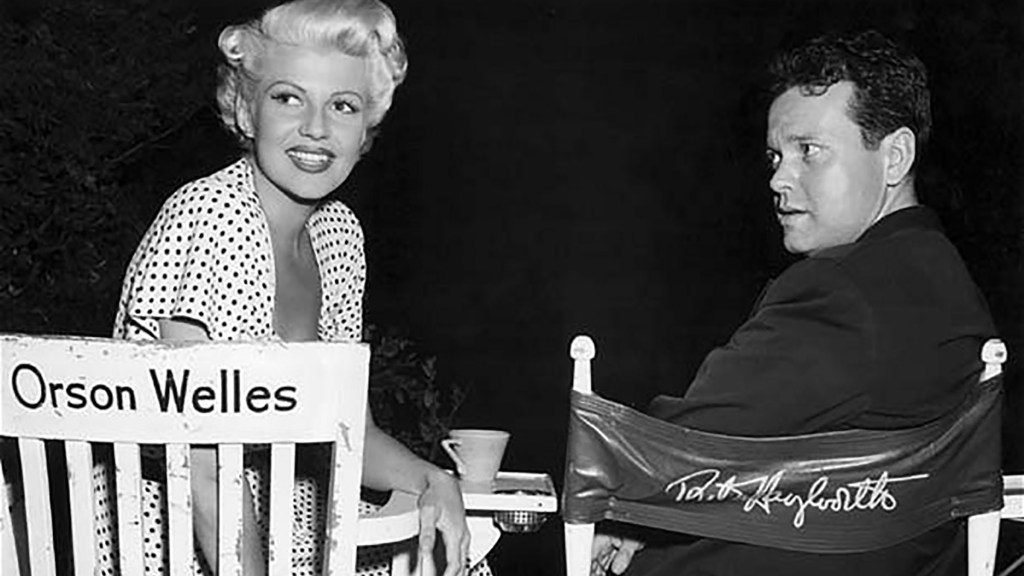
Orson Welles Double Feature


Please join us for a FREE double feature screening event of Orson Welles’ The Lady from Shanghai [1948] and Touch of Evil [1958]. Stop by for one or both!

The Lady from Shanghai

  • Screening Date: Saturday, December 5th, 2015 | 1:00pm
  • Venue: The Mason O. Damon Auditorium at Buffalo Central Library
  • Specifications: 1948 / 87 minutes / English / Black & White
  • Director(s): Orson Welles
  • Print: Supplied by Columbia Pictures c/o Movie Licensing USA
  • Tickets: Free and Open to the Public
  • Deal: Stop in early for a FREE Breadhive soft pretzel while supplies last!

Touch of Evil

  • Screening Date: Saturday, December 5th, 2015 | 3:00pm
  • Venue: The Mason O. Damon Auditorium at Buffalo Central Library
  • Specifications: 1958 / 111 minutes (restored to Welles’ vision) / English / Black & White
  • Director(s): Orson Welles
  • Print: Supplied by Universal Pictures c/o Movie Licensing USA
  • Tickets: Free and Open to the Public
  • Deal: Stop in early for a FREE Breadhive soft pretzel while supplies last!

Event Sponsors:

Venue Information:

1 Lafayette Square, Buffalo, NY 14203
(please use Clinton St entrance for Mason O. Damon Auditorium)


The Lady From Shanghai


Courtesy of Sony Pictures Museum:

After being fired from RKO with his reputation tarnished by Hearst’s destructive campaign to bury Citizen Kane, Orson Welles was down for the count when Columbia Pictures studio chief Harry Cohn decided to take a chance on him by green-lighting what would become a film noir classic. Lady from Shanghai stars one of the biggest movie stars and a Columbia favorite, Rita Hayworth, who was easily sold on the project since Welles was her real life husband at the time. The film follows Hayworth as the femme fatale who baits an Irish seaman (Welles) into a dangerous, tangled web of lies, deceit and murder. The climactic “hall of mirrors” sequence is among the most spellbinding scenes in cinematic history. Although the film was subsequently misunderstood by audiences and critics of the time (Hayworth’s radically altered look – short platinum blonde hair – shocked movie-goers), it is now considered a masterpiece of the film noir genre.

Tidbits:

  • National Film Preservation Board – 2018 – National Film Registry

Touch of Evil


Courtesy of Barnes & Noble:

This baroque nightmare of a south-of-the-border mystery is considered to be one of the great movies of Orson Welles, who both directed and starred in it. On honeymoon with his new bride, Susan (Janet Leigh), Mexican-born policeman Mike Vargas (Charlton Heston) agrees to investigate a bomb explosion. In so doing, he incurs the wrath of local police chief Hank Quinlan (Welles), a corrupt, bullying behemoth with a perfect arrest record. Vargas suspects that Quinlan has planted evidence to win his past convictions, and he isn’t about to let the suspect in the current case be railroaded. Quinlan, whose obsession with his own brand of justice is motivated by the long-ago murder of his wife, is equally determined to get Vargas out of his hair, and he makes a deal with local crime boss Uncle Joe Grandi (Akim Tamiroff) to frame Susan on a drug rap, leading to one of the movie’s many truly harrowing sequences.

Touch of Evil dissects the nature of good and evil in a hallucinatory, nightmarish ambience, helped by the shadow-laden cinematography of Russell Metty and by the cast, which, along with Tamiroff and Welles includes Charlton Heston as a Mexican; Marlene Dietrich, in a brunette wig, as a brittle madam who delivers the movie’s unforgettable closing words; Mercedes McCambridge as a junkie; and Dennis Weaver as a tremulous motel clerk. Touch of Evil has been released with four different running times — 95 minutes for the 1958 original, which was taken away from Welles and brutally cut by the studio; 108 minutes and 114 minutes in later versions; and 111 minutes in the 1998 restoration. Based on a 58-page memo written by Welles after he was barred from the editing room during the film’s original post-production, this restoration, among numerous other changes, removed the opening titles and Henry Mancini’s music from the opening crane shot, which in either version ranks as one of the most remarkably extended long takes in movie history.

Tidbits:

  • National Film Preservation Board – 1993 – National Film Registry

Director Bio

“A film is never really good unless the camera is an eye in the head of a poet.”

Courtesy of Turner Classic Movies:

An undeniable pioneer in both radio and film, actor-director Orson Welles used his bona fide genius to change the face of both mediums with imagination, ambition and technically daring.

Having started off as a performer on stage, most notably with John Houseman, with whom he formed the famed Mercury Theatre, Welles used his distinctive baritone voice to create innovative radio dramas. He became famous – notorious, even – following his 1938 broadcast of H.G. Wells’ War of the Worlds, which he presented as a real time news event, sparking panic among listeners who thought Martians really were invading New Jersey.

The fame he achieved in the wake of the broadcast attracted RKO Pictures, where he made the most stunning directorial debut in the history of cinema with Citizen Kane (1941), long considered to be the greatest film ever made. Using innovative narrative and technological techniques, Welles singlehandedly changed the face of cinema, earning the nickname the Boy Wonder. He went on to direct The Magnificent Ambersons (1942), though both films were financial failures that prompted his exit from RKO.

After marrying Love Goddess Rita Hayworth and directing The Stranger (1946) and Macbeth (1948), Welles began a 10-year self-imposed Hollywood exile that saw him appear onscreen in movies like The Third Man (1949) while directing well-received films overseas like Othello (1952) and Mr. Arkadin (1955). He returned to Hollywood to helm Touch of Evil (1958), a classic film noir, while suffering a commercial drubbing with his adaptation of Franz Kafka’s The Trial (1962).

His take on Shakespeare’s famed character, Falstaff, in Chimes at Midnight (1966) again earned international acclaim despite being largely ignored in the United States. Though he fell on hard times in the 1970s, Welles nonetheless remained busy with numerous projects in various stages of completion while appearing onscreen in a number of performances and using his distinctive voice in a variety of narrator roles. When he died in 1985, Welles left behind a legacy as a consummate artist and true auteur whose influence was profoundly felt by several generations of filmmakers.

Filmography:

  • Hopper/Welles (2020)
  • The Other Side of the Wind (2018)
  • It’s All True (1993)
  • F for Fake (1973)
  • Don Quixote (1972)
  • The Deep (1970)
  • The Merchant of Venice (1969)
  • The Immortal Story (1968)
  • The Heroine (1967)
  • Chimes at Midnight (1965)
  • The Trial (1962)
  • No Exit (1962)
  • Orson Welles at Large: Portrait of Gina (1958)
  • The Fountain of Youth (1958)
  • Touch of Evil (1958)
  • Moby Dick Rehearsed (1955)
  • Confidential Report (1955)
  • Othello (1951)
  • Black Magic (1949)
  • Macbeth (1948)
  • The Lady from Shanghai (1947)
  • The Stranger (1946)
  • It’s All True (1943)
  • Journey Into Fear (1943)
  • The Magnificent Ambersons (1942)
  • Citizen Kane (1941)
  • Too Much Johnson (1938)

Links

Here is a curated selection of links shared on our Facebook page for additional insight/information:

  • 11/25/15 – “What exactly is Film noir? Is it a movement, a mode, a style, or a genre? These questions have preoccupied film scholars for decades. According to filmmaker Paul Schrader, noir began with The Maltese Falcon and ended with Orson Welles’ Touch of Evil.” Drew Morton, indieWIRElink
  • 12/02/15 – Orson Welles was notorious for being out of sync with the studios he worked with and went so far as to write a 58 page memo to the Vice President of Universal Studios at the time, Edward I. Muhl, on how Touch of Evil was being tampered with and the corrections that should be made to fix the film. You can read the full memo here.
  • 12/02/15 – “Restoring the Touch Of Genius to a Classic” by Walter Murch – link
  • 12/04/15 – “…It’s greater and stranger than most conventionally good movies because of this bizarre thematic Möbius strip: Welles tried to make a personal artistic statement out of a B-movie thriller, and the thriller became the exact nightmare he was trying to make a statement about. In a way, the art was more self-aware than he was; it refused to stop being life. He had built the hall of mirrors, then found that he’d wandered into it.” Brian Phillips on The Lady from Shanghai, Grantlandlink

The Look of Silence – November 24th, 2015

The Look of Silence [2015]


Please join us for a one-night screening event of Joshua Oppenheimer’s The Look of Silence [2015], the Buffalo debut of the lauded companion to his documentary The Act of Killing.

  • Screening Date: Tuesday, November 24th, 2015 | 9:30pm
  • Venue: North Park Theatre
  • Specifications: 2015 / 103 minutes / Indonesian with English subtitles / Color
  • Director(s): Joshua Oppenheimer
  • Print: Supplied by Drafthouse Films
  • Tickets: $8.00 online; $7.00 at the door
  • Deal: Discounted drinks available after the screening at Més Que with your ticket

Event Sponsors:

Venue Information:

1428 Hertel Ave, Buffalo, NY 14216


Synopsis

Courtesy of Drafthouse Films:

Through Joshua Oppenheimer’s work filming perpetrators of the Indonesian genocide, a family of survivors discovers how their son was murdered – and the identity of the men who murdered him.
The Look of Silence is Joshua Oppenheimer’s powerful companion piece to the Oscar®-nominated The Act Of Killing. Through Oppenheimer’s footage of perpetrators of the 1965 Indonesian genocide, a family of survivors discovers how their son was murdered, as well as the identities of the killers. The documentary focuses on the youngest son, an optometrist named Adi, who decides to break the suffocating spell of submission and terror by doing something unimaginable in a society where the murderers remain in power: he confronts the men who killed his brother and, while testing their eyesight, asks them to accept responsibility for their actions. This unprecedented film initiates and bears witness to the collapse of fifty years of silence.

Tidbits:

  • Venice Film Festival – 2014 – Winner: Best Euro-Mediterranean Film, Winner: FIPRESCI Prize, Winner: Golden Mouse, Winner: Grand Special Jury Prize & Winner: Human Rights Film Network Award
  • Berlin International Film Festival – 2015 – Winner: Peace Film Award
  • SXSW Film Festival – 2015 – Winner: Festival Favorites (Audience Award)
  • Academy Awards – 2016 – Nominee: Best Documentary, Feature
  • Independent Spirit Awards – 2016 – Winner: Best Documentary
  • Village Voice Film Poll – 2015 – Winner: Best Documentary

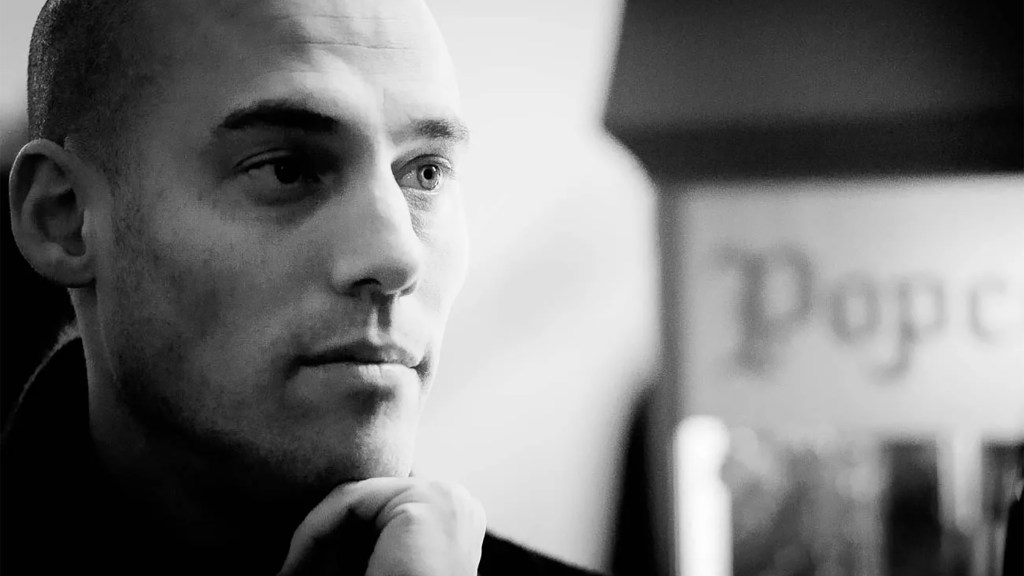
Director Notes

“The fundamental difference that people fail to take into account is that non-fiction filmmakers ultimately have undeserved inferiority complexes when only fiction filmmakers are described as “storytellers”, even though we are telling stories from real life. To say that is to somehow overlook what is really special about non-fiction, as we are watching real people and going through things that are changing their lives and I think there is something sacred about that material that is created.”

Courtesy of the film’s website:

The Act of Killing exposed the consequences for all of us when we build our everyday reality on terror and lies. The Look of Silence explores what it is like to be a survivor in such a reality. Making any film about survivors of genocide is to walk into a minefield of clichés, most of which serve to create a heroic (if not saintly) protagonist with whom we can identify, thereby offering the false reassurance that, in the moral catastrophe of atrocity, we are nothing like perpetrators. But presenting survivors as saintly in order to reassure ourselves that we are good is to use survivors to deceive ourselves. It is an insult to survivors’ experience, and does nothing to help us understand what it means to survive atrocity, what it means to live a life shattered by mass violence, and to be silenced by terror. To navigate this minefield of clichés, we have had to explore silence itself.

The result, The Look of Silence, is, I hope, a poem about a silence borne of terror – a poem about the necessity of breaking that silence, but also about the trauma that comes when silence is broken. Maybe the film is a monument to silence – a reminder that although we want to move on, look away and think of other things, nothing will make whole what has been broken. Nothing will wake the dead. We must stop, acknowledge the lives destroyed, strain to listen to the silence that follows.

– JOSHUA OPPENHEIMER

Photo by Heinrich-Böll-Stiftung

Filmography:

  • The Look of Silence (2014)
  • The Act of Killing (2012)
  • The Globalisation Tapes (2003)
  • The Entire History of the Louisiana Purchase (1998)

Links

Here is a curated selection of links shared on our Facebook page for additional insight/information:

  • 11/3/15 – “One recalls Claude Lanzmann’s approach in Shoah (1985), which eschewed archival footage of concentration camp horrors, allowing long shots of the grounds bearing little trace of their existence to resonate within both participants and viewers. Just as Lanzmann used that erasure to imply the unrepresentability of the crimes of the Holocaust, the silent looks and absences of Oppenheimer’s movie conjure disturbing images of what we don’t see and invite anxious meditations on the ugliest aspects of human nature.” Tony Pipolo, Artforumlink
  • 11/6/15 – “Like its predecessor, it’s a devastatingly beautiful film about the power of cinema, and its ability to testify to some aspect of human nature with a veracity and elegance that escapes other mediums. Every scene weighs on the audience. But Oppenheimer and Adi manage to locate a lightness as well that lessens the burden.” Lenika Cruz, The Atlanticlink
  • 11/6/15 – After having been selected for DOC NYC’s Oscar predicting short list a few weeks back, Joshua Oppenheimer’s The Look of Silence was nominated this week for Best Feature in the 31st annual International Documentary Association Awards! – link
  • 11/7/15 – “The film’s seeming gentleness is offered as a striking counterpoint to the urgency of its content and its very concrete import for Adi, whose manifest bravery is quite awe-inspiring.” Jonathan Romney, Film Commentlink
  • 11/8/15 – At Sight & Sound, filmmaker and film critic Robert Greene discusses two of the greatest doc filmmakers currently working: Joshua Oppenheimer & Adam Curtis – link
  • 11/10/15 – “Listening to Oppenheimer speak was, in its own way, nearly as overwhelming an experience as watching his films. He’s light-years ahead ahead of most of his fellow filmmakers, to say nothing of most people writing on the subject, in his understanding of the nature and purpose of nonfiction film, the inaccessibility of the historical past, and the effectiveness, or lack thereof, of conventional human-rights documentaries.” Sam Adams, indieWIRElink
  • 11/15/15 – Yesterday, Joshua Oppenheimer’s The Look of Silence screened as part of DOC NYC’s Oscar predicting Short List. Here’s the immensely insightful post-screening Q&A with the filmmaker – link
  • 11/19/15 – “Director Joshua Oppenheimer describes how his Oscar-nominated The Act of Killing led to a follow-up, and a sea change in Indonesian history.” David Ehrlich, Vanity Fairlink
  • 11/22/15 – “This is a portrait of the human body at degree zero, human politics at degree zero, human guilt at degree zero.” Joshua Oppenheimer on The Look of Silence, The Vergelink
  • 11/25/15 – Human Rights Watch is sponsoring a petition that would pressure the U.S. Senate to acknowledge the 1965-66 mass killings and support peace in Indonesia. Sign up at the link if you feel inclined. – link
  • 11/26/15 – “Among the docs, Joshua Oppenheimer’s sequel to The Act of Killing, The Look of Silence continues to be the one film that ALWAYS gets mentioned” Anne Thompson, indieWIRElink
  • 11/29/15 – “An incredible, jaw-dropping 2015 moment: The Look of Silence. What I appreciate more than anything in a given year are these moments when a filmmaker and reality seem to conspire to blow me away. Joshua Oppenheimer did plenty to knock our socks off with The Act of Killing, but in this follow-up film, he is able to transcend the medium in a more subtle way. In this story of the Indonesian genocide, when a perpetrator’s daughter turns to one of the victims and says that she recognizes him, it struck me to the core, recalling a moment in Flannery O’Connor’s A Good Man Is Hard to Find. It was, for me, a moment of ecstatic truth.” Tom Roston, POV Blog – link
  • 12/06/15 – Congrats to Cultivate Cinema Circle alum The Look of Silence on winning Best Documentary Feature of 2015 at the 31st Annual International Documentary Association Awards! – link
  • 12/06/15 – “A Plea to Moviegoers: See The Look of Silence for Documentary Filmmaking at Its Most Harrowing and Heroic” by Matthew Eng – link
  • 12/14/15 – The Online Film Critics Society, which Cultivate Cinema Circle programmers Jordan M. Smith and Jared Mobarak are both members of, have named Joshua Oppenheimer’s The Look of Silence the Best Documentary of 2015! – link
  • 12/26/15 – Nonfics lists Cultivate Cinema Circle alums The Look of Silence and Kurt Cobain: Montage of Heck among the year’s best documentaries! – link
  • 1/8/16 – Artvoice‘s Jordan Canahai has named his Top 10 films of 2015, including two Cultivate Cinema Circle alums among the ranks: HARD TO BE A GOD & THE LOOK OF SILENCE! – link
  • Local Media Coverage:
    11/18/15 – M. Faust review printed in The Publiclink
    11/19/15 – Jordan Canahai review printed in Artvoicelink
    11/20/15 – Christopher Schobert offers his thoughts on Buffalo.com – link
    11/24/15 – Jordan Canahai interviews Joshua Oppenheimer online at Artvoice‘s website – link

The Gleaners and I – November 18th, 2015

The Gleaners and I [2000]


Please join us for the fifth and final screening of our Agnès Varda series with a one-night event showing of The Gleaners and I [Les glaneurs et la glaneuse] [2000].

  • Screening Date: Wednesday, November 18th, 2015 | 7:00pm
  • Venue: Canisius College Science Hall
  • Specifications: 2000 / 82 minutes / French with English subtitles / Color
  • Director(s): Agnès Varda
  • Print: Supplied by Zeitgeist Films
  • Tickets: Free and Open to the Public
  • Deals: Stop in early for FREE Breadhive granola while supplies last!
  • Giveaway: Thanks to the University of Illinois Press, we’ll be giving away a copy of Kelley Conway’s new entry in the Contemporary Film Directors series, Agnès Varda, at this screening!


Event Sponsors:

Venue Information:

2001 Main Street (Between Delavan & Jefferson), Buffalo NY 14208


Synopsis

Courtesy of Zeitgeist Films:

Agnès Varda, Grande Dame of the French New Wave, made 2000’s most acclaimed non-fiction film-a self-described “wandering-road documentary.” Beginning with the famous Jean-François Millet painting of women gathering wheat left over from a harvest, she focuses her ever-seeking eye on gleaners: those who scour already-reaped fields for the odd potato or turnip. Her investigation leads us from forgotten corners of the French countryside to off-hours at the green markets of Paris, following those who insist on finding a use for that which society has cast off, whether out of necessity or activism. Varda’s own ruminations on her life as a filmmaker (a gleaner of sorts) give her a connection to her subjects that creates a touching human portrait that the L.A. Weekly deemed “a protest film that’s part social critique, part travelogue, but always an unsentimental celebration of human resilience.”

Tidbits:

  • Cannes Film Festival – 2000
  • Toronto International Film Festival – 2000
  • New York Film Festival – 2000
  • Viennale – 2000 – Winner: Standard Readers’ Jury Prize
  • Village Voice Film Poll – 2001 – Winner: Best Documentary

Director Bio

“I’m not interested in seeing a film just made by a woman – not unless she is looking for new images.”

The only female director of the French New Wave, Agnès Varda has been called both the movement’s mother and its grandmother. The fact that some have felt the need to assign her a specifically feminine role, and the confusion over how to characterize that role, speak to just how unique her place in this hallowed cinematic movement—defined by such decidedly masculine artists as Jean-Luc Godard and François Truffaut—is. Varda not only made films during the nouvelle vague, she helped inspire it. Her self-funded debut, the fiction-documentary hybrid 1956’s La Pointe Courte is often considered the unofficial first New Wave film; when she made it, she had no professional cinema training (her early work included painting, sculpting, and photojournalism). Though not widely seen, the film got her commissions to make several documentaries in the late fifties. In 1962, she released the seminal nouvelle vague film Cléo from 5 to 7; a bold character study that avoids psychologizing, it announced her official arrival. Over the coming decades, Varda became a force in art cinema, conceiving many of her films as political and feminist statements, and using a radical objectivity to create her unforgettable characters. She describes her style as cinécriture (writing on film), and it can be seen in formally audacious fictions like Le bonheur and Vagabond as well as more ragged and revealing autobiographical documentaries like The Gleaners and I and The Beaches of Agnès.

Filmography:

  • Faces Places (2017)
  • The Beaches of Agnes (2008)
  • Cinevardaphoto (2005)
  • The Gleaners and I (2000)
  • The Universe of Jacques Demy (1995)
  • One Hundred and One Nights (1995)
  • The Young Girls Turn 25 (1993)
  • Jacquot (1991)
  • Le Petit Amour (1988)
  • Jane B. par Agnes V. (1988)
  • Vagabond (1985)
  • Mur Murs (1981)
  • Documenteur (1981)
  • One Sings, the Other Doesn’t (1977)
  • Les créatures (1969)
  • Lions Love (1969)
  • Far From Vietnam (1968)
  • Le Bonheur (1966)
  • Cleo From 5 to 7 (1962)
  • La Pointe Courte (1954)

Links

Here is a curated selection of links shared on our Facebook page for additional insight/information:

  • 8/31/15 – Today via The Criterion Collection: “Just a casual courtyard chat between Agnès Varda and Guillaume-en-Égypte” – link
  • 9/2/15 – Need an Agnès Varda primer prior to our upcoming series on the grandmother of the French New Wave at Canisius College this fall? Helen Carter’s summery overview in Senses of Cinema serves as a perfect introduction! – link
  • 9/3/15 – Wonderful interview w/ Agnès Varda on her home on the rue Daguerre, Paris via Sight & Soundlink
  • 9/24/15 – Great news! Two Agnès Varda rarities – Jane B. and Kung-Fu Master – are headed for a US re-release thanks to Cinelicious Pics! – link
  • 9/29/15 – Agnès Varda on Coming to California – link
  • 10/6/15 – Agnès Varda shares credit for making an impact on feminist cinema in Kelly Gallagher’s riot grrrl infused THE HERSTORY OF THE FEMALE FILMMAKER! – link
  • 10/9/15 – Via The Criterion Collection today: “Agnès Varda keeps popping up in the most unexpected places. The indefatigable eighty-seven-year-old filmmaker stopped by our offices this week, along with her daughter, Rosalie, to say hello and fill us in on what she’s been up to. We’re happy to report that this legend of the French New Wave—and beyond—shows no signs of slowing down.” – link
  • 10/12/15 – Violet Lucca speaks with Agnès Varda back in 2011 for Film Comment. – link
  • 10/18/15 – At 87, Agnès Varda continues to make the news with a new video essay by Kevin B. Lee on her work found over at Fandorlink
  • 10/29/15 – “Varda may be a critically neglected filmmaker, and her work may be economically marginal in relation to the global entertainment industry. But does that give her the right to compare herself to those who are literally starving and homeless? The answer, perhaps, is that we’ve missed the point if we consider creative achievement and practical survival to be entirely separate. Less fancifully than at first appears, Varda’s notion of herself as a “gleaner” suggests the real continuity between superficially different forms of human resourcefulness – both those hailed as art, and those rarely hailed at all.” Jake Wilson, Senses of Cinemalink
  • 11/6/15 – The Gleaners and I isn’t a scolding treatise about the shamefulness of waste, but a celebratory jig inspired by the pleasures of squeezing every last, sweet drop from a grape harvest, or giving a tossed-off bit of plastic tubing new life in a 3-D painting. At the same time, Agnès Varda tints every frame of The Gleaners and I with a kind of joyous mournfulness: When you realize life is slipping by you, you want to hold on to every scrap.” Stephanie Zacharek, Salonlink
  • 11/12/15 – “In many respects, The Gleaners and I is a fitting culmination of the projects, ideas and experiments Varda committed herself to over the course of her career. If, as Amy Taubin has astutely pointed out, Varda’s work can be viewed as “portraits of people and places,” then The Gleaners and I serves as a kind of a gallery exhibit of precisely observed miniatures and cameo portraits (which is unsurprising considering Varda’s more recent focus on installation work).” Jesse Ataide, Fandor’s Keyframe – link
  • 11/17/15 – In Sight & Sound‘s recent poll of the Greatest Documentaries of All Time, Agnès Varda’s The Gleaners and I was voted #8! – link
  • 11/27/15 – David Bordwell, one of the most impacting and prolific film theorists, has published some thoughts on Kelley Conway’s new book on Agnès Varda! – link

Alice in the Cities – November 5th, 2015

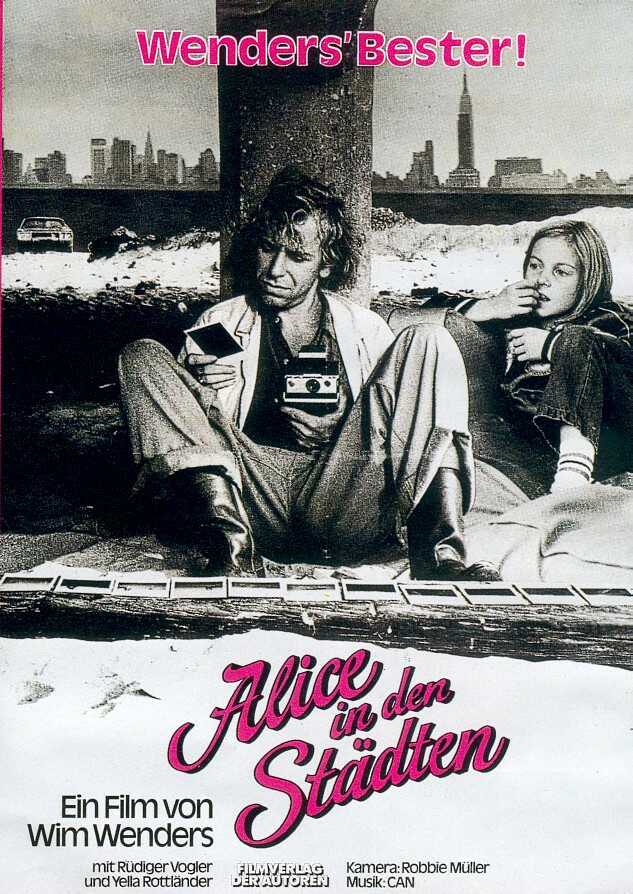
Alice in the Cities [1974]


Please join us for a one-night screening event of a restored and reframed print of Wim Wender’s Alice in den Städten (Alice in the Cities) [1974].

  • Screening Date: Thursday, November 5th, 2015 | 9:30pm
  • Venue: North Park Theatre
  • Specifications: 1974 / 112 minutes / German with English subtitles / Black & White
  • Director(s): Wim Wenders
  • Print: Supplied by Janus Films
  • Tickets: $9.50 at the door
  • Deal: Discounted drinks available after the screening at Més Que with your ticket

Event Sponsors:

Venue Information:

1428 Hertel Ave, Buffalo, NY 14216


Synopsis

Courtesy of Janus Films:

Technically, Alice in the Cities is Wenders’s fourth film, but he often refers to it as his first, because it was during this film that he discovered the genre of the road movie. (It would later become the first part of his road movie trilogy, along with Wrong Move and Kings of the Road.) It was also his first film to be shot partly in the U.S. and the first to feature his alter ego, Philip Winter (Rüdiger Vogler). Alice is often compared with Charlie Chaplin’s The Kid. In 1974, it won the German Critics Prize.

The German journalist Winter wants to write a story about America but is unable to accomplish anything but a series of Polaroids before disappointedly beginning his journey back home. At the same time, he reluctantly agrees to take little Alice (Yella Rottländer) with him, because her mother (Lisa Kreuzer)—whom he meets in New York on the day before his departure—has urgent business to take care of there. In Amsterdam, the mother then fails to appear as they agreed, so Winter and Alice set out to try to find Alice’s grandmother in the Ruhr region. During their search together, their initial mutual dislike gradually transforms into a heartfelt affection.

4K scan and 2K restoration, 2014 • 2K DCP

Tidbits:

  • Locarno International Film Festival – 1974
  • New York Film Festival – 1974

Restoration

For decades, some of Wenders’s films either remained unavailable because of unresolved rights clearances or could be seen only in poor quality due to damage to the materials. The foundation began to digitally restore them in 2014, and, as a result, the public is today once again able to experience these films in optimal quality. Restoring Wenders’s body of work represents one of the central missions and greatest challenges of the Wim Wenders Stiftung.

As a first step, the original film materials are brought together from various storage facilities and documented. The production documents are examined and analyzed with regard to the legal situation. In addition, an archiving concept with a classification scheme for the inventory and processing of both film and documentary materials is being developed. The restoration work itself consists of several stages: the evaluation of all source material, the scanning of the analog material, the retouching of individual frames from damaged film sequences by hand and the stabilization of individual frames, and the reframing and color correction of the image. The sound was already processed digitally back in 2002 by André Bendocchi-Alves. After completion of the restoration work, the source materials are then transferred to the German Federal Film Archive for proper long-term storage. It almost goes without saying that a change of medium from analog to digital will rarely pass unnoticed. For this reason, particular attention is paid to maintaining the visual “charm” of the originally analog film images with the idiosyncrasies of the film grain. Whereas the reprocessing of classic films is typically supervised and assessed by curators and archivists in order to make careful decisions for a restoration “in the sense of the director’s original vision,” the Wim Wenders Stiftung situation provides one special advantage: the director himself is involved in the restoration process, thus guaranteeing a processing of the films that is far from an outside interpretation.

The Wim Wenders Stiftung digitally restored eight films in the course of one year. Image processing was done by the company ARRI Film & TV under the supervision of Wim and Donata Wenders and was supported by grants from the German Federal Film Board (FFA) and the Centre national de la cinématographie (CNC). Further films were transferred to current state-of-the-art high-resolution digital formats in order to be able to show them in cinemas and on television. The foundation will continue to pursue the preservation of the cinematic work of Wenders and to thus make it accessible to the public on a permanent basis.

Alice in the Cities was shot on 16 mm black-and-white negative in the summer of 1973. For fifteen years, all copies in circulation worldwide were made from the original negative. By the time a 35 mm duplicate negative was finally made in 1988, the original material was damaged by countless scratches, vertical lines, and cracks.

The digital restoration of the film was done in 2014. For this purpose, the original negative was scanned in 4K resolution using the wet-gate method and retouched and color-corrected in 2K resolution. Individual sequences that were too heavily damaged on the original 16 mm negative were replaced with sections from the 35 mm duplicate negative. Although the film was shot in the 1:1.37 format commissioned by the German public broadcasting entity WDR, Wenders and his cameraman, Robby Müller, composed the shots for the widescreen 1:1.66 format. At the director’s request, Alice in the Cities was also screened in cinemas that way. With this digital restoration, the film is now finally framed in Wenders’s preferred format.


Director Bio

“Any movie that has that spirit and says things can be changed is worth making.”

Wim Wenders (born 1945) came to international prominence as one of the pioneers of the New German Cinema in the 1970s and is considered to be one of the most important figures in contemporary German film. In addition to his many prize-winning feature films, his work as a scriptwriter, director, producer, photographer, and author also encompasses an abundance of innovative documentary films, international photo exhibitions, and numerous monographs, film books, and prose collections. He lives and works in Berlin with his wife, Donata Wenders.

Wenders studied medicine and philosophy before moving to Paris in 1966 to study painting. Though ostensibly pursuing an apprenticeship in the studio of the graphic designer and engraver Johnny Friedlaender, he spent his afternoons and evenings in the Cinémathèque française. This “crash course in the history of film” would become the most important stage in his education, as Wenders soon began to think of film as an “extension of painting by other means.”

His career as a filmmaker began in 1967, when Wenders enrolled at the newly founded University of Television and Film Munich (HFF Munich). Parallel to his studies at the HFF, he also worked as a film critic from 1967 to 1970. At this point, he had already directed various short films. Upon graduating from the university in 1971, he, together with fifteen other directors and authors, founded the Filmverlag der Autoren, a distribution company for films by German auteurs, which organized the production, rights administration, and distribution of their own independent films.

After completing his debut feature out of film school, The Goalie’s Anxiety at the Penalty Kick (1971), Wenders turned to shooting his road movie trilogy—Alice in the Cities (1974), Wrong Move (1975), and Kings of the Road (1976)—in which the protagonists try to come to terms with their rootlessness in postwar Germany, among other things. His international breakthrough came with The American Friend (1977). Since then, Wenders has continued to work both in Europe and the United States, as well as in Latin America and Asia, and has been honored with numerous awards at festivals around the world, including the Golden Lion in Venice for The State of Things (1982); the Palme d’Or and the British Film Academy Award for Paris, Texas (1984); the Director’s Prize in Cannes for Wings of Desire (1987); and the Silver Bear for The Million Dollar Hotel (2000) at the Berlin International Film Festival. His documentary films Buena Vista Social Club (1999), Pina (2011), and The Salt of the Earth (2014) were all nominated for Oscars. During the 2015 Berlin International Film Festival, Wenders was presented with the Honorary Golden Bear for his lifetime achievement. His most recent feature film, Every Thing Will Be Fine, was shown in the official program of the Berlinale out of competition in 2015.

In the fall of 2012, together with his wife, Donata, Wenders established the Wim Wenders Stiftung in Düsseldorf. The establishment of the foundation was deeply rooted in the intention to create a legally binding framework to bring together the cinematic, photographic, artistic, and literary life’s work of Wenders in his native country and to make it permanently accessible to the public worldwide. At the same time, the nonprofit foundation model serves to ensure that Wenders’s whole body of work may belong only to itself as endowment capital, and that it thus remains beyond the reach of any form of private self-interest. All proceeds from the licensing business are used to finance the central purpose of the foundation: the promotion of the arts and culture through the restoration, dissemination, and preservation of Wenders’s work on the one hand, and through the support of young talents in the field of innovative narrative cinema on the other.

Photo by Donata Wenders, 2004

Filmography:

  • Submergence (2018)
  • Pope Francis: A Man of His Word (2018)
  • Every Thing Will Be Fine (2015)
  • The Salt of the Earth (2014)
  • Pina (2011)
  • Palermo Shooting (2009)
  • Invisibles (2007)
  • Chacun son cinema (2007)
  • Don’t Come Knocking (2005)
  • The Million Dollar Hotel (2000)
  • Buena Vista Social Club (1998)
  • A Trick of the Light (1996)
  • Lumiere Et Compagnie (1996)
  • Lisbon Story (1995)
  • Faraway, So Close (1993)
  • Until the End of the World (1991)
  • Notebook on Cities and Clothes (1989)
  • Wings of Desire (1987)
  • Tokyo-Ga (1985)
  • Room 666 (1984)
  • Paris, Texas (1984)
  • Hammett (1982)
  • The State of Things (1982)
  • Lightning Over Water (1980)
  • The American Friend (1977)
  • Kings of the Road (1976)
  • Wrong Move (1975)
  • Alice in the Cities (1974)
  • The Scarlet Letter (1973)
  • The Goalie’s Anxiety at the Penalty Kick (1971)
  • Summer in the City (1971)

Links

Here is a curated selection of links shared on our Facebook page for additional insight/information:

  • 10/23/15 – “We wrapped up our interview at 1pm. Afterwards, I walked across London for five hours in a daft tribute to Wenders. He’d told me that he didn’t know what a boardwalk was until he saw the one that he filmed in Alice. Places tell stories, he said. There’s a close link, as Herr Wenders knows better than any other filmmaker, between motion and emotion.” Mark Cousins, Prospect Magazinelink
  • 10/28/15 – “Where Alice in the Cities stands apart is in its delicate balance between an appreciation and criticism of the factors that have shaped Wenders as a filmmaker – neither Wenders nor Winter can entirely ignore the instinctive allure of a country that appeals so much to the imagination and yet is the source of such frustration for both director and character. As polemic as it is poetic, Alice … also represents a filmmaker at his artistic peak, drawing together the stylistic elements that would become his most recognisable without sacrificing the virility and enthusiasm that set his work apart.” Owen Armstrong, Vertigo Magazinelink
  • 11/2/15 – “For a film about national identity, Alice in the Cities is paradoxically fixated on disconnection from place. Philip Winter, the film’s key protagonist (Rüdiger Vogler, a Wim Wenders regular), is as much a foreigner in the United States and Amsterdam as he is in his own country. As he explores Germany’s Ruhr district with his 9-year-old companion (the eponymous Alice, played superbly by Yella Rottländer), it is as if Philip has carried America back with him; his homeland now replete with fast food, country music and Coca-Cola machines.” David Heslin, Senses of Cinemalink
  • 11/8/15 – Mr. Wenders on what inspired Alice in the Citieslink

The Beaches of Agnès – November 4th, 2015

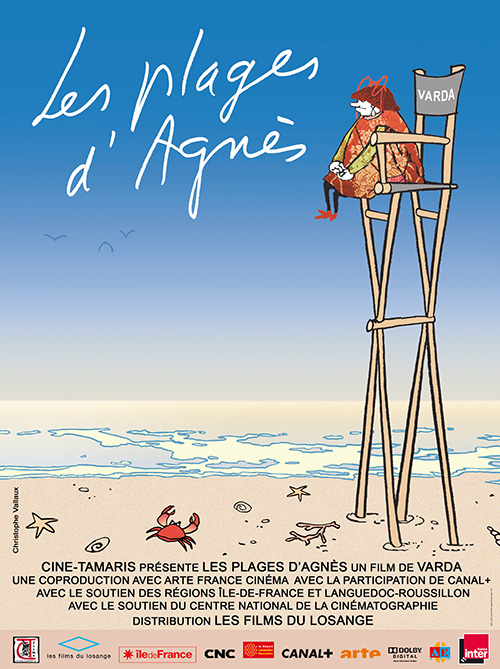
The Beaches of Agnès [2008]


Please join us for the fourth screening of our Agnès Varda series with a one-night event showing of The Beaches of Agnès [Les plages d’Agnès] [2008].

  • Screening Date: Wednesday, November 4th, 2015 | 7:00pm
  • Venue: Canisius College Science Hall
  • Specifications: 2008 / 110 minutes / French with English subtitles / Color
  • Director(s): Agnès Varda
  • Print: Supplied by The Cinema Guild
  • Tickets: Free and Open to the Public
  • Deals: Stop in early for FREE Breadhive granola while supplies last!


Event Sponsors:

Venue Information:

2001 Main Street (Between Delavan & Jefferson), Buffalo NY 14208


Synopsis

Courtesy of The Cinema Guild:

A reflection on art, life and the movies, The Beaches of Agnès is a magnificent film from the great Agnès Varda, director of Cleo from 5 to 7 and The Gleaners and I, a richly cinematic self portrait that touches on everything from the feminist movement and the Black Panthers to the films of husband Jacques Demy and the birth of the French New Wave.

When one thinks of the major figures of postwar cinema, the name Agnès Varda immediately springs to mind. Her body of work in both fiction and documentary is defined by a wealth of innovation and imagination. Irrepressible and enquiring, she is a force of nature, and even at eighty shows no signs of slowing down. Her new film is a reminder that there are few artists capable of such eloquence in cinema.

Varda takes beaches as her point of departure. Though she was not born near the ocean, she would travel to the seaside every Easter and summer during her childhood, and her memories of these trips act as a springboard for the film’s meditation on her early life. She recalls her wartime exile to the coastal village of Sète as a period of endless fun and life jackets. While a young adult, Varda began her career as a photographer before raising a family with her husband, Jacques Demy (best known for The Umbrellas of Cherbourg) and eventually turning to filmmaking. Returning to Sète over a decade after the end of the war, she used the locale and its fishermen as the backdrop for her remarkable first feature film, La Pointe Courte.

Varda weaves photographs, vintage footage, film clips, and present-day sequences into a memorable voyage through her life, during which she confronts the joy of creation and the pain of personal loss, death and aging. It is a singular trip played out against the exciting context of the postwar explosion of cultural expression in France. She knew everyone: her colleagues in the French New Wave, the Black Panthers in California and even Jim Morrison, who would visit when in Paris. Idiosyncratic, engaging and deeply moving, The Beaches of Agnès is a journey through an extraordinary artistic life.

Tidbits:

  • Venice Film Festival – 2008
  • Toronto International Film Festival – 2008
  • Directors Guild of America – 2010 – Nominee: Outstanding Directorial Achievement in Documentary
  • César Awards – 2009 – Winner: Best Documentary Film

Director Bio

“I’m not interested in seeing a film just made by a woman – not unless she is looking for new images.”

The only female director of the French New Wave, Agnès Varda has been called both the movement’s mother and its grandmother. The fact that some have felt the need to assign her a specifically feminine role, and the confusion over how to characterize that role, speak to just how unique her place in this hallowed cinematic movement—defined by such decidedly masculine artists as Jean-Luc Godard and François Truffaut—is. Varda not only made films during the nouvelle vague, she helped inspire it. Her self-funded debut, the fiction-documentary hybrid 1956’s La Pointe Courte is often considered the unofficial first New Wave film; when she made it, she had no professional cinema training (her early work included painting, sculpting, and photojournalism). Though not widely seen, the film got her commissions to make several documentaries in the late fifties. In 1962, she released the seminal nouvelle vague film Cléo from 5 to 7; a bold character study that avoids psychologizing, it announced her official arrival. Over the coming decades, Varda became a force in art cinema, conceiving many of her films as political and feminist statements, and using a radical objectivity to create her unforgettable characters. She describes her style as cinécriture (writing on film), and it can be seen in formally audacious fictions like Le bonheur and Vagabond as well as more ragged and revealing autobiographical documentaries like The Gleaners and I and The Beaches of Agnès.

Filmography:

  • Faces Places (2017)
  • The Beaches of Agnes (2008)
  • Cinevardaphoto (2005)
  • The Gleaners and I (2000)
  • The Universe of Jacques Demy (1995)
  • One Hundred and One Nights (1995)
  • The Young Girls Turn 25 (1993)
  • Jacquot (1991)
  • Le Petit Amour (1988)
  • Jane B. par Agnes V. (1988)
  • Vagabond (1985)
  • Mur Murs (1981)
  • Documenteur (1981)
  • One Sings, the Other Doesn’t (1977)
  • Les créatures (1969)
  • Lions Love (1969)
  • Far From Vietnam (1968)
  • Le Bonheur (1966)
  • Cleo From 5 to 7 (1962)
  • La Pointe Courte (1954)

Links

Here is a curated selection of links shared on our Facebook page for additional insight/information:

  • 8/31/15 – Today via The Criterion Collection: “Just a casual courtyard chat between Agnès Varda and Guillaume-en-Égypte” – link
  • 9/2/15 – Need an Agnès Varda primer prior to our upcoming series on the grandmother of the French New Wave at Canisius College this fall? Helen Carter’s summery overview in Senses of Cinema serves as a perfect introduction! – link
  • 9/3/15 – Wonderful interview w/ Agnès Varda on her home on the rue Daguerre, Paris via Sight & Soundlink
  • 9/24/15 – Great news! Two Agnès Varda rarities – Jane B. and Kung-Fu Master – are headed for a US re-release thanks to Cinelicious Pics! – link
  • 9/29/15 – Agnès Varda on Coming to California – link
  • 10/6/15 – Agnès Varda shares credit for making an impact on feminist cinema in Kelly Gallagher’s riot grrrl infused THE HERSTORY OF THE FEMALE FILMMAKER! – link
  • 10/9/15 – Via The Criterion Collection today: “Agnès Varda keeps popping up in the most unexpected places. The indefatigable eighty-seven-year-old filmmaker stopped by our offices this week, along with her daughter, Rosalie, to say hello and fill us in on what she’s been up to. We’re happy to report that this legend of the French New Wave—and beyond—shows no signs of slowing down.” – link
  • 10/12/15 – Violet Lucca speaks with Agnès Varda back in 2011 for Film Comment. – link
  • 10/16/15 – “From the beaches of Belgium to the beaches of Noirmoutier, Varda recycles her life story through recuperated photographs and film stock, narration and installation. Looking directly at the camera, Varda tells us that her life is about loving Jacques Demy, painting, family, puzzles, and loving Jacques Demy: motifs throughout the film, which provide a loose, meandering structure, an associative technique not unlike turning the pages of a family scrapbook and pausing to linger on a detail that sparks a memory, and then going off in a different direction. Press material for the film described it as an “auto-bio-filmo-puzzlo self-portrait.”” Maryann De Julio, Senses of Cinemalink
  • 10/17/15 – “This film is more than a self-portrait—it’s a crowning artistic glory.” Richard Brody on The Beaches of Agnès, The New Yorkerlink
  • 10/18/15 – At 87, Agnès Varda continues to make the news with a new video essay by Kevin B. Lee on her work found over at Fandorlink
  • 10/28/15 – “Whether largely fiction (Cleo from 5 to 7) or largely documentary (Jacquot de Nantes and The Gleaners and I) or balanced between the two (Vagabond), Agnès Varda’s greatest films have been portraits of people and places—faces and landscapes inseparable from one another. “If we open people up, we would find a landscape. If we open me up, we would find beaches,” she says at the beginning of The Beaches of Agnès, her lovely autobiographical documentary, one of the most popular and critically lauded movies of her career.” Amy Taubin – link
  • 10/31/15 – “The Beaches of Agnès is her most recent film, and a cinematic self-portrait. She carries us from beach to beach, introducing us to the people who made her, both literally (her family) and metaphorically (her colleagues and the art that inspired her). Poetic logic and daydreams are all over the film, as they are in every one of her films; it’s just that this film is about her. So here, as the protagonist/filmmaker, she is, as she’s said before, “the other than me” and via a travelogue through beaches, clips from her films, photographs she took and whimsical dialogues with those people who have influenced her, we can piece together the puzzle of her life and career.” Sara Scheiron, International Documentary Association in an interview with Agnès Varda – link
  • 11/3/15 – An interview with Agnès Varda about The Beaches of Agnès on PBS’s POV! – link

Day of Wrath – October 23rd, 2015

Day of Wrath [1943]


Please join us for one-night event screening of Carl Theodor Dreyer’s Day of Wrath [Vredens dag] [1943].

  • Screening Date: Friday, October 23rd, 2015 / 8:00pm
  • Venue: Buffalo Sugar City
  • Specifications: 1943 / 97 minutes / Danish with English subtitles / Black & White
  • Director(s): Carl Theodor Dreyer
  • Print: Supplied by Janus Films
  • Tickets: $5.00 at the door

Event Sponsors:

Venue Information:

1239 Niagara St Buffalo, NY 14213
(Between Auburn Ave and Breckenridge St)


Synopsis

Courtesy of Criterion Collection:

Filmed during the Nazi occupation of Denmark, Carl Dreyer’s Day of Wrath [Vredens dag] is a harrowing account of individual helplessness in the face of growing social repression and paranoia. Anna, the young second wife of a well-respected but much older pastor, falls in love with her stepson when he returns to their small seventeenth-century village. Stepping outside the bounds of the village’s harsh moral code has disastrous results. Exquisitely photographed and passionately acted, Day of Wrath remains an intense, unforgettable experience.

Tidbits:

  • Venice Film Festival – 1947
  • National Board of Review – 1948 – Winner: NBR Award

Director Bio

“Nothing in the world can be compared to the human face. There is no greater experience in a studio than to witness the expression of a sensitive face under the mysterious power of inspiration. To see it animated from inside, and turning into poetry.”

The creator of perhaps cinema’s most purely spiritual works, Danish master Carl Theodor Dreyer is one of the most influential moving image makers of all time, his arrestingly spare and innovative approach echoed in the films of Ingmar Bergman, Robert Bresson, Andrei Tarkovsky, Lars von Trier, and countless others. After making his mark with such narrative silent films as the provocative Michael (1924) and Master of the House (1925), Dreyer created The Passion of Joan of Arc (1928), which, though deemed a failure on its release, is now considered, with its mix of stark realism and expressionism (and astonishing, iconic performance by Maria Falconetti), one of the great artistic works of the twentieth century. For the next four decades, Dreyer would continue to make films about people caught in battle between the spirit and the flesh and to experiment technically with the form. Vampyr (1932) is a mesmerizing horror fable full of camera and editing tricks; Day of Wrath (1943) is an intense tale of social repression, made during the Nazi occupation of Denmark; Ordet (1955) is a shattering look at a farming family’s inner religious world; and Gertrud (1964) is a portrait of a fiercely independent woman’s struggle for personal salvation.

Filmography:

  • Gertrud (1966)
  • Ordet (1955)
  • Slot i et Slot, Et (1954)
  • Storstromsbroen (1950)
  • Thorvaldsen (1949)
  • De Naaede Faergen (1948)
  • Landsbykirken (1947)
  • Kampen Mod Kraeften (1947)
  • Vandet pa landet (1946)
  • Day of Wrath (1943)
  • Modrehjaelpen (1942)
  • Vampyr (1932)
  • The Passion of Joan of Arc (1927)
  • Glomdalsbruden (1925)
  • Master of the House (1925)
  • Michael (1924)
  • Die Gezeichneten (1922)
  • Der Var Engang (1922)
  • The Parson’s Widow (1920)
  • Praesidenten (1919)
  • Leaves From Satan’s Book (1919)

Links

Here is a curated selection of links shared on our Facebook page for additional insight/information:

  • 9/28/15 – For those needing an intro to the Danish master of austerity, look no further than Acquarello’s profile of Carl Theodor Dreyer at Senses of Cinema! – link
  • 9/28/15 – “Fantastically restrained love triangle involving a pastor, his young bride, and his son. Throw in cauldrons full of witchcraft and a mother more sexually suspicious than Mrs. Bates, and you’ve got perfection.” Guy Maddin on Carl Theodor Dreyer’s Day of Wrathlink
  • 10/3/15 – In Sight & Sound‘s latest critic poll of the best films of all time, film historian Philip Kemp listed Day of Wrath alongside the Coen Brothers’ Fargo, Billy Wilder’s The Apartment, Max Ophüls’ Letter from an Unknown Woman (1948 film) and other worthy films in his top 10! – link
  • 10/10/15 – “Vampyr, for instance, was one of the most poetic horror films ever made, and Day of Wrath (1943) one of the most terrifying…What Dreyer achieves is the sense that for these sternly Protestant people, whose inscrutable faces conceal great passion, witchcraft was a frightening reality. He does not argue for or against them, but simply, as one critic has said, evokes the dark night of the soul through an intensely physical world.” Derek Malcolm, The Guardianlink
  • 10/12/15 – “Given all the execution by burning in Carl Theodor Dreyer’s Day of Wrath (1943), it seems only natural to open a discussion of the film by asking what’s at stake. It’s not just witches. The Danish director’s 1943 tale of forbidden love during Europe’s seventeenth-century inquisition puts many things into the, er, crucible: the soul’s fate, the consequences of extreme repression, even narrative coherence. Dreyer unifies them so masterfully in pursuit of higher truth that Day of Wrath is often classified as his best work.” Darrell Hartman, Artforumlink
  • 10/23/15 – “The two great Danish filmmakers, Carl Theodor Dreyer and Lars von Trier, share an artistic kinship. Women suffer, are tortured and burned at the stake, but even down to individual shots, some of von Trier’s earliest films show traces of Dreyer’s style. The twin geniuses of Danish cinema are juxtaposed here in a tour de force of their work.” Peter Schepelern, “From Dreyer to Von Trier” – link
  • 10/23/15 – “I can’t imagine how it must have felt to sit in a crowded theater, watching Day of Wrath during its original release in 1943. Set in 17th century Denmark, when rising religious fanaticism gave church leaders the authority to execute those of “questionable” morality, the film must have mirrored, much too closely for comfort, the Nazi atrocities being waged just outside the theater door.” Darren Hughes, Long Pauseslink
  • 2/3/16 – Missed our screening of Carl Theodor Dreyer’s Day of Wrath last season at Sugar City? The BFI has some ideas of where to start with the spiritually foreboding master of cinematic austerity. – link

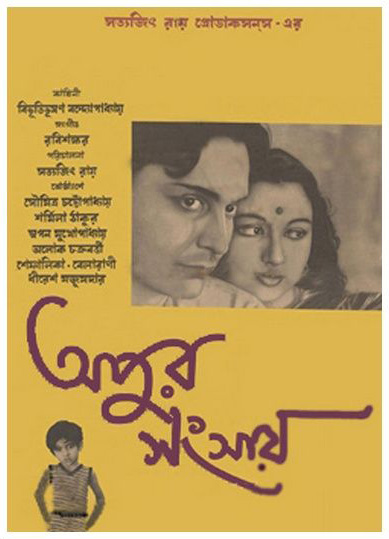
Apur Sansar – October 22nd, 2015

Apur Sansar [1959]


Please join us for a one-night screening event of the third film from Satyajit Ray’s famed Apu Trilogy, Apur Sansar (The World of Apu) [1959]. We are honored to also announce the return of “The New Cinephilia” author Girish Shambu to introduce the film.

  • Screening Date: Thursday, October 22nd, 2015 | 9:30pm
  • Venue: North Park Theatre
  • Specifications: 1959 / 105 minutes / Bengali with subtitles / Black & White
  • Director(s): Satyajit Ray
  • Print: Supplied by Janus Films
  • Tickets: $10.50 online; $9.50 at the door
  • Deal: Discounted drinks available after the screening at Més Que with your ticket

Event Sponsors:

Venue Information:

1428 Hertel Ave, Buffalo, NY 14216


Synopsis

Courtesy of Janus Films:

By the time Apur Sansar was released, Satyajit Ray had directed not only the first two Apu films but also the masterpiece The Music Room, and was well on his way to becoming a legend. This extraordinary final chapter brings our protagonist’s journey full circle. Apu is now in his early twenties, out of college, and hoping to live as a writer. Alongside his professional ambitions, the film charts his romantic awakening, which occurs as the result of a most unlikely turn of events, and his eventual, fraught fatherhood. Featuring soon to be Ray regulars Soumitra Chatterjee and Sharmila Tagore in star-making performances, and demonstrating Ray’s ever-more-impressive skills as a crafter of pure cinematic imagery, Apur Sansar is a breathtaking conclusion to this monumental trilogy.

Tidbits:

  • Locarno International Film Festival – 1968

Restoration

In 1992, the Academy of Motion Picture Arts and Sciences presented an honorary lifetime achievement Oscar to director Satyajit Ray. When sourcing material from Ray’s films for the Academy Awards ceremony, telecast producers were dismayed by the poor condition of the existing prints. The following year, after Ray’s death, a project was initiated to restore many of Ray’s films, including those in The Apu Trilogy.

In 1993, several of the filmmaker’s original negatives were shipped to Henderson’s Film Laboratories in London. In July, a massive nitrate fire at the lab spread to the film vaults, destroying more than twenty-five original negatives of important British classics—and burning several Ray films, including the original negatives of The Apu Trilogy. Any ashes, fragments, or film cans that could be identified as belonging to Ray’s films were sent to the Academy Film Archive, but the trilogy negatives were deemed unprintable—there were no technologies available at the time that were capable of fully restoring such badly damaged film elements.

When the Criterion Collection began working on this restoration with the Academy Film Archive in 2013, the negatives were in storage and hadn’t been seen in twenty years. Many portions were indeed burned to ash, and what remained was startlingly fragile, thanks to deterioration and the heat and contaminants the elements had been exposed to. Head and tail leaders were often missing from reels. Yet significant portions survived, from which high-quality images might be rendered.

No commercial laboratory would handle this material, so it was entrusted to L’Immagine Ritrovata in Bologna, one of the world’s premier restoration facilities. There, technicians successfully rehydrated the brittle film using a special solution (one part glycerol, one part acetone, three parts water). Scanning tests determined that pin-registered wet-gate scans yielded the best results. Technicians then set about physically repairing the elements. This meant almost a thousand hours of meticulous hand labor, which even included rebuilding the perforation holes on the sides of the film and removing melted tape and glue. Using fine-grain masters and duplicate negatives preserved by Janus Films, the Academy, the Harvard Film Archive, and the British Film Institute, the technicians found excellent replacements for the unusable or missing sections of the original negatives. In the end, 40 percent of Pather Panchali and over 60 percent of Aparajito were restored directly from the original negatives. The two surviving reels of Apur Sansar were too damaged to be used in the restoration, so all of that film was restored from a fine-grain master and a duplicate negative.

Over the course of nearly six months of steady work, the Criterion Collection restoration lab handled the digital restoration, including eliminating dirt, debris, warps, and cracks. Emphasis was placed on retaining the look and character of the original material, preferring when necessary to leave damage rather than overprocess digital images that might lose the grain and feel of film.

All in all, the restoration of The Apu Trilogy has been years in the making. The return of these films to theaters marks a triumph for the archivists and members of the preservation community who had the foresight and faith to protect these vital treasures of world cinema—even when all seemed lost.

New 4K restorations made by the Criterion Collection in collaboration with the Academy Film Archive at the Academy of Motion Picture Arts and Sciences


10 Apu Facts

1 Satyajit Ray worked a twenty-hour-a-day schedule to complete the editing of Pather Panchali in time for its premiere at New York’s Museum of Modern Art on May 3, 1955, in a print without subtitles. The New York opening of this restoration falls sixty years, almost to the day, after that premiere.

2 Pather Panchali was such a smash in New York that it played for eight months at the Fifth Avenue Playhouse in 1958.

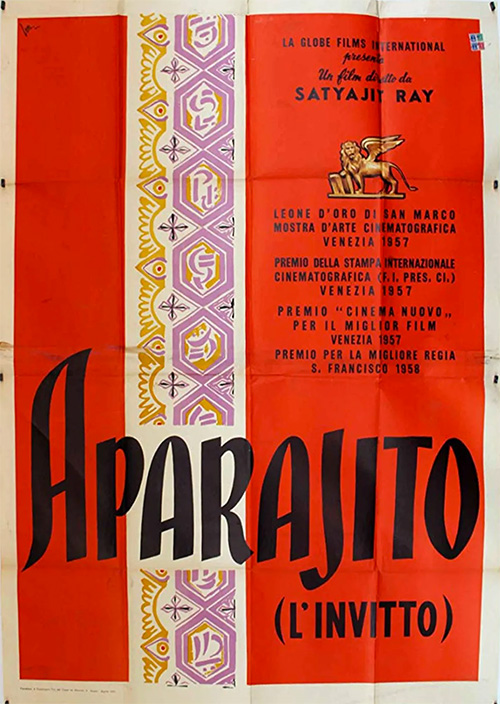
3 Aparajito won the Golden Lion at the Venice Film Festival, making it the only sequel to have ever won the grand prize at one of the world’s three major festivals (Berlin, Cannes, and Venice).

4 Matt Groening, creator of The Simpsons, is a big fan of The Apu Trilogy, and he named the show’s convenience store owner Apu Nahasapeemapetilon after its protagonist.

5 Ray started out as a graphic designer and book illustrator, and his creations included woodcut art for a children’s edition of Bibhutibhusan Banerjee’s novel Pather Panchali. As a filmmaker, he designed all of his own publicity materials, and usually his opening credits.

6 In 1951, while Ray was trying to raise money for Pather Panchali, he drew thirtyone pages of storyboards for a documentary about Indian classical musician Ravi Shankar. The film was never made, though the storyboards have been preserved by the Satyajit Ray Society.

7 Cinematographer Subrata Mitra was only twenty-one years old when he began work on Pather Panchali, and had never handled a movie camera before.

8 Ray and Mitra pioneered the use of bounced light. For Aparajito, they had to build a studio set that would replicate the living conditions of Apu’s family in Varanasi (then known as Benares), a structure that had a central courtyard and a skylight opening at the top, and that was essentially without shadows. Mitra came up with the idea to stretch a sheet of cloth above the studio-built courtyard and bounce artificial light from below, creating more depth and natural-looking shadows in the courtyard space.

9 Chunibala Devi, who plays “Auntie” in Pather Panchali, was a stage actor at the turn of the century, worked in silent cinema, and then retired from entertainment. She was about eighty years old when Ray met her, and aside from being one of the few actors who received a small salary, she also required a daily dose of opium.

10 Apur Sansar was the first film Ray made with actors Soumitra Chatterjee and Sharmila Tagore, who would become major stars. Each went on to appear in many more Ray films.


Director Bio

“What is attempted in these films is of course a synthesis. But it can be seen by someone who has his feet in both cultures. Someone who will bring to bear on the films involvement and detachment in equal measure.”

Satyajit Ray was an only child, born in 1921 into a creative, intellectual family of Brahmos—members of a Christian-influenced Hindu movement—in Kolkata. His grandfather, Upendrakishore Ray, was a renowned writer, composer, and children’s magazine founder, and his father, Sukumar Ray, was a writer and illustrator, a household name for his nonsense verse. Satyajit had an unsurprising early facility with the arts, both musical and visual. His father died when he was not yet three, and he lived with his mother and an uncle in the southern part of Kolkata, where he taught himself to read Western classical music and discovered Hollywood movies.

After finishing college, beginning in 1940, Ray studied art for two and a half years in Santiniketan, at the university founded by the great Bengali intellectual, writer, and artist Rabindranath Tagore, who would become one of the most important influences in his life. Returning to Kolkata, Ray found work as a graphic artist at a British-run advertising agency and a Bengali-run publishing house, and cofounded the Calcutta Film Society, where he and other film lovers watched mostly European and Hollywood movies and engaged in lengthy addas (coffeehouse conversations) about what was missing from Indian cinema, which was still primarily a Bollywood landscape. While working full-time, Ray began writing screenplays on the side, for his own enjoyment and occasionally for pay, deepening his understanding of cinematic storytelling.

In 1949, Ray met the great French director Jean Renoir, who was location scouting in Kolkata for The River. When Renoir asked if he had a film idea of his own, Ray described the story of Pather Panchali, a novel by Bibhutibhusan Banerjee for which Ray had once designed woodcut illustrations and that struck him as being highly cinematic in nature. Renoir encouraged Ray’s love of film and his pursuit of the project.

In 1950, Ray and his wife, Bijoya, moved to England, where he would work at his advertising agency’s London office. During those six months, the couple saw ninety-nine films, including Vittorio De Sica’s recent neorealist masterpiece Bicycle Thieves. It was this film that had the strongest impact on Ray, as it led him to the discovery that one could make a film with nonprofessionals, on location, largely outdoors, and on a shoestring budget. In late 1950, on the boat back to Kolkata, he wrote a first treatment for Pather Panchali.

In 1955, after three years of shooting and editing that was intermittent due to a lack of financing, Ray completed his debut film, which, after legendary screenings in New York and Cannes, officially put him on the map during the golden age of art-house cinema; with Pather Panchali, Ray took his place alongside Ingmar Bergman, Federico Fellini, and Akira Kurosawa as one of the most important international filmmakers. He went on to close out the 1950s with a string of masterpieces, including the two films that rounded out The Apu Trilogy, Aparajito (1956) and Apur Sansar (1959), and The Music Room (1958).

Over the course of his thirty-six-year career, Ray would direct twenty-eight features. He also designed posters and composed musical scores for many of his own films. He won awards at the world’s major film festivals, including Cannes, Venice, and Berlin. In 1992, thanks to a campaign led by several Hollywood heavyweights, including Martin Scorsese and Francis Ford Coppola, the Academy of Motion Picture Arts and Sciences awarded him an honorary lifetime achievement Oscar, which he accepted from a hospital bed in Kolkata, where he had been admitted for a heart condition. Less than a month later, Ray died at the age of seventy. His work remains an inspiration to filmmakers around the world.

Filmography:

  • The Stranger (1991)
  • Shakha Proshaka (1990)
  • An Enemy of the People (1989)
  • The Home and the World (1984)
  • Sadgati (1982)
  • The Elephant God (1979)
  • The Chess Players (1977)
  • The Masses’ Music (1976)
  • The Middleman (1976)
  • Ashani Sanket (1973)
  • Simbaddha (1972)
  • The Adversary (1971)
  • Days and Nights in the Forest (1969)
  • The Big City (1967)
  • Kanchenjungha (1966)
  • The Coward (1965)
  • The Lonely Wife (1965)
  • Two Daughters (1963)
  • The Music Room (1963)
  • Devi (1962)
  • The Expedition (1962)
  • Three Daughters: Monihara (1961)
  • Three Daughters: The Postmaster (1961)
  • Three Daughters: Samapti (1961)
  • The World Of Apu (1959)
  • Aparajito (1956)
  • Pather Panchali (1955)

Links

Here is a curated selection of links shared on our Facebook page for additional insight/information:

  • 9/20/15 – “I watched The Apu Trilogy recently over a period of three nights, and found my thoughts returning to it during the days. It is about a time, place and culture far removed from our own, and yet it connects directly and deeply with our human feelings. It is like a prayer, affirming that this is what the cinema can be, no matter how far in our cynicism we may stray.” Roger Ebert, 2001 – link
  • 10/6/15 – “For with this beautiful picture, which completes the story of the Hindu lad we first met as a boy in Pather Panchali and saw grow into a raw young man in the succeeding Aparajito, an impressive capstone is put not only upon a touching human drama but also upon the development of a genuine artist’s skill. Mr. Ray, whose grasp of the cinema medium was uncertain in Pather Panchali, his first film, demonstrates in Apur Sansar that he is master of a complex craft and style.” Bosley Crowther, The New York Times, 1960 – link
  • 10/22/15 – “Unlike the popular cinema of his time, he did not paint his characters in extremes of black and white. Ray’s characters lived in an instantly recognisable middle ground. There are no heroes in his films; instead you have the brave heroism of ordinary individuals, battling with the demons of their day-to-day lives.” Sharmila Tagore, co-star of Apur Sansar, The Wirelink
  • 11/19/15 – Having Girish Shambu in attendance to introduce the Apu Trilogy at the North Park Theatre was an honor. Now you can read his new essay on the series over at The Criterion Collection – link
  • 11/23/15 – We stumbled upon this wonderful archive of classic Satyajit Ray posters & wanted to share! – link

Vagabond – October 21st, 2015

Vagabond [1985]


Please join us for the third screening of our Agnès Varda series with a one-night event showing of Vagabond [Sans toit ni loi] [1985].

  • Screening Date: Wednesday, October 21st, 2015 | 8:00pm
  • Venue: Canisius College Science Hall
  • Specifications: 1985 / 105 minutes / French with English subtitles / Color
  • Director(s): Agnès Varda
  • Print: Supplied by Janus Films / Criterion Collection
  • Tickets: Free and Open to the Public
  • Deals: Stop in early for FREE Breadhive granola while supplies last!


Event Sponsors:

Venue Information:

2001 Main Street (Between Delavan & Jefferson), Buffalo NY 14208


Synopsis

Courtesy of Criterion Collection:

Sandrine Bonnaire won the Best Actress César for her portrayal of the defiant young drifter Mona, found frozen to death in a ditch at the beginning of Vagabond. Agnès Varda pieces together Mona’s story through flashbacks told by those who encountered her (played by a largely nonprofessional cast), producing a splintered portrait of an enigmatic woman. With its sparse, poetic imagery, Vagabond [Sans toit ni loi] is a stunner, and won Varda the top prize at the Venice Film Festival.

Tidbits:

  • Venice Film Festival – 1985 – Winner: Golden Lion, Winner: FIPRESCI Prize & Winner: OCIC Award
  • César Awards – 1986 – Winner: Best Actress, Nominee: Best Film, Nominee: Best Supporting Actress & Nominee: Best Director

Director Bio

“I’m not interested in seeing a film just made by a woman – not unless she is looking for new images.”

The only female director of the French New Wave, Agnès Varda has been called both the movement’s mother and its grandmother. The fact that some have felt the need to assign her a specifically feminine role, and the confusion over how to characterize that role, speak to just how unique her place in this hallowed cinematic movement—defined by such decidedly masculine artists as Jean-Luc Godard and François Truffaut—is. Varda not only made films during the nouvelle vague, she helped inspire it. Her self-funded debut, the fiction-documentary hybrid 1956’s La Pointe Courte is often considered the unofficial first New Wave film; when she made it, she had no professional cinema training (her early work included painting, sculpting, and photojournalism). Though not widely seen, the film got her commissions to make several documentaries in the late fifties. In 1962, she released the seminal nouvelle vague film Cléo from 5 to 7; a bold character study that avoids psychologizing, it announced her official arrival. Over the coming decades, Varda became a force in art cinema, conceiving many of her films as political and feminist statements, and using a radical objectivity to create her unforgettable characters. She describes her style as cinécriture (writing on film), and it can be seen in formally audacious fictions like Le bonheur and Vagabond as well as more ragged and revealing autobiographical documentaries like The Gleaners and I and The Beaches of Agnès.

Filmography:

  • Faces Places (2017)
  • The Beaches of Agnes (2008)
  • Cinevardaphoto (2005)
  • The Gleaners and I (2000)
  • The Universe of Jacques Demy (1995)
  • One Hundred and One Nights (1995)
  • The Young Girls Turn 25 (1993)
  • Jacquot (1991)
  • Le Petit Amour (1988)
  • Jane B. par Agnes V. (1988)
  • Vagabond (1985)
  • Mur Murs (1981)
  • Documenteur (1981)
  • One Sings, the Other Doesn’t (1977)
  • Les créatures (1969)
  • Lions Love (1969)
  • Far From Vietnam (1968)
  • Le Bonheur (1966)
  • Cleo From 5 to 7 (1962)
  • La Pointe Courte (1954)

Links

Here is a curated selection of links shared on our Facebook page for additional insight/information:

  • 8/31/15 – Today via The Criterion Collection: “Just a casual courtyard chat between Agnès Varda and Guillaume-en-Égypte” – link
  • 9/2/15 – Need an Agnès Varda primer prior to our upcoming series on the grandmother of the French New Wave at Canisius College this fall? Helen Carter’s summery overview in Senses of Cinema serves as a perfect introduction! – link
  • 9/3/15 – Wonderful interview w/ Agnès Varda on her home on the rue Daguerre, Paris via Sight & Soundlink
  • 9/24/15 – Great news! Two Agnès Varda rarities – Jane B. and Kung-Fu Master – are headed for a US re-release thanks to Cinelicious Pics! – link
  • 9/29/15 – Agnès Varda on Coming to California – link
  • 10/1/15 – “The investigative structure of the film is an attempt to reconstruct the final days of Mona’s life through what Varda describes as “pieces of a jigsaw puzzle that is inevitably incomplete” and reveals more about the people who talk about her than about Mona herself, who remains ungraspable (the film’s working title was “À saisir,” a term that means both “to seize” a property and “to understand” or “to grasp” something).” Chris Darke on Agnès Varda’s Vagabondlink
  • 10/6/15 – Agnès Varda shares credit for making an impact on feminist cinema in Kelly Gallagher’s riot grrrl infused THE HERSTORY OF THE FEMALE FILMMAKER! – link
  • 10/9/15 – Via The Criterion Collection today: “Agnès Varda keeps popping up in the most unexpected places. The indefatigable eighty-seven-year-old filmmaker stopped by our offices this week, along with her daughter, Rosalie, to say hello and fill us in on what she’s been up to. We’re happy to report that this legend of the French New Wave—and beyond—shows no signs of slowing down.” – link
  • 10/12/15 – Violet Lucca speaks with Agnès Varda back in 2011 for Film Comment. – link
  • 10/13/15 – “In contemporary North America, female homelessness remains largely an invisible phenomenon. Out of sight, women are also proverbially out of mind, which silently suggests that economic and sociological constraints don’t affect women in the same radical manner as men; that women aren’t displaced, forced to relocate for work, or faced with precarious housing. Two films—with twenty years between them—that directly engage with these issues are Vagabond (Agnès Varda, 1985) and Wendy and Lucy (Kelly Reichardt, 2008).” Tina Hassannia, cléolink
  • 10/16/15 – “Vagabond has been called Agnès Varda’s Ulysses, and with good reason. The comparison with James Joyce’s era-defining epic novel extends well beyond a recognizable similarity between the two artists. Both writer and filmmaker occupy vanguard positions in the history of their respective forms, each bringing an experimental vitality to his and her work that affirms the social dimension of art. Just as Joyce attempted to describe contemporary consciousness by reworking the Homeric foundation of modern culture, so does Varda model her simple tale-—of a woman’s place in today’s complex and unresponsive world—on that seminal document of modernist cinema, Orson Welles’ Citizen Kane.” Sandy Flitterman-Lewis on Vagabondlink
  • 10/18/15 – At 87, Agnès Varda continues to make the news with a new video essay by Kevin B. Lee on her work found over at Fandorlink
  • 10/21/15 – “In Mona, Varda created a young woman she describes as “the incarnation of the great NO!” A feral female I’ve never seen before either in film or literature: refusing the basic tools of civilization, refusing to be seductive or seduced, refusing responsibility or continuity, totally unprepared for tenderness. Mona is an unforgettable heroine, a walking affront to society. Where can Varda possibly go from there?” Lynne Littman Littman on Vagabond, International Documentary Association – link
  • 10/23/15 – “There is no expert witness who has some objective perspective. Rather, the film multiplies perspectives. It invites, even demands, the viewer’s own testimony from her own perspective, a testimony that can vary as much as those represented in the film. The viewer is drawn into the film as a third party in every relationship. Since the characters often speak directly to the camera, the viewer is put into the position of the documentarian, analyst, or confessor, who bears witness in the sense of listening to the testimony of others.” Kelly Oliver, Subjectivity Without Subjects: From Abject Fathers to Desiring Motherslink

Mur murs – October 7th, 2015

Mur murs [1981]


Please join us for the second screening of our Agnès Varda series with a one-night event showing of Mur murs [1981].

  • Screening Date: Wednesday, October 7th, 2015 | 8:00pm
  • Venue: Canisius College Science Hall
  • Specifications: 1981 / 80 minutes / French with English subtitles / Color
  • Director(s): Agnès Varda
  • Print: Supplied by Janus Films / Criterion Collection
  • Tickets: Free and Open to the Public
  • Deals: Stop in early for FREE Breadhive granola while supplies last!


Event Sponsors:

Venue Information:

2001 Main Street (Between Delavan & Jefferson), Buffalo NY 14208


Synopsis

Courtesy of Criterion Collection:

After returning to Los Angeles from France in 1979, Agnès Varda created this kaleidoscopic documentary about the striking murals that decorate the city. Bursting with color and vitality, Mur murs is as much an invigorating study of community and diversity as it is an essential catalog of unusual public art.

Tidbits:

  • Cannes Film Festival – 1981
  • New York Film Festival – 1981
  • Toronto International Film Festival – 1981

Director Bio

“I’m not interested in seeing a film just made by a woman – not unless she is looking for new images.”

The only female director of the French New Wave, Agnès Varda has been called both the movement’s mother and its grandmother. The fact that some have felt the need to assign her a specifically feminine role, and the confusion over how to characterize that role, speak to just how unique her place in this hallowed cinematic movement—defined by such decidedly masculine artists as Jean-Luc Godard and François Truffaut—is. Varda not only made films during the nouvelle vague, she helped inspire it. Her self-funded debut, the fiction-documentary hybrid 1956’s La Pointe Courte is often considered the unofficial first New Wave film; when she made it, she had no professional cinema training (her early work included painting, sculpting, and photojournalism). Though not widely seen, the film got her commissions to make several documentaries in the late fifties. In 1962, she released the seminal nouvelle vague film Cléo from 5 to 7; a bold character study that avoids psychologizing, it announced her official arrival. Over the coming decades, Varda became a force in art cinema, conceiving many of her films as political and feminist statements, and using a radical objectivity to create her unforgettable characters. She describes her style as cinécriture (writing on film), and it can be seen in formally audacious fictions like Le bonheur and Vagabond as well as more ragged and revealing autobiographical documentaries like The Gleaners and I and The Beaches of Agnès.

Filmography:

  • Faces Places (2017)
  • The Beaches of Agnes (2008)
  • Cinevardaphoto (2005)
  • The Gleaners and I (2000)
  • The Universe of Jacques Demy (1995)
  • One Hundred and One Nights (1995)
  • The Young Girls Turn 25 (1993)
  • Jacquot (1991)
  • Le Petit Amour (1988)
  • Jane B. par Agnes V. (1988)
  • Vagabond (1985)
  • Mur Murs (1981)
  • Documenteur (1981)
  • One Sings, the Other Doesn’t (1977)
  • Les créatures (1969)
  • Lions Love (1969)
  • Far From Vietnam (1968)
  • Le Bonheur (1966)
  • Cleo From 5 to 7 (1962)
  • La Pointe Courte (1954)

Links

Here is a curated selection of links shared on our Facebook page for additional insight/information:

  • 8/31/15 – Today via The Criterion Collection: “Just a casual courtyard chat between Agnès Varda and Guillaume-en-Égypte” – link
  • 9/2/15 – Need an Agnès Varda primer prior to our upcoming series on the grandmother of the French New Wave at Canisius College this fall? Helen Carter’s summery overview in Senses of Cinema serves as a perfect introduction! – link
  • 9/3/15 – Wonderful interview w/ Agnès Varda on her home on the rue Daguerre, Paris via Sight & Soundlink
  • 9/17/15 – “Unlike the prominently situated billboards that plaster the freeways with crass messages to WANT, DEMAND, and more importantly BUY, these public artworks offer a fascinating counter-movement to this commercial blare, and this was how they first caught French director Agnès Varda’s attention during her time in the city.” Mallory Andrews, MUBI’s Notebook – link
  • 9/24/15 – Great news! Two Agnès Varda rarities – Jane B. and Kung-Fu Master – are headed for a US re-release thanks to Cinelicious Pics! – link
  • 9/28/15 – “Agnès Varda: The Punk-Spirited Grand-Mère Terrible” via An Other magazine – link
  • 9/29/15 – Agnès Varda on Coming to California – link
  • 9/30/15 – “A largely observational compendium of L.A. county street art, graffiti, and the large-scale murals peppering architecture from Venice Beach to the farthest reach of the inner city, the film plays at once as a geographical topography of a city in transition and a meditation on artistic expression and its sociological outgrowth.” Jordan Cronk on Mur Murs, Slant Magazinelink
  • 10/5/15 – “Whereas Documenteur yields few explanations, Mur Murs incessantly pursues them. A mural is never just a painted wall in Mur Murs but a picture with a story, the outside of a particular inside. Varda is not content with the adage that Los Angeles is a city of surfaces; at each stop on her tour of the city, she peels back a facade to reveal what lies beneath, creating in effect a Los Angeles travelogue turned inside out.” Sasha Archibald, East of Borneolink
  • 10/6/15 – Agnès Varda shares credit for making an impact on feminist cinema in Kelly Gallagher’s riot grrrl infused THE HERSTORY OF THE FEMALE FILMMAKER! – link
  • 10/9/15 – Via The Criterion Collection today: “Agnès Varda keeps popping up in the most unexpected places. The indefatigable eighty-seven-year-old filmmaker stopped by our offices this week, along with her daughter, Rosalie, to say hello and fill us in on what she’s been up to. We’re happy to report that this legend of the French New Wave—and beyond—shows no signs of slowing down.” – link
  • 10/12/15 – Violet Lucca speaks with Agnès Varda back in 2011 for Film Comment. – link
  • 10/18/15 – At 87, Agnès Varda continues to make the news with a new video essay by Kevin B. Lee on her work found over at Fandorlink

Aparajito – September 24th, 2015

Aparajito [1956]


Please join us for a one-night screening event of the second film from Satyajit Ray’s famed Apu Trilogy, Aparajito (The Unvanquished) [1956]. We are honored to also announce the return of “The New Cinephilia” author Girish Shambu to introduce the film.

  • Screening Date: Thursday, September 24th, 2015 | 9:30pm
  • Venue: North Park Theatre
  • Specifications: 1956 / 110 minutes / Bengali with subtitles / Black & White
  • Director(s): Satyajit Ray
  • Print: Supplied by Janus Films
  • Tickets: $10.50 online; $9.50 at the door
  • Deal: Discounted drinks available after the screening at Més Que with your ticket

Summer 2015 Season Sponsor:

Event Sponsors:

Venue Information:

1428 Hertel Ave, Buffalo, NY 14216


Synopsis

Courtesy of Janus Films:

Satyajit Ray had not planned to make a sequel to Pather Panchali, but after the film’s international success, he decided to continue Apu’s narrative. Aparajito picks up where the first film leaves off, with Apu and his family having moved away from the country to live in the bustling holy city of Varanasi (then known as Benares). As Apu progresses from wide-eyed child to intellectually curious teenager, eventually studying in Kolkata, we witness his academic and moral education, as well as the growing complexity of his relationship with his mother. This tenderly expressive, often heart-wrenching film, which won three top prizes at the Venice Film Festival, including the Golden Lion, not only extends but also spiritually deepens the tale of Apu.

Tidbits:

  • Venice Film Festival – 1957 – Winner: FIPRESCI Prize, Winner: Golden Lion & Winner: Best Film (New Cinema Award)
  • Berlin International Film Festival – 1960 – Winner: Selznick Golden Laurel for Best Film
  • National Board of Review – 1959 – Winner: Top Foreign Films
  • BAFTA Awards – 1959 – Nominee: Best Film from any Source & Nominee: Best Foreign Actress

Restoration

In 1992, the Academy of Motion Picture Arts and Sciences presented an honorary lifetime achievement Oscar to director Satyajit Ray. When sourcing material from Ray’s films for the Academy Awards ceremony, telecast producers were dismayed by the poor condition of the existing prints. The following year, after Ray’s death, a project was initiated to restore many of Ray’s films, including those in The Apu Trilogy.

In 1993, several of the filmmaker’s original negatives were shipped to Henderson’s Film Laboratories in London. In July, a massive nitrate fire at the lab spread to the film vaults, destroying more than twenty-five original negatives of important British classics—and burning several Ray films, including the original negatives of The Apu Trilogy. Any ashes, fragments, or film cans that could be identified as belonging to Ray’s films were sent to the Academy Film Archive, but the trilogy negatives were deemed unprintable—there were no technologies available at the time that were capable of fully restoring such badly damaged film elements.

When the Criterion Collection began working on this restoration with the Academy Film Archive in 2013, the negatives were in storage and hadn’t been seen in twenty years. Many portions were indeed burned to ash, and what remained was startlingly fragile, thanks to deterioration and the heat and contaminants the elements had been exposed to. Head and tail leaders were often missing from reels. Yet significant portions survived, from which high-quality images might be rendered.

No commercial laboratory would handle this material, so it was entrusted to L’Immagine Ritrovata in Bologna, one of the world’s premier restoration facilities. There, technicians successfully rehydrated the brittle film using a special solution (one part glycerol, one part acetone, three parts water). Scanning tests determined that pin-registered wet-gate scans yielded the best results. Technicians then set about physically repairing the elements. This meant almost a thousand hours of meticulous hand labor, which even included rebuilding the perforation holes on the sides of the film and removing melted tape and glue. Using fine-grain masters and duplicate negatives preserved by Janus Films, the Academy, the Harvard Film Archive, and the British Film Institute, the technicians found excellent replacements for the unusable or missing sections of the original negatives. In the end, 40 percent of Pather Panchali and over 60 percent of Aparajito were restored directly from the original negatives. The two surviving reels of Apur Sansar were too damaged to be used in the restoration, so all of that film was restored from a fine-grain master and a duplicate negative.

Over the course of nearly six months of steady work, the Criterion Collection restoration lab handled the digital restoration, including eliminating dirt, debris, warps, and cracks. Emphasis was placed on retaining the look and character of the original material, preferring when necessary to leave damage rather than overprocess digital images that might lose the grain and feel of film.

All in all, the restoration of The Apu Trilogy has been years in the making. The return of these films to theaters marks a triumph for the archivists and members of the preservation community who had the foresight and faith to protect these vital treasures of world cinema—even when all seemed lost.

New 4K restorations made by the Criterion Collection in collaboration with the Academy Film Archive at the Academy of Motion Picture Arts and Sciences


10 Apu Facts

1 Satyajit Ray worked a twenty-hour-a-day schedule to complete the editing of Pather Panchali in time for its premiere at New York’s Museum of Modern Art on May 3, 1955, in a print without subtitles. The New York opening of this restoration falls sixty years, almost to the day, after that premiere.

2 Pather Panchali was such a smash in New York that it played for eight months at the Fifth Avenue Playhouse in 1958.

3 Aparajito won the Golden Lion at the Venice Film Festival, making it the only sequel to have ever won the grand prize at one of the world’s three major festivals (Berlin, Cannes, and Venice).

4 Matt Groening, creator of The Simpsons, is a big fan of The Apu Trilogy, and he named the show’s convenience store owner Apu Nahasapeemapetilon after its protagonist.

5 Ray started out as a graphic designer and book illustrator, and his creations included woodcut art for a children’s edition of Bibhutibhusan Banerjee’s novel Pather Panchali. As a filmmaker, he designed all of his own publicity materials, and usually his opening credits.

6 In 1951, while Ray was trying to raise money for Pather Panchali, he drew thirtyone pages of storyboards for a documentary about Indian classical musician Ravi Shankar. The film was never made, though the storyboards have been preserved by the Satyajit Ray Society.

7 Cinematographer Subrata Mitra was only twenty-one years old when he began work on Pather Panchali, and had never handled a movie camera before.

8 Ray and Mitra pioneered the use of bounced light. For Aparajito, they had to build a studio set that would replicate the living conditions of Apu’s family in Varanasi (then known as Benares), a structure that had a central courtyard and a skylight opening at the top, and that was essentially without shadows. Mitra came up with the idea to stretch a sheet of cloth above the studio-built courtyard and bounce artificial light from below, creating more depth and natural-looking shadows in the courtyard space.

9 Chunibala Devi, who plays “Auntie” in Pather Panchali, was a stage actor at the turn of the century, worked in silent cinema, and then retired from entertainment. She was about eighty years old when Ray met her, and aside from being one of the few actors who received a small salary, she also required a daily dose of opium.

10 Apur Sansar was the first film Ray made with actors Soumitra Chatterjee and Sharmila Tagore, who would become major stars. Each went on to appear in many more Ray films.


Director Bio

“What is attempted in these films is of course a synthesis. But it can be seen by someone who has his feet in both cultures. Someone who will bring to bear on the films involvement and detachment in equal measure.”

Satyajit Ray was an only child, born in 1921 into a creative, intellectual family of Brahmos—members of a Christian-influenced Hindu movement—in Kolkata. His grandfather, Upendrakishore Ray, was a renowned writer, composer, and children’s magazine founder, and his father, Sukumar Ray, was a writer and illustrator, a household name for his nonsense verse. Satyajit had an unsurprising early facility with the arts, both musical and visual. His father died when he was not yet three, and he lived with his mother and an uncle in the southern part of Kolkata, where he taught himself to read Western classical music and discovered Hollywood movies.

After finishing college, beginning in 1940, Ray studied art for two and a half years in Santiniketan, at the university founded by the great Bengali intellectual, writer, and artist Rabindranath Tagore, who would become one of the most important influences in his life. Returning to Kolkata, Ray found work as a graphic artist at a British-run advertising agency and a Bengali-run publishing house, and cofounded the Calcutta Film Society, where he and other film lovers watched mostly European and Hollywood movies and engaged in lengthy addas (coffeehouse conversations) about what was missing from Indian cinema, which was still primarily a Bollywood landscape. While working full-time, Ray began writing screenplays on the side, for his own enjoyment and occasionally for pay, deepening his understanding of cinematic storytelling.

In 1949, Ray met the great French director Jean Renoir, who was location scouting in Kolkata for The River. When Renoir asked if he had a film idea of his own, Ray described the story of Pather Panchali, a novel by Bibhutibhusan Banerjee for which Ray had once designed woodcut illustrations and that struck him as being highly cinematic in nature. Renoir encouraged Ray’s love of film and his pursuit of the project.

In 1950, Ray and his wife, Bijoya, moved to England, where he would work at his advertising agency’s London office. During those six months, the couple saw ninety-nine films, including Vittorio De Sica’s recent neorealist masterpiece Bicycle Thieves. It was this film that had the strongest impact on Ray, as it led him to the discovery that one could make a film with nonprofessionals, on location, largely outdoors, and on a shoestring budget. In late 1950, on the boat back to Kolkata, he wrote a first treatment for Pather Panchali.

In 1955, after three years of shooting and editing that was intermittent due to a lack of financing, Ray completed his debut film, which, after legendary screenings in New York and Cannes, officially put him on the map during the golden age of art-house cinema; with Pather Panchali, Ray took his place alongside Ingmar Bergman, Federico Fellini, and Akira Kurosawa as one of the most important international filmmakers. He went on to close out the 1950s with a string of masterpieces, including the two films that rounded out The Apu Trilogy, Aparajito (1956) and Apur Sansar (1959), and The Music Room (1958).

Over the course of his thirty-six-year career, Ray would direct twenty-eight features. He also designed posters and composed musical scores for many of his own films. He won awards at the world’s major film festivals, including Cannes, Venice, and Berlin. In 1992, thanks to a campaign led by several Hollywood heavyweights, including Martin Scorsese and Francis Ford Coppola, the Academy of Motion Picture Arts and Sciences awarded him an honorary lifetime achievement Oscar, which he accepted from a hospital bed in Kolkata, where he had been admitted for a heart condition. Less than a month later, Ray died at the age of seventy. His work remains an inspiration to filmmakers around the world.

Filmography:

  • The Stranger (1991)
  • Shakha Proshaka (1990)
  • An Enemy of the People (1989)
  • The Home and the World (1984)
  • Sadgati (1982)
  • The Elephant God (1979)
  • The Chess Players (1977)
  • The Masses’ Music (1976)
  • The Middleman (1976)
  • Ashani Sanket (1973)
  • Simbaddha (1972)
  • The Adversary (1971)
  • Days and Nights in the Forest (1969)
  • The Big City (1967)
  • Kanchenjungha (1966)
  • The Coward (1965)
  • The Lonely Wife (1965)
  • Two Daughters (1963)
  • The Music Room (1963)
  • Devi (1962)
  • The Expedition (1962)
  • Three Daughters: Monihara (1961)
  • Three Daughters: The Postmaster (1961)
  • Three Daughters: Samapti (1961)
  • The World Of Apu (1959)
  • Aparajito (1956)
  • Pather Panchali (1955)

Links

Here is a curated selection of links shared on our Facebook page for additional insight/information:

  • 9/19/15 – “Apu’s wonder at modern inventions and amenities like electricity, the printing press, and automobiles is like a great discovery. It is from such minute observations that a convincing picture of Apu’s transition to maturity and independence is built up in Aparajito. This application of details and the focus on human-relationship is an aspect prevalent in the films of Italian neo-realists like Vittorio De Sica, Roberto Rossellini, Federico Fellini and others. In Aparajito, Benares is seen through the eyes of the curious Apu — the narrow lanes, the sacred monkeys, the muscle builders, the boats on the river, the priests chanting their hymns, and the daily cleansing of bodies on the banks of the holy river Ganges. A parallel could be drawn between De Sica’s The Bicycle Thief where much of the city life and city activities could be viewed through the wandering Bruno’s eyes and Apu’s wonder-filled eyes on his arrival in Benares.” Abhijit Sen – link
  • 9/20/15 – “I watched The Apu Trilogy recently over a period of three nights, and found my thoughts returning to it during the days. It is about a time, place and culture far removed from our own, and yet it connects directly and deeply with our human feelings. It is like a prayer, affirming that this is what the cinema can be, no matter how far in our cynicism we may stray.” Roger Ebert, 2001 – link
  • 11/19/15 – Having Girish Shambu in attendance to introduce the Apu Trilogy at the North Park Theatre was an honor. Now you can read his new essay on the series over at The Criterion Collection – link
  • 11/23/15 – We stumbled upon this wonderful archive of classic Satyajit Ray posters & wanted to share! – link