The Player – November 3rd, 2016

The Player [1992]


Please join us for a special screening of Robert Altman’s The Player [1992].

  • Screening Date: Thursday, November 3rd, 2016 | 7:00pm
  • Venue: Dipson Theatres Amherst
  • Specifications: 1992 / 124 minutes / English / Color
  • Director(s): Robert Altman
  • Print: Supplied by Janus Films
  • Tickets: $9.50 general admission at the door

Event Sponsors:

Venue Information:

3500 Main Street, Buffalo, NY 14226


Synopsis

Courtesy of the 1992 San Francisco International Film Festival:

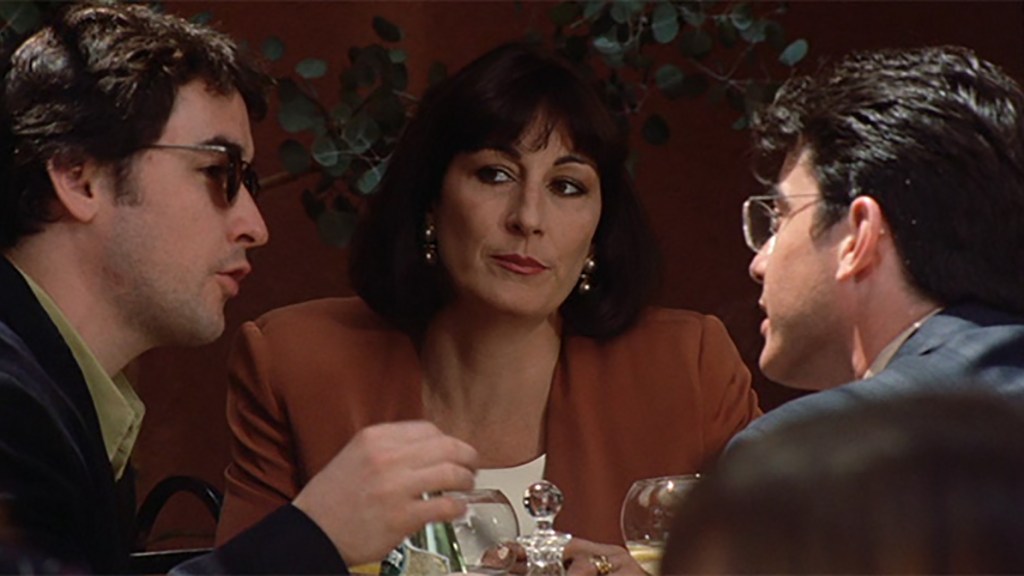
Robert Altman (MASH, Nashville, Vincent & Theo) seems born to direct this savage satire on behind-the-scenes Hollywood movie-making. Tim Robbins plays Griffin Mill, a senior vice president at a major Hollywood studio (the studio’s motto: “Movies—Now More Than Ever!”). He spends his days passing judgment on fawning writers and directors pitching their script ideas (of course, Julia Roberts or Bruce Willis is always very interested in the project), taking power lunches, and worrying that he’s about to be ousted by flavor-of-the-month producer Leonard Levy (Peter Gallagher). Mill is also being stalked by a screenwriter he snubbed months before. When he accidentally kills the suspected stalker, his life begins to unravel. Or does it?

Filled with real-life stars both playing and satirizing themselves (Cher, Anjelica Huston, Burt Reynolds, Lily Tomlin and many others), The Player is the ultimate insider’s look by a couple of disgruntled insiders. Altman and screenwriter Michael Tolkin (who directed last fall’s controversial The Rapture) wield a razor-sharp blade, hacking their way through Hollywood with a feral relish, presenting a world of hilarious nastiness, where no movie concept is too stupid (anyone for The Graduate II?), no principle precious enough to uphold, and murder is just another career move. You’ll never look at a Hollywood production quite the same way again.

— Tod Booth

Tidbits:

  • Cannes Film Festival – 1992 – Winner: Best Actor & Best Director
  • Academy Awards – 1993 – Nominee: Best Director, Best Writing, Screenplay Based on Material Previously Produced or Published & Best Film Editing

Roger Ebert Interview

Courtesy of rogerebert.com:

There is the temptation to write this article from the obvious angle, which is that Robert Altman, the perennial Hollywood maverick and outsider, has skewered the establishment with his savage new comedy named The Player. There would be some truth there.

Altman has never been a happy camper, and The Player shows Hollywood in the 1990s with an unforgiving clarity. All of the insider books you’ve read–the Julia Phillips autobiography, the exposes about David Begelman and Heaven’s Gate and Bonfire and even Michael Milkin — were the words. This is the music.

But there are wheels within wheels, and Altman the outsider is also Altman the industry survivor, who has made most of his films for big studios, who has worked with the top stars (Paul Newman, Warren Beatty, Cher, Robin Williams), and who was as happy as a clam when 20th Century-Fox rented him a yacht at the Cannes Film Festival.

“The reason I’m not exempt from the criticisms in my film,” Altman himself says, “is that I’m a player, too.”

He knows how the game is played. And that is why he has made the most knowledgeable, cynical and unforgiving film about the movie industry since Sunset Boulevard. That is also why his film is funny, suspenseful and entertaining. “Message pictures” close in a week in Hollywood; no matter what you want to say, you’d better make people want to pay money to hear you say it.

Altman’s movie chronicles some time in the life of an upper-level studio executive, played by Tim Robbins (Bull Durham) as a completely self-absorbed cynic who knows no religion except for studio politics. During the course of the film, Robbins finds his job is threatened, he murders a writer, and he engages in corporate infighting, more or less in that order of importance. His character is surrounded by dozens of other players, and Altman has filled the movie with dozens of famous cameo appearances.

Will the movie be too “inside?” Not a chance. In an age when the papers print the box office totals every Monday, when Entertainment Tonight is a daily trade report, when Entertainment Weekly and Premiere read like Variety, the real question is, what took Hollywood so long to make The Player? Moviegoers have been ready for this film for years. “More people can tell you when a picture is over budget,” Altman says, “than can tell you who the director is.”

For Altman, the film’s reception has been sweet revenge. He owned the town in the 1970s, with hits like M*A*S*H and McCabe and Mrs. Miller and Nashville. Then he made a string of movies that were not box office hits, although he winces in pain when he hears Popeye (1980) included in any list of his flops. “That movie made a lot of money,” he says. “It was a hit. Repeat. A hit. It ushered in all of the comic book movies.”

But Popeye was perceived as a flop, and after a decade of big-budget films with big stars, Altman spent the 1980s making small-budget films with small stars, or big stars who were working for scale. Some of them were great films: Secret Honor, for example, with Philip Baker Hall in a one-man performance as Richard Nixon, or Fool for Love, based on the Sam Shepard play. But Altman remained in exile, nursing his projects in Paris and New York, unwanted and increasingly uneasy in Hollywood.

And now comes The Player, based on a novel and screenplay by Michael Tolkin, a writer whose portrait of the way Hollywood treats writers is no doubt based on his own bitter ruminations in the dark of the night.

“At first,” Altman told me, “I thought the movie was a metaphor for Hollywood. Then I realized that Hollywood is a metaphor for the situation in our culture today. Greed is our ruling principal, and Hollywood is just a convenient example of it. Before the movie had even opened anywhere, I’d already received more mail on it than any other movie I’ve ever made. People in the banking business think it’s about banking. People in the newspaper business think it’s about newspapers.”

We were talking one afternoon in his suite at one of those exclusive hotels that overlook Beverly Hills. He seemed a little like a guy who had spent ten years losing his shirt in Vegas, and had just broken the bank.

“I think what happened is, we struck a nerve. The movie is like a march, and everyone wants to join in. It’s like a march on Washington. It stands for the savings and loan debacle, for the Reagan-Bush administration. It’s like we held up a sign saying, ‘Throw the bastards out!'”

When he put out a call for movie stars to come and play themselves, Altman said, “they turned up, 65 of them, with no paranoia, and they all knew exactly what they wanted to say. They were mad. When Burt Reynolds sits in the restaurant and calls everyone an a——, do you think he doesn’t mean it?”

Reynolds may even have been including Altman. “I’m as guilty as anybody else,” he said. “I’m a part of this system I’m satirizing. I play the game, too. I have this ridiculous reputation of being an outsider and a rebel. I don’t know anyone who’s been treated better than I have. John Ford, Howard Hawks…who’s had a better career than I have?”

The fly in the ointment (or, as Altman prefers, “the hair in the butter”) is that Hollywood is still not ready to finance the movies he wants to make. “They see this one, and they say, great! Terrific! What do you want to do? And then, without pausing, they tell me what they want me to do. And when I say, I have this project here–actually, it’s a film based on a group of stories by Raymond Carver–they don’t want to do it. Nothing has changed.”

The problem, Altman said, is that The Player is all too accurate, and what corporate Hollywood thinks about these days is the bottom line. “Two studio heads came right out and said so. Joe Roth at Fox and Brandon Tartikoff at Paramount, both said they were only interested in making pictures that made a lot of money, and don’t have a downside to them. Great. Except they ought to listen to Einstein, who said the train is moving, but so is the station. Their philosophy leads to an endless attempt to make last year’s big hit. What an audience really wants to see is something they’ve never seen before. They respond to The Player because they haven’t seen it before, and they smell the truth in it. It happened with Easy Rider, with MASH, with Close Encounters, with Star Wars. The pictures that really make it, got made by accident.”

Altman twisted the top off a diet soda and settled back and his eyes twinkled. No one looks more avuncular and more conspiratorial at the same time.

“I’ll let you in on something,” he said. “I think the room at the top is empty. There are all these guys in Hollywood who are just below the top, and they take the information, and send it up to the empty room, and it comes back just the same as when they sent it up. There’s not even a bad guy up there. So he can’t even make a good mistake.” What would you do, if you ran a studio?

Altman laughed. “I would never run a studio,” he said. “But when I pick a project, I go by hunches. I use all of the information I can take in, through my sense, my skin, my eyesight, hearing. And when I make that decision, it’s the way I bet on a horse. If everybody at the races bet according to the form, there wouldn’t be any races. And if they keep doing the same thing in Hollywood, there ain’t gonna be any movies.”


Director Bio

“Filmmaking is a chance to live many lifetimes.”

Courtesy of The Criterion Collection:

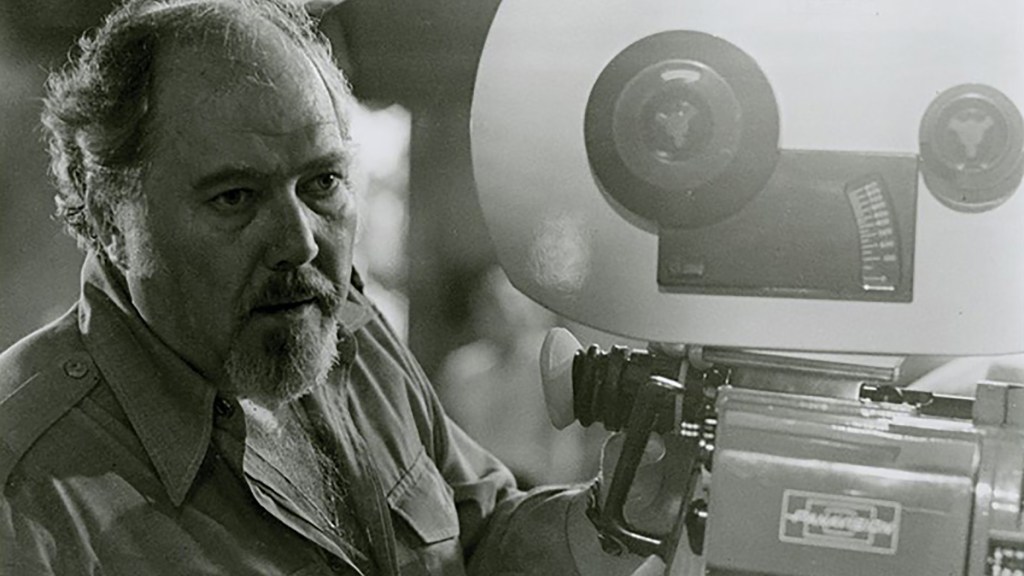
Few directors in recent American film history have gone through as many career ups and downs as Robert Altman did. Following years of television work, the rambunctious midwesterner set out on his own as a feature film director in the late 1950s, but didn’t find his first major success until 1970, with the antiauthoritarian war comedy M*A*S*H. Hoping for another hit just like it, studios hired him in the years that followed, most often receiving difficult, caustic, and subversive revisionist genre films. After the success of 1975’s panoramic American satire Nashville, Altman once again delved into projects that were more challenging, especially the astonishing, complex, Bergman-influenced 3 Women. Thereafter, Altman was out of Hollywood’s good graces, though in the eighties, a decade widely considered his fallow period, he came through with the inventive theater-to-film Nixon monologue Secret Honor and the TV miniseries political satire Tanner ’88. The double punch of The Player and the hugely influential ensemble piece Short Cuts brought him back into the spotlight, and he continued to be prolific in his output into 2006, when his last film, A Prairie Home Companion, was released months before his death at the age of eighty-one.

Filmography:

  • A Prairie Home Companion (2006)
  • The Company (2003)
  • Gosford Park (2001)
  • Dr. T and the Women (2000)
  • Cookie’s Fortune (1999)
  • The Gingerbread Man (1998)
  • Kansas City (1996)
  • Ready to Wear (1994)
  • Short Cuts (1993)
  • The Player (1992)
  • Vincent & Theo (1990)
  • The Caine Mutiny Court-Martial (1988)
  • Aria (1988)
  • O.C. And Stiggs (1987)
  • Beyond Therapy (1987)
  • Fool For Love (1985)
  • Secret Honor (1984)
  • Streamers (1983)
  • Come Back to the 5 & Dime, Jimmy Dean, Jimmy Dean (1982)
  • Popeye (1980)
  • Health (1980)
  • A Perfect Couple (1979)
  • Quintet (1979)
  • A Wedding (1978)
  • 3 Women (1977)
  • Nashville (1975)
  • Thieves Like Us (1974)
  • California Split (1974)
  • The Long Goodbye (1973)
  • images (1972)
  • McCabe & Mrs. Miller (1971)
  • M*A*S*H (1970)
  • Brewster McCloud (1970)
  • That Cold Day in the Park (1969)
  • Countdown (1968)
  • The James Dean Story (1957)
  • The Delinquents (1957)

A Wedding – October 6th, 2016

A Wedding [1978]


Please join us for a special screening of Robert Altman’s A Wedding [1978], newly restored in 4K by Twentieth Century Fox.

  • Screening Date: Thursday, October 6th, 2016 | 7:00pm
  • Venue: Dipson Theatres Amherst
  • Specifications: 1978 / 125 minutes / English / Color
  • Director(s): Robert Altman
  • Print: Supplied by Twentieth Century Fox Film Corporation
  • Tickets: $9.50 general admission at the door

Event Sponsors:

Venue Information:
3500 Main Street, Buffalo, NY 14226


Synopsis

Courtesy of 1978 program notes, one and two:

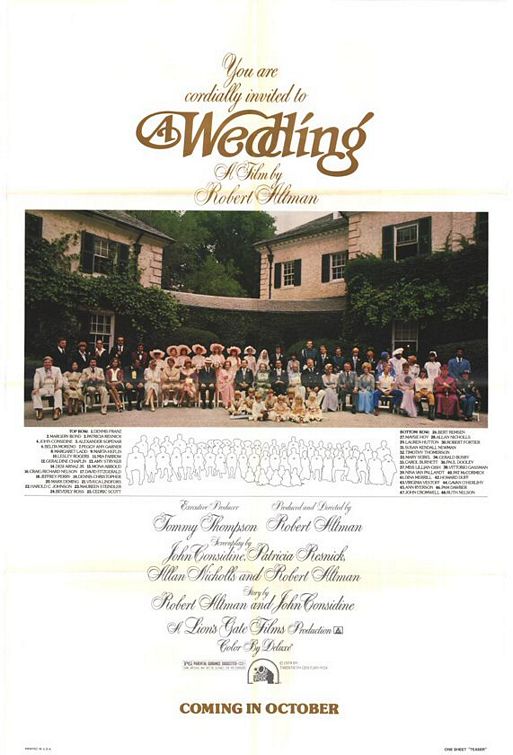
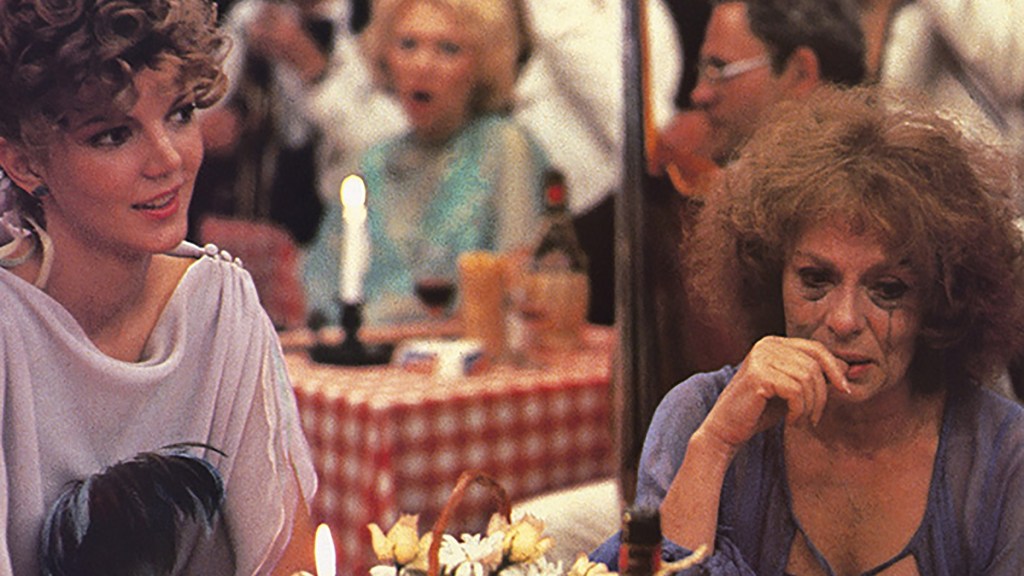
A Wedding. The wedding day of a girl from a new-rich Southern family and a boy from an old-money middlewestern matriarchy is the subject of Robert Altman’s most explosively funny film. But like Renoir’s The Rules of the Game, the tone is both comic and tragic, farcical and melodramatic: in short, like life as we know it (but as we hardly ever see it on the screen) in all its squalor and magnificence.

[It’s] a small-scale Nashville — the setting is a society wedding, not a whole town, but there is the same panoramic view, episodic structure and wry comment on American foibles. In a star-studded cast, Carol Burnett shines as the bride’s mother who enjoys a brief flirtation with a wedding guest, Geraldine Chaplin as the wedding organizer and veteran director John Cromwell as the bumbling bishop performing the ceremony.

Tidbits:

  • New York Film Festival – 1978
  • San Sebastián International Film Festival – 1978 – Winner: Best Actress
  • BAFTA Awards – 1979 – Nominee: Best Direction & Best Screenplay
  • Writers Guild of America – 1979 – Nominee: Best Comedy Written Directly for the Screen
  • César Awards – 1979 – Nominee: Best Foreign Film
  • Golden Globes – 1979 – Nominee: Best Actress in a Supporting Role – Motion Picture

Roger Ebert Interview

Courtesy of rogerebert.com:

CANNES, France — Yes, it was very pleasant. We sat on the stern of Robert Altman’s rented yacht in the Cannes harbor, and looked across at the city and the flags and the hills. There was a scotch and soda with lots of ice, and an efficient young man dressed all in white who came on quiet shoes to fill the glasses when it was necessary.

Altman wore a knit sport shirt with the legend of the Chicago Bears over the left pocket: A souvenir, no doubt, from his trips to Chicago to scout locations for A Wedding. He was in a benign mood, and it was a day to savor.

The night before, his film 3 Women had played as an official entry in the Cannes festival, and had received a genuinely warm standing ovation, the most enthusiastic of the festival. Because his M*A*S*H had won the Grand Prix in 1970, Altman could have shown this film out of competition. But he wasn’t having any: “If you don’t want to be in competition,” he was saying, “that means you’re either too arrogant, or too scared. So you might lose? I’ve lost before; there’s nothing wrong with losing.”

He was, as it turned out, only being halfway prophetic: Three days later the jury would award the Grand Prix to an Italian film, giving 3 Women the best actress award for Shelley Duvall’s performance. But on this afternoon it was still possible to speculate about the grand prize, with the boat rocking gently and nothing on he immediate horizon except, of course, the necessity to be in Chicago in June to begin a $4 million movie with 48 actors, most of whom would be on the set every day for two months.

“I’d be back supervising the preparation,” Altman said, “except I’m lazy. Also, my staff knows what I want better than I do. If I’m there, they feel like they have to check with me, and that only slows them down.” Lauren Hutton drifted down from the upper deck. She’ll play a wedding photographer making a 16-mm documentary film-within-a-film in A Wedding, and Altman’s counting on her character to help keep the other characters straight.

“With 48 people at the wedding party, we have to be sure the audience can tell them apart. The bridesmaids will all be dressed the same, for example. So Lauren will be armed with a book of Polaroids of everybody, as a guide for herself, and we can fall back on her confusion when we think the audience might be confused.”

Fresh drinks arrived. Altman sipped his and found it good. His wife, Kathryn, returning from a tour of the yacht harbor, walked up the gangplank and said she had some calls to make. Altman sipped again. “It’s lovely sitting on this yacht,” he said after a moment. “Beats any hotel in town.”

The boat is called Pakcha? I asked.

“Yeah,” said Altman. “Outta South Hampton. It’s been around the world twice. Got its name in one of those South Sea Islands.

Pakcha is a Pacific dialect word for ‘traveling while businessman.'” He shrugged, as if to say, how can I deny it? He sipped his drink again, and I asked if that story was really true about how he got the idea for A Wedding.

“Yeah, that’s how it came about, all right. We were shooting 3 Women out in the desert, and it was a really hot day and we were in a hotel room that was like a furnace, and I wasn’t feeling too well on account of having felt too well the night before, and this girl was down from L.A. to do some in-depth gossip and asked me what my next movie was going to be. At that moment, I didn’t even feel like doing this movie, so I told her I was gonna shoot a wedding next. A wedding? Yeah, a wedding.

“So a few moments later my production assistant comes up and she says, ‘Bob, did you hear yourself just then?’ Yeah, I say, I did. ‘That’s not a bad idea, is it? She says. Not a bad idea at all, I say; and that night we started on the outline.” 3 Women itself had an equally unlikely genesis, Altman recalled: “I dreamed it. I dreamed of the desert, and these three women, and I remember every once in a while I’d dream that I was waking up and sending out people to scout locations and cast the thing. And when I woke up in the morning, it was like I’d done the picture. What’s more, I liked it. So, what the hell, I decided to do it.”

The movie is about…well, it’s about whatever you think it’s about. Two of the women, the main characters, seem to undergo a mysterious personality transfer in the film’s center, and then they fuse with the third woman to form a new personality altogether.

Some viewers have found it to be an Altman statement on women’s liberation, but he doesn’t see it that way: “For women’s lib or against? Don’t ask me. If I sat here and said the film was about X, Y and Z, that restricts the audience to finding the film within my boundaries. I want them to go outside to bring themselves to the film. What they find there will be at least as interesting as what I did…

“And I kept on discovering things in the film right up to the final edit. The film begins, for example, with Sissy Spacek wandering in out of the desert and meeting Shelley Duvall and getting the job in the rehabilitation center. And when I was looking at the end of the film during the editing process, it occurred to me that when you see that final exterior shot of the house, and the dialog asks the Sissy Spacek character to get the sewing basket — well, she could just walk right out of the house and go to California and walk in at the beginning of the movie, and it would be perfectly circular and even make sense that way. But that’s only one way to read it.”

Altman said he’s constantly amazed by the things he reads about his films in reviews. “Sometimes,” he said, “I think the critics take their lead from the statements directors themselves make about their films. There was an astonishing review in Newsweek by Jack Kroll, for example, of Fellini’s Casanova. It made no sense at all, in terms of the film itself. But then I read something Fellini had said about the film, and I think Kroll was simply finding in the film what Fellini said he put there.

“With 3 Women, now, a lot of the reviews go on and on about the supposed Jungian implications of the relationships. If you ask me to give a child’s simplified difference between Jung and Freud, I couldn’t. It’s just a field I know nothing about. But the name of Jung turns up in the production notes that were written for the press kit, and there you are.”

The problem, he said, is that people insist on getting everything straight. On having movies make sense, and on being provided with a key for unlocking complex movies.

“It’s the weirdest thing. We’re willing to accept anything, absolutely anything, in real life. But we demand order from our fantasies. Instead of just going along with them and saying, yeah, that’s right, it’s a fantasy and it doesn’t make sense. Once you figure out a fantasy, it may be more satisfying but it’s less fun.”

For reasons having something to do with that, he said, he likes to take chances on his films: “Every film should be different, and get into a different area, and have its own look. I’d hate to start repeating myself. I have this thing I call a fear quotient. The more afraid I am, going in, the better the picture is likely to be.” A pause.

“And on that basis, A Wedding is going to be my best picture yet. “I like to allow for accidents, for happy occurrences and mistakes. That’s why I don’t plan too carefully, and whey we’re going to use two cameras and shoot 500,000 feet of film on A Wedding. Sometimes you don’t know yourself what’s going to work. I think a problem with some of the younger directors, who were all but raised on film, is that their film grammar has become too rigid. Their work is inspired more by other films than by life.

“That happened to Godard, and to Friedkin it may be happening. To Bogdanovich without any doubt. He has all these millions of dollars and all these great technicians, and he tells them what he wants and they give it to him. Problem is, maybe when he gets it, it turns out he didn’t really want it after all, but he’s stuck with it.”

Altman has rarely had budgets large enough to afford such freedom, if freedom’s the word. Although he’s had only one smash hit, M*A*S*H, he keeps working and remains prolific because his films are budgeted reasonably and brought in on time. 3 Women, for example, is a challenging film that may not find enormous audiences, but at $1.6 million it will likely turn a profit.

“I made a deal with the studio,” he said, “if we go over budget, I pay the difference. If we stay under, I keep the change. On that one, we came in about $100,000 under budget, which certainly wasn’t enough to meet much of the overhead of keeping this whole organization going…but then of course you hope the film goes into profit.”

He always makes a film believing it will be enormously profitable, he said: “When I’m finished, I can’t see any way that millions of people won’t want to see what I’ve done. With The Long Goodbye, for example, we thought we had a monster hit on our hands. With Nashville, my second biggest grossing film, we did have a hit, but it was oversold. Paramount was so convinced they were going through the sky on that film that they spent so damned much money promoting it that they may never break even. It grossed $16 million, which was very good considering its budget, but they thought it would top $40 million, and they were wrong.”

But, of course, A Wedding, will be a monster hit? “I really hope so. If things work out the way I anticipate they will, it will certainly be my funniest film. I mean really funny. But then funny things happen every day.”

The man in white came on quiet shoes, and there was another scotch and soda where the old one had been. Altman obviously had a funny example in mind. “I had this lady interviewer following me around,” he said. “More of that in-depth crap. She was convinced that life with Altman was a never-ending round of orgies and excess. She was even snooping around in my hotel bathroom, for Christ’s sake, and she found this jar of funny white powder in the medicine cabinet. Aha! she thinks. Cocaine! So she snorts some. Unfortunately, what she didn’t know was that I’m allergic to commercial toothpaste because the dentine in it makes me break out in a rash. So my wife mixes up baking soda and salt for me, and — poor girl.”

He lifted his glass and mutely toasted her, and Cannes, and whatever.

photos courtesy of Splendor Films.


Director Bio

“Filmmaking is a chance to live many lifetimes.”

Courtesy of The Criterion Collection:

Few directors in recent American film history have gone through as many career ups and downs as Robert Altman did. Following years of television work, the rambunctious midwesterner set out on his own as a feature film director in the late 1950s, but didn’t find his first major success until 1970, with the antiauthoritarian war comedy M*A*S*H. Hoping for another hit just like it, studios hired him in the years that followed, most often receiving difficult, caustic, and subversive revisionist genre films. After the success of 1975’s panoramic American satire Nashville, Altman once again delved into projects that were more challenging, especially the astonishing, complex, Bergman-influenced 3 Women. Thereafter, Altman was out of Hollywood’s good graces, though in the eighties, a decade widely considered his fallow period, he came through with the inventive theater-to-film Nixon monologue Secret Honor and the TV miniseries political satire Tanner ’88. The double punch of The Player and the hugely influential ensemble piece Short Cuts brought him back into the spotlight, and he continued to be prolific in his output into 2006, when his last film, A Prairie Home Companion, was released months before his death at the age of eighty-one.

Filmography:

  • A Prairie Home Companion (2006)
  • The Company (2003)
  • Gosford Park (2001)
  • Dr. T and the Women (2000)
  • Cookie’s Fortune (1999)
  • The Gingerbread Man (1998)
  • Kansas City (1996)
  • Ready to Wear (1994)
  • Short Cuts (1993)
  • The Player (1992)
  • Vincent & Theo (1990)
  • The Caine Mutiny Court-Martial (1988)
  • Aria (1988)
  • O.C. And Stiggs (1987)
  • Beyond Therapy (1987)
  • Fool For Love (1985)
  • Secret Honor (1984)
  • Streamers (1983)
  • Come Back to the 5 & Dime, Jimmy Dean, Jimmy Dean (1982)
  • Popeye (1980)
  • Health (1980)
  • A Perfect Couple (1979)
  • Quintet (1979)
  • A Wedding (1978)
  • 3 Women (1977)
  • Nashville (1975)
  • Thieves Like Us (1974)
  • California Split (1974)
  • The Long Goodbye (1973)
  • images (1972)
  • McCabe & Mrs. Miller (1971)
  • M*A*S*H (1970)
  • Brewster McCloud (1970)
  • That Cold Day in the Park (1969)
  • Countdown (1968)
  • The James Dean Story (1957)
  • The Delinquents (1957)

Links

Here is a curated selection of links shared on our Facebook page for additional insight/information:

  • 9/20/16 – “The staging of the action is as exhilarating as ever, and there are glorious moments in the twisted, kaleidoscopic narrative.”
    Geoff Andrew, Time Out New York
  • 9/30/16 – Guess who Robert Altman and 20th Century Fox have invited to A Wedding? – 1978 TV Trailer
  • 10/06/16 – Not a pull quote to be found, but a solid critical look at A Wedding by Jonathan Rosenbaum none-the-less – link
  • 10/29/16 – Need a beginner’s guide to the work of Robert Altman? Look no further than Noel Murray’s in-depth intro over at The A.V. Club! – link
  • 11/22/16 – On Friday (11/25/16), in honor of the 10th anniversary of his death, the BFI published Geoff Andrew’s must read intro to the wild and woolly world of director Robert Altman. – link
  • 11/29/16 – Must read for Robert Altman fans – Stephen Lemons’ gushing career overview for Salon – link