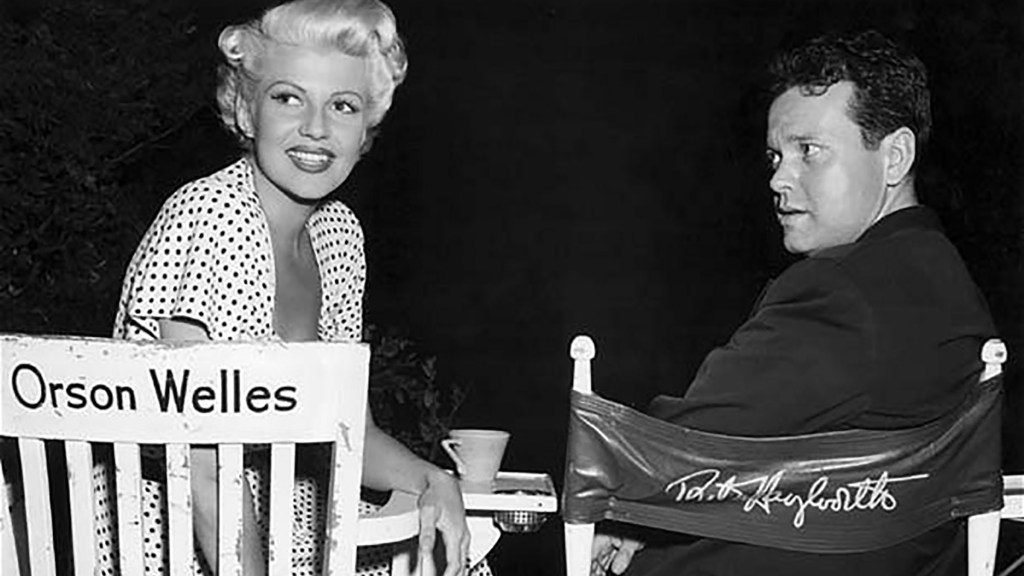
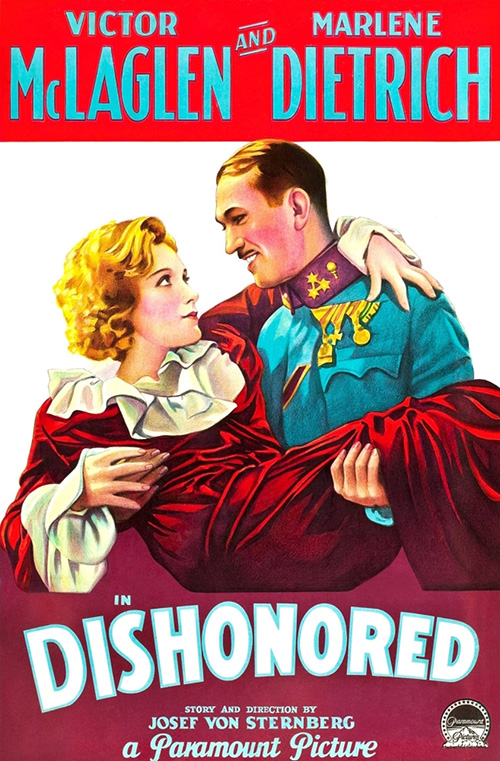
Dishonored – November 20th, 2021

Dishonored [1931]


Please join Cultivate Cinema Circle as we screen Josef von Sternberg and Marlene Dietrich’s film Dishonored [1931].


Event Sponsors:

Venue Information:

Downtown Central Library Auditorium
1 Lafayette Square, Buffalo, NY 14203
(Enter from Clinton Street between Oak and Washington Streets)
716-858-8900 • www.BuffaloLib.org
COVID protocol will be followed.


Synopsis

Marlene Dietrich as an Austrian spy in a bizarre World War I story, notable for Josef von Sternberg’s stylish direction. Colonel: Victor McLaglen. Von Hindau: Warner Oland. Lieutenant: Barry Norton. Secret Service Head: Gustav von Seyffertitz. Kovrin: Lew Cody. Interesting cast.

Tidbits:

  • National Board of Review – 1931 – Top Ten Films

Actor Bio

This image has an empty alt attribute; its file name is marlenedietrich-1024x576.jpg

“I had no desire to be an film actress, to always play somebody else, to be always beautiful with somebody constantly straightening out your every eyelash. It was always a big bother to me.”

Courtesy of TCM:

Arguably one of the most beautiful women ever to grace the silver screen, actress Marlene Dietrich utilized her cat-shaped eyes, high cheekbones, and halo of blonde curls to capture the imagination of fans both male and female. At once alluring and sexy, Dietrich projected a curious androgyny by casting off societal mores and sometimes dressing as man, wearing trousers, vests and ties. She received her start in her native Germany working as a chorus girl and later performer in silent films, where she caught the attention of director Josef von Sternberg, who became both mentor and lover. It was von Sternberg who introduced Dietrich to America in “Morocco” (1930), a bold and rather scandalous debut that featured the actress dressed in a man’s tuxedo and kissing another woman. She went on to star in a number of hit movies with von Sternberg, including “Shanghai Express” (1932) and “The Scarlett Empress” (1934), before the two broke off their professional and personal relationship. Though one of the highest paid actresses of her day, Dietrich nonetheless made a series of flops like “Angel” (1937) and “Knight Without Armor” (1937) that tagged her as box office poison. Meanwhile, she became actively involved in selling war bonds and performing for the troops during World War II. Dietrich’s film career wound down in the 1950s following noted performances in “Witness for the Prosecution” (1957), “Touch of Evil” (1958) and “Judgment at Nuremberg” (1961). During this time, she found second life as a stage performer who sold-out houses the world over. But a series of injuries suffered in the mid-1970s forced her retirement while raising charges that she was battling alcoholism. Though she remained in seclusion for the rest of her days, Dietrich left behind a legacy as an alluring screen goddess whose sensual, yet mysterious persona embodied the true definition of movie star.

Born on Dec. 27, 1901 in Schöneberg, Germany, Dietrich was raised with her sister, Elizabeth, in Berlin and Dressau by her father, Louis, a policeman, and her mother, Wilhelmina, a jeweler’s daughter. After her father’s death in 1907, her mother remarried his best friend, Edouard von Losch, who later died on the battlefield in World War I. As a child, Dietrich showed promise as a violinist, attending the Hochschule fur Musik following her attendance in all-girls schools for her primary education. But her dreams of becoming a concert violinist were cut short after she suffered a wrist injury. Luckily she was also interested in theater and dance, which led to auditioning for famed stage impresario Max Reinhardt’s school in Berlin, though she failed to earn a place on her first try. Eventually, Dietrich was accepted, but in the meantime she made her stage debut as a chorus girl in 1921. The following year, she made her first film, “So Sind die Manner” (“The Little Napoleon”) and landed her first lead, opposite William Dieterle in his directorial debut, “Der Mensche am Wege” (“Man by the Roadside”) (1923). It was while working on “Tragödie der Liebe” (“Love Tragedy”) (1923) that Dietrich met actor Rudolf Sieberwhich, whom she married later that year. The two had their only child, Maria Sieberwhich – who later changed her name to Maria Riva – in 1924.

Dietrich continued to appear in German films, including the Alexander Korda-directed “Eine DuBarry von Heute” (“A Modern Dubarry”) (1926) and “Madame Wunscht keine Kinder” (“Madame Wants No Children”) (1926). But despite being married, Dietrich engaged in a seemingly endless string of affairs with both men and women throughout her life. One of the earliest and most beneficial was with Austrian filmmaker, Josef von Sternberg, who had established himself in Hollywood and returned to Germany at the suggestion of actor Emil Jannings to make the country’s first sound feature, “Der Blaue Engel” (“The Blue Angel”) (1929). Casting the lead role of the sexy cabaret star Lola Lola, who could drive men to the most extreme humiliations in the name of love, proved to be a challenge for von Sternberg until he met Dietrich. If ever an actress and a role were right for one another, this was it. But her screen test failed to impress those working for the director, who dismissed her as commonplace. With the cameras rolling, however, there was nothing common about Dietrich, which von Sternberg recognized immediately and prompted a multi-film collaboration that brought out the best in both actress and director. Meanwhile, “Die Blaue Engel” was an international success and led Paramount Pictures to offer Dietrich a contract in the hopes the actress would be their answer to MGM’s great import, Greta Garbo. By the spring of 1930, she arrived in Hollywood.

The first U.S. film between Dietrich and von Sternberg was “Morocco” (1930), a bold debut that featured the actress as cabaret singer Amy Jolly, an independent woman who dressed as a man, locked lips with a woman and referred to her leading man (Gary Cooper) as her girlfriend. Showcasing the actress’ smoldering charisma, made more striking by von Sternberg’s dark-shadowed lighting that brought out her simultaneously alluring and androgynous qualities, “Morocco” was a hit for the studio, netting some $2 million in revenue while firmly establishing Dietrich as an overnight star. The role also earned the actress her only Academy Award nomination of her career. Over the next five years, director and star worked together on what may have been one of the more intriguing collaborations of the Golden Age. Each of their films was manufactured in the studio, despite being set in foreign lands. Von Sternberg, however, used light and shadow to paint visual poetry and conjure an image of a leading lady that was at once alluring and scathing. Whether it was playing a spy dressed in black leather in “Dishonored” (1931) or the glamorous lady of the evening in “Shanghai Express” (1932) or Russian monarch Catherine the Great in “The Scarlett Empress” (1934), Dietrich projected an ineffable allure that turned her into one of the biggest stars of her day. Cultivating a dual appeal, her sultry come-hither eyes basked in heavy makeup and shadow drew in the men, while her penchant for wearing more masculine clothes, including slacks, blazers and ties, made her a hit with women itching for liberation of that kind.

With “The Devil Is a Woman” (1935), a controversial box office flop criticized for its apparent denigration of Spanish people, Dietrich and von Sternberg worked together for the last time. Meanwhile, the delightful Ernst Lubitsch-directed romantic comedy “Desire” (1936) proved a hit and solidified her status as the highest-paid actress in Hollywood before fellow Paramount contract player Carole Lombard usurped her a year later. Dietrich made a smooth segue into her first Technicolor movie, “The Garden of Allah” (1937), a romantic melodrama starring Charles Boyer and produced by David O. Selznick. But her next couple of films, “Angel” (1937) and the notoriously expensive flop “Knight without Armor” (1937), earned the tag of box office poison and led Paramount to buy out the remainder of her contract. Defying the pundits, Dietrich roared back with one of her best performances as the saloon entertainer Frenchy who winkingly crowed “See What the Boys in the Back Room Will Have” in the James Stewart Western, “Destry Rides Again” (1939). But it would be Dietrich’s last brush with her former glamorous glory, which waned in the years prior to World War II despite the actress continuing to make movies. By this time, Dietrich was prolifically engaged in many affairs with famous men and women. Among the many conquests she indulged in over the years were the likes of Gary Cooper, John Wayne, German cabaret singer Margo Lion, George Bernard Shaw, female speedboat racer Marion Carstairs, Yul Brynner, Cuban writer Mercedes de Acosta and President John F. Kennedy. While some affairs lasted decades, others were perfunctory. But almost all were committed while she remained married to Sieberwhich, though the two were long separated by the time of his death in 1976.

Though on top once again, Dietrich – who was put under contract by Universal – made a number of lackluster films, including “Seven Sinners” (1940) and “Pittsburgh” (1942) opposite John Wayne, “Manpower” (1941) with Edward G. Robinson, and “The Lady is Willing” (1942), screwball comedy starring Fred MacMurray. But while her career was flagging, Dietrich was actively involved on the home front with the war effort. A virulent anti-Nazi – reportedly she was disgusted to learn that Adolf Hitler considered her his favorite actress – Dietrich went above and beyond the call of duty, becoming one of the first celebrities to raise war bonds – she went on to sell more than any other star – while going on extended USO tours in 1944-45. Meanwhile, she participated in a series of propaganda broadcasts for the radio that were meant to demoralize enemy troops. When all was done and told, few could point to another celebrity outside of Bob Hope who did more for the boys at war. In 1947, Dietrich was awarded the Presidential Medal of Freedom for her efforts, which she considered to be her proudest moment. Following the war, she co-starred opposite Jean Gabin in the unspectacular French crime film “Martin Roumagnac” (1946) before turning in an amusing turn as a gypsy in “Golden Earrings” (1946).

Dietrich went on to deliver an underappreciated performance as a wisecracking and cynical ex-Nazi chanteuse in the Billy Wilder-directed comedy “A Foreign Affair” (1948), one of the director’s more forgotten films. Although she was still a star, Dietrich had become known as “the world’s most glamorous grandmother” after her daughter Maria Riva gave birth. Hollywood has never quite known what to do with actresses of a certain age, particularly those whose careers were based on their looks. Unlike her former rival Garbo, who retired in 1941, Dietrich continued to work despite her reputation as difficult. Still commanding hefty paychecks, she appeared in a variety of projects, most notably Alfred Hitchcock’s “Stage Fright” (1950) and Fritz Lang’s “Rancho Notorious” (1952). But when Tinseltown failed to provide consistent work, Dietrich turned to the concert stage, spending four years in the mid-‘50s on tour in venues as diverse as Las Vegas hotels and London nightclubs. In fact, her primary source of income came from a long string of stage performances that she continued well into the 1970s, with every increasingly limited onscreen appearances. Her act – which was honed with composer Burt Bacharach – consisted of some of her popular songs, which were sung while wearing elegant gowns, while for the second half of her performance, she would wear a top hat and tails, and sing songs often associated with men.

Despite being a stage sensation, Dietrich appeared sporadically on screen, becoming one of the many performers who made cameo appearances in the Oscar-winning Best Picture “Around the World in 80 Days” (1956). But her film work was questionable at best, as demonstrated with the rather unimpressive Italian comedy-drama, “The Monte Carlo Story” (1957). Dietrich did offer a nice turn as the stylish title character in “Witness for the Prosecution” (1957), a courtroom drama directed by Billy Wilder that was widely considered one of his best films. She was also terrific in a small role as the fortune-telling brothel madam who advises corrupt cop Hank Quinlan (Orson Welles) that his future was all used up in the director’s film noir classic “Touch of Evil” (1958). Meanwhile, director Stanley Kramer tapped her to portray the widow of a German officer in another superb courtroom drama, “Judgment at Nuremberg” (1961), which marked the end of a mini-resurgence that offered audiences a last glimpse of the actress in top form. Aside from a cameo appearance as herself in the Audrey Hepburn romantic comedy, “Paris When It Sizzles” (1964), Dietrich failed to grace the screen again until her final appearances in the German-made romance “Just a Gigolo” (1978).

For much of the 1960s and 1970s, Dietrich headlined concert performances around the world, playing everywhere from Moscow to Jerusalem, where she broke the social taboo of singing songs in German while in Israel. In 1960, her tour of Germany met with some derision from her former countrymen who felt that Dietrich had betrayed them during the war. Later in the decade, she enjoyed a spectacular run on Broadway in 1967 and even earned a Special Tony Award for her performance the following year. The show was later recreated for the television special “Marlene Dietrich: I Wish You Love” (CBS, 1973). It was during this time that her health began to deteriorate, exacerbated by increased use of alcohol and painkillers to ease the pain caused by injury. In 1973, Dietrich required skin grafts after falling off the stage in Washington, D.C., while the following year she fractured her leg. During a performance in Australia in 1975, Dietrich fell off the stage and broke her leg, forcing her to retire. Meanwhile, in 1984, Maximilian Schell – who starred with Dietrich in “Judgment at Nuremberg” – made the fascinating documentary “Marlene,” in which the actress refused to be photographed, though she consented to recorded interviews. By this time, she was living in virtual seclusion in the Paris apartment where she died on May 6, 1992 at the age of 90.

Filmography:

  • Entertaining the Troops (1989)
  • Going Hollywood: The War Years (1988)
  • Marlene (1984)
  • Just a Gigolo (1978)
  • Paris When It Sizzles (1964)
  • Black Fox (1962)
  • Judgment at Nuremberg (1961)
  • Touch of Evil (1958)
  • The Monte Carlo Story (1957)
  • Witness for the Prosecution (1957)
  • Around the World in 80 Days (1956)
  • Rancho Notorious (1952)
  • No Highway in the Sky (1951)
  • Stage Fright (1950)
  • Jigsaw (1949)
  • A Foreign Affair (1948)
  • Golden Earrings (1947)
  • Martin Roumagnac (1946)
  • Kismet (1944)
  • Follow the Boys (1944)
  • The Lady Is Willing (1942)
  • Pittsburgh (1942)
  • The Spoilers (1942)
  • Manpower (1941)
  • The Flame of New Orleans (1941)
  • Seven Sinners (1940)
  • Destry Rides Again (1939)
  • Knight Without Armor (1937)
  • Angel (1937)
  • Desire (1936)
  • The Garden of Allah (1936)
  • I Loved a Soldier (1936)
  • The Devil Is a Woman (1935)
  • The Scarlet Empress (1934)
  • The Song of Songs (1933)
  • Shanghai Express (1932)
  • Blonde Venus (1932)
  • Dishonored (1931)
  • Morocco (1930)
  • The Blue Angel (1930)
  • Das Schiff der Verlorenen Menschen (1929)
  • Die Frau Nach der Man Sich Sehnt (1929)
  • Prinzessin Olala (1928)
  • Ich kusse ihre Hand, Madame (1928)
  • Cafe Electric (1927)
  • Manon Lescaut (1926)
  • Madame Wunscht keine Kinder (1926)
  • The Joyless Street (1925)
  • Der Mensch Am Wege (1923)
  • Tragodie der Liebe (1923)

Director Bio

“I care nothing about the story, only how it is photographed and presented.”

Courtesy of TCM:

Once considered one of Hollywood’s premier directors during the 1930s, Josef von Sternberg was mainly remembered for his seven films with German actress Marlene Dietrich. But his main contributions were actually to the language of film, particularly his handling of lighting and mise-en-scene. Von Sternberg was first and foremost a master cinematographer whose expressionistic use of light and dark created stunning visuals onscreen that took on a life of their own. He made his mark as a director during the silent era with “The Salvation Hunters” (1925), “Underworld” (1927) and “The Last Command” (1928). Following the failure of “Thunderbolt” (1929), von Sternberg went back to Germany and cast the then-unknown Marlene Dietrich in “The Blue Angel” (1930), which he shot concurrently in English and in his native tongue. The film turned Dietrich into an international star, and with the exotic actress as his muse, rejuvenated his Hollywood career. Von Sternberg directed Dietrich in six more films, most notably “Morocco” (1930), “Blonde Venus” (1932), “The Shanghai Express” (1932) and “The Scarlett Empress” (1934). But once “The Devil is a Woman” (1935) failed at the box office, von Sternberg’s collaboration with Dietrich was over. While he directed a few more films like “Crime and Punishment” (1935) and “The Shanghai Gesture” (1941), von Sternberg’s career diminished. Despite the rather quiet end to his days as a director, von Sternberg’s influence and reputation as the ultimate Svengali remained consequential for generations of filmmakers.

Born on May 29, 1894 in Vienna, Austria, von Sternberg was raised by his father, Moses, a former soldier in the Austrian-Hungarian army who made his way to America was his son was three, and his mother, Serafin. In 1901, his father sent for the family after obtaining work and von Sternberg lived for a time in New York, before going back to Vienna. In 1908, he returned to the States, this time for good, and grew up on Long Island, where he worked as an apprentice at his aunt’s millinery store and as a stock clerk for a lace store. After dropping out of Jamaica High School, von Sternberg found work cleaning and repairing movie prints at the World Film Company in Fort Lee, NJ, where he rose to chief assistant to the director general. He went on to help make training films for the U.S. Army Signal Corps before earning his first credit as an assistant director on “The Mystery of the Yellow Ribbon” (1919), directed by Emile Chautard. In 1923, he moved to Hollywood and was the assistant director on “By Divine Right” (1923), before marking his debut as a director on “The Salvation Hunters” (1925), a successful picture widely considered to be America’s first true independent film.

After joining Paramount Pictures as an assistant director, von Sternberg returned to directing his own films, making pictures like “Exquisite Sinner” (1926), “Underworld” (1927) and “The Last Command” (1928), which starred the great German actor Emil Jannings. It was Jannings who recommended that von Sternberg return to Europe to direct the film version of Heinrich Mann’s “The Blue Angel” (1930). Casting the lead role of the sexy cabaret star Lola Lola, who could drive men to the most extreme humiliations in the name of love, proved to be a challenge for von Sternberg until he met Marlene Dietrich. If ever an actress and a role were right for one another, this was it. But her screen test failed to impress those working for the director, who dismissed her as commonplace. With the cameras rolling, however, there was nothing common about Dietrich – particularly when she sang “Falling in Love Again” to a smitten Jannings – which von Sternberg recognized immediately and which prompted a multi-film collaboration that brought out the best in both actress and director. Though some would claim he would later exert too much of a Svengali-like influence over both her film roles and her personal life. Meanwhile, “Die Blaue Engel” was an international success and helped rejuvenate von Sternberg’s Hollywood career, which faltered after the failure of “Thunderbolt” (1929).

The first U.S. film between von Sternberg and Dietrich was “Morocco” (1930), a bold debut that featured her as cabaret singer Amy Jolly, an independent woman who dressed as a man, locked lips with a woman and referred to her leading man (Gary Cooper) as her girlfriend. Showcasing the actress’ smoldering charisma, made more striking by von Sternberg’s dark-shadowed lighting that brought out her simultaneously alluring and androgynous qualities, “Morocco” was a hit for the studio, netting some $2 million in revenue. Over the next five years, director and star worked together on what may have been one of the more intriguing collaborations of the Golden Age. Each of their films was manufactured in the studio, despite being set in foreign lands. Von Sternberg, however, used light and shadow to paint visual poetry and conjure an image of a leading lady that was at once beautiful and scathing. Whether casting his actress as a spy dressed in black leather in “Dishonored” (1931) or the glamorous lady of the evening in “Shanghai Express” (1932) or Russian monarch Catherine the Great in “The Scarlett Empress” (1934), von Sternberg shaped Dietrich’s ineffable allure that turned her into one of the biggest stars of her day. But with “The Devil Is a Woman” (1935), a controversial box office flop criticized for its apparent denigration of Spanish people, von Sternberg and Dietrich worked together for the last time.

During his post-Dietrich era, von Sternberg directed a handful of projects before his career went into permanent decline. He directed an adaptation of Fyodor Dostoevsky’s “Crime and Punishment” (1935) before launching an attempt to helm “I, Claudius” in 1937, which remained unfinished due to problems with financial backers. After “Sergeant Madden” (1939), starring Wallace Beery, he directed “The Shanghai Gesture” (1941), a delightfully dark film noir of suspense and exoticism in which Gene Tierney, Ona Munson, and Victor Mature together assume the Dietrich persona in this exploration of the denizens of a lurid Shanghai gambling house. It would be another 11 years before he directed his next film, “Macao” (1952), a financial disaster that turned out to be the last he made for Hollywood. He went on to help the Japanese-made war film, “The Saga of Anatahan” (1952), a poetic study of Japanese soldiers isolated on an island at the end of WWII, which the director later cited as his favorite work. Meanwhile, he was one of several directors to work on Howard Hughes’ “Jet Pilot” (1957), which starred John Wayne and took four painful years to make. In 1959, von Sternberg began teaching film courses at the University of California, Los Angeles, where two of his students turned out to be Jim Morrison and Ray Manzarek of The Doors. Manzarek later cited von Sternberg as the greatest influence on the band and their music. He left his post at UCLA in 1963 and died six years later on Dec. 22, 1969 of a heart attack. He was 75 years old.

Filmography:

  • The Epic That Never Was (I, Claudius) (1965)
  • Jet Pilot (1957)
  • Macao (1952)
  • Anatahan (1952)
  • The Shanghai Gesture (1942)
  • I Take This Woman (1940)
  • Sergeant Madden (1939)
  • I, Claudius (1937)
  • The King Steps Out (1936)
  • Crime and Punishment (1935)
  • The Devil Is a Woman (1935)
  • The Scarlet Empress (1934)
  • Shanghai Express (1932)
  • Blonde Venus (1932)
  • Dishonored (1931)
  • An American Tragedy (1931)
  • Morocco (1930)
  • The Blue Angel (1930)
  • Thunderbolt (1929)
  • The Case of Lena Smith (1929)
  • The Dragnet (1928)
  • The Docks of New York (1928)
  • The Last Command (1928)
  • Underworld (1927)
  • A Woman of the Sea (1926)
  • The Exquisite Sinner (1926)
  • The Masked Bride (1925)
  • Salvation Hunters (1925)

Links

Here is a curated selection of links for additional insight/information:

  • Cultivate Cinema Circle info-sheet – link
  • “The rise of the great movie stars is almost always a story of collaboration with great directors. The film career of Marlene Dietrich burst into enduring prominence in 1930, with Josef von Sternberg’s The Blue Angel, and they made six more films together, including Dishonored, from 1931, in which Dietrich’s onscreen persona became refined to a degree of breathtaking precision, and expanded to a historical—even a philosophical—scope. Dishonored, set during the First World War, is a story of danger and death; it’s a war film in which the crucial battles are psychological ones that are fought in back rooms. Dietrich plays a spy, or, rather, a prostitute who becomes a spy—Agent X-27, to be specific; she boldly and slyly uses her powers of seduction to expose enemy spies and extract their secrets. It’s also a sort of musical, in which Dietrich deploys the music-hall artistry that’s essential to The Blue Angel and gives it a deliriously political angle.” – Richard Brody, The New Yorker [2017] – link
  • “Film is a collaborative medium, or so people say, unless by ‘people’ we mean Josef von Sternberg. To become a director is, more often than not, to reveal yourself as a control freak, but von Sternberg was the original micromanager, and his arrogance was legendary. Even long after his career was over, he was reluctant to discuss colleagues. Screenwriter Jules Furthman was responsible for much of the script of Shanghai Express, but von Sternberg always maintained that the entire treatment was one page written by story creator Harry Hervey. Von Sternberg biographer John Baxter cites the gifted Paramount art director Hans Dreier as a major stylistic influence, taking the director from a realistic approach to the “veiled sensuality” he would develop over the course of his career—and adds drily, ‘It goes without saying that [Dreier] receives no mention in Fun in a Chinese Laundry,’ von Sternberg’s notoriously cranky memoir…As von Sternberg’s vision grew and expanded, so did Dreier’s, to include things like the vast courtyard in which X-27 breathes her last in Dishonored. Its walls are so tall they seem to belong to Mad King Ludwig’s castle, and the bricks are also enormous and sculpted, the better to contrast with the slender beauty facing the firing squad.” – Farran Smith Nehme, Current [2018] – link

Morocco – November 6th, 2021

Morocco [1930]


Please join Cultivate Cinema Circle as we screen Josef von Sternberg and Marlene Dietrich’s Oscar nominated (Best Actress, Director, Cinematography & Art Direction) film Morocco [1930].


Event Sponsors:

Venue Information:

Downtown Central Library Auditorium
1 Lafayette Square, Buffalo, NY 14203
(Enter from Clinton Street between Oak and Washington Streets)
716-858-8900 • www.BuffaloLib.org
COVID protocol will be followed.


Synopsis

Romance between a legionnaire and a trollop. Marlene Dietrich, Gary Cooper, Adolphe Menjou, Ulrich Haupt, Juliette Compton.

Tidbits:

  • Academy Awards – 1931 – Nominee: Best Actress in a Leading Role, Best Director, Best Cinematography & Best Art Direction
  • National Board of Review – 1930 – Top Ten Films
  • National Film Preservation Board – 1992 – National Film Registry

Actor Bio

“I had no desire to be an film actress, to always play somebody else, to be always beautiful with somebody constantly straightening out your every eyelash. It was always a big bother to me.”

Courtesy of TCM:

Arguably one of the most beautiful women ever to grace the silver screen, actress Marlene Dietrich utilized her cat-shaped eyes, high cheekbones, and halo of blonde curls to capture the imagination of fans both male and female. At once alluring and sexy, Dietrich projected a curious androgyny by casting off societal mores and sometimes dressing as man, wearing trousers, vests and ties. She received her start in her native Germany working as a chorus girl and later performer in silent films, where she caught the attention of director Josef von Sternberg, who became both mentor and lover. It was von Sternberg who introduced Dietrich to America in “Morocco” (1930), a bold and rather scandalous debut that featured the actress dressed in a man’s tuxedo and kissing another woman. She went on to star in a number of hit movies with von Sternberg, including “Shanghai Express” (1932) and “The Scarlett Empress” (1934), before the two broke off their professional and personal relationship. Though one of the highest paid actresses of her day, Dietrich nonetheless made a series of flops like “Angel” (1937) and “Knight Without Armor” (1937) that tagged her as box office poison. Meanwhile, she became actively involved in selling war bonds and performing for the troops during World War II. Dietrich’s film career wound down in the 1950s following noted performances in “Witness for the Prosecution” (1957), “Touch of Evil” (1958) and “Judgment at Nuremberg” (1961). During this time, she found second life as a stage performer who sold-out houses the world over. But a series of injuries suffered in the mid-1970s forced her retirement while raising charges that she was battling alcoholism. Though she remained in seclusion for the rest of her days, Dietrich left behind a legacy as an alluring screen goddess whose sensual, yet mysterious persona embodied the true definition of movie star.

Born on Dec. 27, 1901 in Schöneberg, Germany, Dietrich was raised with her sister, Elizabeth, in Berlin and Dressau by her father, Louis, a policeman, and her mother, Wilhelmina, a jeweler’s daughter. After her father’s death in 1907, her mother remarried his best friend, Edouard von Losch, who later died on the battlefield in World War I. As a child, Dietrich showed promise as a violinist, attending the Hochschule fur Musik following her attendance in all-girls schools for her primary education. But her dreams of becoming a concert violinist were cut short after she suffered a wrist injury. Luckily she was also interested in theater and dance, which led to auditioning for famed stage impresario Max Reinhardt’s school in Berlin, though she failed to earn a place on her first try. Eventually, Dietrich was accepted, but in the meantime she made her stage debut as a chorus girl in 1921. The following year, she made her first film, “So Sind die Manner” (“The Little Napoleon”) and landed her first lead, opposite William Dieterle in his directorial debut, “Der Mensche am Wege” (“Man by the Roadside”) (1923). It was while working on “Tragödie der Liebe” (“Love Tragedy”) (1923) that Dietrich met actor Rudolf Sieberwhich, whom she married later that year. The two had their only child, Maria Sieberwhich – who later changed her name to Maria Riva – in 1924.

Dietrich continued to appear in German films, including the Alexander Korda-directed “Eine DuBarry von Heute” (“A Modern Dubarry”) (1926) and “Madame Wunscht keine Kinder” (“Madame Wants No Children”) (1926). But despite being married, Dietrich engaged in a seemingly endless string of affairs with both men and women throughout her life. One of the earliest and most beneficial was with Austrian filmmaker, Josef von Sternberg, who had established himself in Hollywood and returned to Germany at the suggestion of actor Emil Jannings to make the country’s first sound feature, “Der Blaue Engel” (“The Blue Angel”) (1929). Casting the lead role of the sexy cabaret star Lola Lola, who could drive men to the most extreme humiliations in the name of love, proved to be a challenge for von Sternberg until he met Dietrich. If ever an actress and a role were right for one another, this was it. But her screen test failed to impress those working for the director, who dismissed her as commonplace. With the cameras rolling, however, there was nothing common about Dietrich, which von Sternberg recognized immediately and prompted a multi-film collaboration that brought out the best in both actress and director. Meanwhile, “Die Blaue Engel” was an international success and led Paramount Pictures to offer Dietrich a contract in the hopes the actress would be their answer to MGM’s great import, Greta Garbo. By the spring of 1930, she arrived in Hollywood.

The first U.S. film between Dietrich and von Sternberg was “Morocco” (1930), a bold debut that featured the actress as cabaret singer Amy Jolly, an independent woman who dressed as a man, locked lips with a woman and referred to her leading man (Gary Cooper) as her girlfriend. Showcasing the actress’ smoldering charisma, made more striking by von Sternberg’s dark-shadowed lighting that brought out her simultaneously alluring and androgynous qualities, “Morocco” was a hit for the studio, netting some $2 million in revenue while firmly establishing Dietrich as an overnight star. The role also earned the actress her only Academy Award nomination of her career. Over the next five years, director and star worked together on what may have been one of the more intriguing collaborations of the Golden Age. Each of their films was manufactured in the studio, despite being set in foreign lands. Von Sternberg, however, used light and shadow to paint visual poetry and conjure an image of a leading lady that was at once alluring and scathing. Whether it was playing a spy dressed in black leather in “Dishonored” (1931) or the glamorous lady of the evening in “Shanghai Express” (1932) or Russian monarch Catherine the Great in “The Scarlett Empress” (1934), Dietrich projected an ineffable allure that turned her into one of the biggest stars of her day. Cultivating a dual appeal, her sultry come-hither eyes basked in heavy makeup and shadow drew in the men, while her penchant for wearing more masculine clothes, including slacks, blazers and ties, made her a hit with women itching for liberation of that kind.

With “The Devil Is a Woman” (1935), a controversial box office flop criticized for its apparent denigration of Spanish people, Dietrich and von Sternberg worked together for the last time. Meanwhile, the delightful Ernst Lubitsch-directed romantic comedy “Desire” (1936) proved a hit and solidified her status as the highest-paid actress in Hollywood before fellow Paramount contract player Carole Lombard usurped her a year later. Dietrich made a smooth segue into her first Technicolor movie, “The Garden of Allah” (1937), a romantic melodrama starring Charles Boyer and produced by David O. Selznick. But her next couple of films, “Angel” (1937) and the notoriously expensive flop “Knight without Armor” (1937), earned the tag of box office poison and led Paramount to buy out the remainder of her contract. Defying the pundits, Dietrich roared back with one of her best performances as the saloon entertainer Frenchy who winkingly crowed “See What the Boys in the Back Room Will Have” in the James Stewart Western, “Destry Rides Again” (1939). But it would be Dietrich’s last brush with her former glamorous glory, which waned in the years prior to World War II despite the actress continuing to make movies. By this time, Dietrich was prolifically engaged in many affairs with famous men and women. Among the many conquests she indulged in over the years were the likes of Gary Cooper, John Wayne, German cabaret singer Margo Lion, George Bernard Shaw, female speedboat racer Marion Carstairs, Yul Brynner, Cuban writer Mercedes de Acosta and President John F. Kennedy. While some affairs lasted decades, others were perfunctory. But almost all were committed while she remained married to Sieberwhich, though the two were long separated by the time of his death in 1976.

Though on top once again, Dietrich – who was put under contract by Universal – made a number of lackluster films, including “Seven Sinners” (1940) and “Pittsburgh” (1942) opposite John Wayne, “Manpower” (1941) with Edward G. Robinson, and “The Lady is Willing” (1942), screwball comedy starring Fred MacMurray. But while her career was flagging, Dietrich was actively involved on the home front with the war effort. A virulent anti-Nazi – reportedly she was disgusted to learn that Adolf Hitler considered her his favorite actress – Dietrich went above and beyond the call of duty, becoming one of the first celebrities to raise war bonds – she went on to sell more than any other star – while going on extended USO tours in 1944-45. Meanwhile, she participated in a series of propaganda broadcasts for the radio that were meant to demoralize enemy troops. When all was done and told, few could point to another celebrity outside of Bob Hope who did more for the boys at war. In 1947, Dietrich was awarded the Presidential Medal of Freedom for her efforts, which she considered to be her proudest moment. Following the war, she co-starred opposite Jean Gabin in the unspectacular French crime film “Martin Roumagnac” (1946) before turning in an amusing turn as a gypsy in “Golden Earrings” (1946).

Dietrich went on to deliver an underappreciated performance as a wisecracking and cynical ex-Nazi chanteuse in the Billy Wilder-directed comedy “A Foreign Affair” (1948), one of the director’s more forgotten films. Although she was still a star, Dietrich had become known as “the world’s most glamorous grandmother” after her daughter Maria Riva gave birth. Hollywood has never quite known what to do with actresses of a certain age, particularly those whose careers were based on their looks. Unlike her former rival Garbo, who retired in 1941, Dietrich continued to work despite her reputation as difficult. Still commanding hefty paychecks, she appeared in a variety of projects, most notably Alfred Hitchcock’s “Stage Fright” (1950) and Fritz Lang’s “Rancho Notorious” (1952). But when Tinseltown failed to provide consistent work, Dietrich turned to the concert stage, spending four years in the mid-‘50s on tour in venues as diverse as Las Vegas hotels and London nightclubs. In fact, her primary source of income came from a long string of stage performances that she continued well into the 1970s, with every increasingly limited onscreen appearances. Her act – which was honed with composer Burt Bacharach – consisted of some of her popular songs, which were sung while wearing elegant gowns, while for the second half of her performance, she would wear a top hat and tails, and sing songs often associated with men.

Despite being a stage sensation, Dietrich appeared sporadically on screen, becoming one of the many performers who made cameo appearances in the Oscar-winning Best Picture “Around the World in 80 Days” (1956). But her film work was questionable at best, as demonstrated with the rather unimpressive Italian comedy-drama, “The Monte Carlo Story” (1957). Dietrich did offer a nice turn as the stylish title character in “Witness for the Prosecution” (1957), a courtroom drama directed by Billy Wilder that was widely considered one of his best films. She was also terrific in a small role as the fortune-telling brothel madam who advises corrupt cop Hank Quinlan (Orson Welles) that his future was all used up in the director’s film noir classic “Touch of Evil” (1958). Meanwhile, director Stanley Kramer tapped her to portray the widow of a German officer in another superb courtroom drama, “Judgment at Nuremberg” (1961), which marked the end of a mini-resurgence that offered audiences a last glimpse of the actress in top form. Aside from a cameo appearance as herself in the Audrey Hepburn romantic comedy, “Paris When It Sizzles” (1964), Dietrich failed to grace the screen again until her final appearances in the German-made romance “Just a Gigolo” (1978).

For much of the 1960s and 1970s, Dietrich headlined concert performances around the world, playing everywhere from Moscow to Jerusalem, where she broke the social taboo of singing songs in German while in Israel. In 1960, her tour of Germany met with some derision from her former countrymen who felt that Dietrich had betrayed them during the war. Later in the decade, she enjoyed a spectacular run on Broadway in 1967 and even earned a Special Tony Award for her performance the following year. The show was later recreated for the television special “Marlene Dietrich: I Wish You Love” (CBS, 1973). It was during this time that her health began to deteriorate, exacerbated by increased use of alcohol and painkillers to ease the pain caused by injury. In 1973, Dietrich required skin grafts after falling off the stage in Washington, D.C., while the following year she fractured her leg. During a performance in Australia in 1975, Dietrich fell off the stage and broke her leg, forcing her to retire. Meanwhile, in 1984, Maximilian Schell – who starred with Dietrich in “Judgment at Nuremberg” – made the fascinating documentary “Marlene,” in which the actress refused to be photographed, though she consented to recorded interviews. By this time, she was living in virtual seclusion in the Paris apartment where she died on May 6, 1992 at the age of 90.

Filmography:

  • Entertaining the Troops (1989)
  • Going Hollywood: The War Years (1988)
  • Marlene (1984)
  • Just a Gigolo (1978)
  • Paris When It Sizzles (1964)
  • Black Fox (1962)
  • Judgment at Nuremberg (1961)
  • Touch of Evil (1958)
  • The Monte Carlo Story (1957)
  • Witness for the Prosecution (1957)
  • Around the World in 80 Days (1956)
  • Rancho Notorious (1952)
  • No Highway in the Sky (1951)
  • Stage Fright (1950)
  • Jigsaw (1949)
  • A Foreign Affair (1948)
  • Golden Earrings (1947)
  • Martin Roumagnac (1946)
  • Kismet (1944)
  • Follow the Boys (1944)
  • The Lady Is Willing (1942)
  • Pittsburgh (1942)
  • The Spoilers (1942)
  • Manpower (1941)
  • The Flame of New Orleans (1941)
  • Seven Sinners (1940)
  • Destry Rides Again (1939)
  • Knight Without Armor (1937)
  • Angel (1937)
  • Desire (1936)
  • The Garden of Allah (1936)
  • I Loved a Soldier (1936)
  • The Devil Is a Woman (1935)
  • The Scarlet Empress (1934)
  • The Song of Songs (1933)
  • Shanghai Express (1932)
  • Blonde Venus (1932)
  • Dishonored (1931)
  • Morocco (1930)
  • The Blue Angel (1930)
  • Das Schiff der Verlorenen Menschen (1929)
  • Die Frau Nach der Man Sich Sehnt (1929)
  • Prinzessin Olala (1928)
  • Ich kusse ihre Hand, Madame (1928)
  • Cafe Electric (1927)
  • Manon Lescaut (1926)
  • Madame Wunscht keine Kinder (1926)
  • The Joyless Street (1925)
  • Der Mensch Am Wege (1923)
  • Tragodie der Liebe (1923)

Director Bio

“I care nothing about the story, only how it is photographed and presented.”

Courtesy of TCM:

Once considered one of Hollywood’s premier directors during the 1930s, Josef von Sternberg was mainly remembered for his seven films with German actress Marlene Dietrich. But his main contributions were actually to the language of film, particularly his handling of lighting and mise-en-scene. Von Sternberg was first and foremost a master cinematographer whose expressionistic use of light and dark created stunning visuals onscreen that took on a life of their own. He made his mark as a director during the silent era with “The Salvation Hunters” (1925), “Underworld” (1927) and “The Last Command” (1928). Following the failure of “Thunderbolt” (1929), von Sternberg went back to Germany and cast the then-unknown Marlene Dietrich in “The Blue Angel” (1930), which he shot concurrently in English and in his native tongue. The film turned Dietrich into an international star, and with the exotic actress as his muse, rejuvenated his Hollywood career. Von Sternberg directed Dietrich in six more films, most notably “Morocco” (1930), “Blonde Venus” (1932), “The Shanghai Express” (1932) and “The Scarlett Empress” (1934). But once “The Devil is a Woman” (1935) failed at the box office, von Sternberg’s collaboration with Dietrich was over. While he directed a few more films like “Crime and Punishment” (1935) and “The Shanghai Gesture” (1941), von Sternberg’s career diminished. Despite the rather quiet end to his days as a director, von Sternberg’s influence and reputation as the ultimate Svengali remained consequential for generations of filmmakers.

Born on May 29, 1894 in Vienna, Austria, von Sternberg was raised by his father, Moses, a former soldier in the Austrian-Hungarian army who made his way to America was his son was three, and his mother, Serafin. In 1901, his father sent for the family after obtaining work and von Sternberg lived for a time in New York, before going back to Vienna. In 1908, he returned to the States, this time for good, and grew up on Long Island, where he worked as an apprentice at his aunt’s millinery store and as a stock clerk for a lace store. After dropping out of Jamaica High School, von Sternberg found work cleaning and repairing movie prints at the World Film Company in Fort Lee, NJ, where he rose to chief assistant to the director general. He went on to help make training films for the U.S. Army Signal Corps before earning his first credit as an assistant director on “The Mystery of the Yellow Ribbon” (1919), directed by Emile Chautard. In 1923, he moved to Hollywood and was the assistant director on “By Divine Right” (1923), before marking his debut as a director on “The Salvation Hunters” (1925), a successful picture widely considered to be America’s first true independent film.

After joining Paramount Pictures as an assistant director, von Sternberg returned to directing his own films, making pictures like “Exquisite Sinner” (1926), “Underworld” (1927) and “The Last Command” (1928), which starred the great German actor Emil Jannings. It was Jannings who recommended that von Sternberg return to Europe to direct the film version of Heinrich Mann’s “The Blue Angel” (1930). Casting the lead role of the sexy cabaret star Lola Lola, who could drive men to the most extreme humiliations in the name of love, proved to be a challenge for von Sternberg until he met Marlene Dietrich. If ever an actress and a role were right for one another, this was it. But her screen test failed to impress those working for the director, who dismissed her as commonplace. With the cameras rolling, however, there was nothing common about Dietrich – particularly when she sang “Falling in Love Again” to a smitten Jannings – which von Sternberg recognized immediately and which prompted a multi-film collaboration that brought out the best in both actress and director. Though some would claim he would later exert too much of a Svengali-like influence over both her film roles and her personal life. Meanwhile, “Die Blaue Engel” was an international success and helped rejuvenate von Sternberg’s Hollywood career, which faltered after the failure of “Thunderbolt” (1929).

The first U.S. film between von Sternberg and Dietrich was “Morocco” (1930), a bold debut that featured her as cabaret singer Amy Jolly, an independent woman who dressed as a man, locked lips with a woman and referred to her leading man (Gary Cooper) as her girlfriend. Showcasing the actress’ smoldering charisma, made more striking by von Sternberg’s dark-shadowed lighting that brought out her simultaneously alluring and androgynous qualities, “Morocco” was a hit for the studio, netting some $2 million in revenue. Over the next five years, director and star worked together on what may have been one of the more intriguing collaborations of the Golden Age. Each of their films was manufactured in the studio, despite being set in foreign lands. Von Sternberg, however, used light and shadow to paint visual poetry and conjure an image of a leading lady that was at once beautiful and scathing. Whether casting his actress as a spy dressed in black leather in “Dishonored” (1931) or the glamorous lady of the evening in “Shanghai Express” (1932) or Russian monarch Catherine the Great in “The Scarlett Empress” (1934), von Sternberg shaped Dietrich’s ineffable allure that turned her into one of the biggest stars of her day. But with “The Devil Is a Woman” (1935), a controversial box office flop criticized for its apparent denigration of Spanish people, von Sternberg and Dietrich worked together for the last time.

During his post-Dietrich era, von Sternberg directed a handful of projects before his career went into permanent decline. He directed an adaptation of Fyodor Dostoevsky’s “Crime and Punishment” (1935) before launching an attempt to helm “I, Claudius” in 1937, which remained unfinished due to problems with financial backers. After “Sergeant Madden” (1939), starring Wallace Beery, he directed “The Shanghai Gesture” (1941), a delightfully dark film noir of suspense and exoticism in which Gene Tierney, Ona Munson, and Victor Mature together assume the Dietrich persona in this exploration of the denizens of a lurid Shanghai gambling house. It would be another 11 years before he directed his next film, “Macao” (1952), a financial disaster that turned out to be the last he made for Hollywood. He went on to help the Japanese-made war film, “The Saga of Anatahan” (1952), a poetic study of Japanese soldiers isolated on an island at the end of WWII, which the director later cited as his favorite work. Meanwhile, he was one of several directors to work on Howard Hughes’ “Jet Pilot” (1957), which starred John Wayne and took four painful years to make. In 1959, von Sternberg began teaching film courses at the University of California, Los Angeles, where two of his students turned out to be Jim Morrison and Ray Manzarek of The Doors. Manzarek later cited von Sternberg as the greatest influence on the band and their music. He left his post at UCLA in 1963 and died six years later on Dec. 22, 1969 of a heart attack. He was 75 years old.

Filmography:

  • The Epic That Never Was (I, Claudius) (1965)
  • Jet Pilot (1957)
  • Macao (1952)
  • Anatahan (1952)
  • The Shanghai Gesture (1942)
  • I Take This Woman (1940)
  • Sergeant Madden (1939)
  • I, Claudius (1937)
  • The King Steps Out (1936)
  • Crime and Punishment (1935)
  • The Devil Is a Woman (1935)
  • The Scarlet Empress (1934)
  • Shanghai Express (1932)
  • Blonde Venus (1932)
  • Dishonored (1931)
  • An American Tragedy (1931)
  • Morocco (1930)
  • The Blue Angel (1930)
  • Thunderbolt (1929)
  • The Case of Lena Smith (1929)
  • The Dragnet (1928)
  • The Docks of New York (1928)
  • The Last Command (1928)
  • Underworld (1927)
  • A Woman of the Sea (1926)
  • The Exquisite Sinner (1926)
  • The Masked Bride (1925)
  • Salvation Hunters (1925)

Links

Here is a curated selection of links for additional insight/information:

  • Cultivate Cinema Circle info-sheet – link
  • “Sternberg proved that consistency of style is ultimately more convincing than documentary certification. Morocco is the product of a period when movies could still create their own mystique, and if Sternberg’s sets look less real today, his characters ring even more true … he never sacrifices the contemplative aspect of his compositions for easy effects of parody and pathos.” — Andrew Sarris, The Films of Josef von Sternberg [1966]
  • “The Von Sternberg/Dietrich heroine is the object of male desire, but she is not the passive object of a controlling look. Dietrich looks back. She seems to question her objectification, as in the scenes where her response to her on-screen audiences offers a self-referential comment on the relationship of the spectatorial gaze to the spectacle of female exhibitionism. Possession of the performer through the gaze is really nonpossession. In Morocco, Amy Jolly wanders through the nightclub audience; a man attempts to hold her by her clothing. She stops, stares at him, then pulls away. A similar sequence of events occurs in Blonde Venus. The female subverts the power of the male gaze.” – Gaylyn Studlar, Journal of Film and Video [1985] – link
  • If there is a scene in Morocco which everyone remembers, it is the one where Amy first appears before the rowdy patrons of Lo Tinto’s cabaret, the crucible of Morocco. Insolently she confronts them in a man’s clothing and quells their uproar. She sings of love and tears, death and dreams. In a magical moment she takes a flower from a pretty young woman, kisses her full on the lips, then strolls mannishly away. She is simultaneously provocative, alluring and inviolable. This early scene, and others in which von Sternberg makes ironic play with society’s muddled distinctions between sexuality, sensuality and sex roles, are essential for a positive interpretation of the film’s conclusion.” – John Flaus, Senses of Cinema [2014] – link

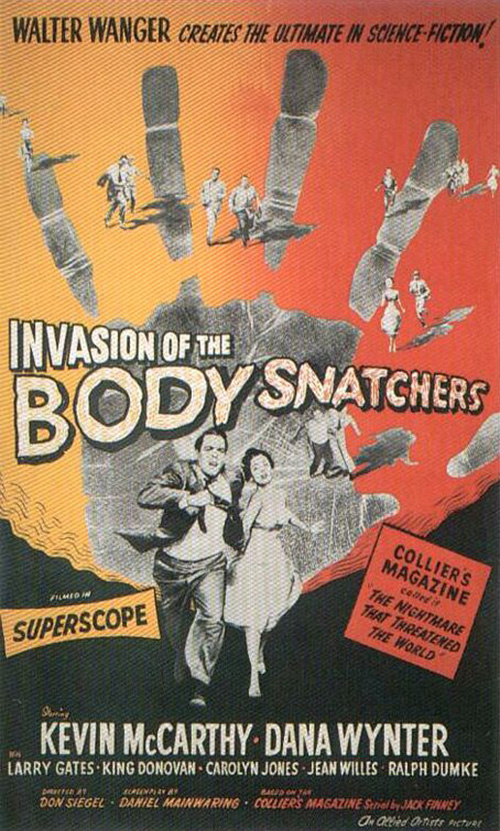
Invasion of the Body Snatchers – October 23rd, 2021

Invasion of the Body Snatchers [1956]


Please join Cultivate Cinema Circle as we screen Don Siegel’s film Invasion of the Body Snatchers [1956].


Event Sponsors:

Venue Information:

Downtown Central Library Auditorium
1 Lafayette Square, Buffalo, NY 14203
(Enter from Clinton Street between Oak and Washington Streets)
716-858-8900 • www.BuffaloLib.org
COVID protocol will be followed.


Synopsis

Extraterrestrial invaders mimic the likeness of humans in an insidious plot to take over Earth. When a doctor discovers pods containing creatures that can assume the physical appearance of anyone they choose, he attempts to destroy them.

Tidbits:

  • National Film Preservation Board – 1994 – National Film Registry

Director Bio

Courtesy of TCM:

The montage department at Warner Bros. gave producer-director Don Siegel the necessary tools to impart his signature economical, action-driven style that made films like “Riot on Cell Block 11” (1954), “Invasion of the Body Snatcher” (1955), “The Killers” (1964), “Dirty Harry” (1971) and “Charley Varrick” (1973) such high water marks in the crime and thriller genres. Though Siegel disavowed any notable style, his films were earmarked by their brisk pace, uncompromising violence, and heroes that frequently followed the same moral path as their villains. Siegel’s strongest pictures were in collaboration with “Harry” star Clint Eastwood, whose own prominence was boosted by his work with the director in “Coogan’s Bluff” (1968) and “Escape from Alcatraz” (1979), among others. There was no denying that Siegel’s four-decade career generated some of the most enjoyable and mature crime dramas to come from Hollywood.

Born in Chicago, IL on Oct. 26, 1912, Don Siegel came from a musical family that included a violinist father. As a young man, Siegel initially trained to be a stage actor. After graduating from Jesus College in Cambridge, England, he began working in the Warner Bros. film library in 1934. Siegel quickly graduated to assistant editor and later assistant head of the insert department before taking control of the studio’s montage department. There, he composed some of the most striking montages for features, including the opening sequence in “Casablanca” (1942), “Now, Voyager” (1942) and “Action in the North Atlantic” (1943). His experience there led to work as a second unit and assistant director on films like “Sergeant York” (1941) and “To Have and Have Not” (1943). Both experiences would prove invaluable to his subsequent career as a director; the montage work taught him to plan his shots with meticulous care, which would in turn allow him greater control over the finished product by limiting the amount of footage available for producers to re-edit his films. The limited time, budget and access to performers afforded to second unit directors taught Siegel the importance of working quickly and accurately, both of which would be hallmarks of his subsequent directorial style.

Features were Siegel’s ultimate goal, but Warner chief Jack Warner refused to let him out of his contract for fear that they would lose his distinctive montage. Warner eventually consented to let Siegel direct a pair of short films; the first, “Star in the Night” (1945), was a modern Western that presented a 20th century take on the Biblical story of Christmas, while “Hitler Lives” (1946) incorporated wartime footage of Nazi leaders with dramatized scenes to underscore its message of vigilance towards postwar Germany and Nazi sympathizers in the United States. Though Siegel was not credited for the latter project, both films won the Academy Award for Best Live Action Short Film. “Hitler” would also serve as the seed of a lingering debate in regard to Siegel’s political stance, with some viewing it as a strongly conservative picture, while others taking its message as virulently anti-totalitarianism. Regardless of their themes, both films signaled that Siegel was ready to tackle features, and in 1946, he ended his 14-year relationship with Warner Bros. to freelance as a director for various studios.

Siegel’s first directorial effort was “The Verdict” (1946), an offbeat mystery featuring the fabled screen duo of Peter Lorre and Sydney Greenstreet. Soon after, he began to craft his signature style through a series of dramas and thrillers, most notably “Night Unto Night” (1949), a unusual feature about the romance between a man (Ronald Reagan) stricken with epilepsy and a woman (Siegel’s wife, actress Vivica Lindfors) contemplating suicide after her divorce. Though Siegel would deny any sense of an individual style, recurrent themes and elements would begin to surface in his work in the late 1940s and early 1950s. Pictures like “The Big Steal” (1949), “Riot in Cell Block 11” (1954) and “Private Hell 36” (1954) were briskly paced, violent affairs, with restless camerawork following his characters rather than dictating their movement. Such an approach lent a realistic feel which heighted the drama and action that were inherent to his films.

Siegel’s editing background also brought a burst of energy to his action scenes; fistfights, car chases and shootouts were delivered in brief but intense explosions of tension and release. Siegel’s heroes also reflected his economical, no-nonsense approach; Robert Mitchum’s Army lieutenant in “Big Steal” and Neville Brand’s inmate in “Cell Block 11” (1954) were tough, single-minded men whose sole purpose in life was to stand by their own personal codes of honor. They avoided the standard societal codes, operating under their own rules, and frequently broke traditional movie tenets in their pursuit of their desires, whether financial, personal or otherwise. Often times, there was very little separating his heroes from his villains. Such an approach endeared Siegel to noir fans, as well as serious students of American cinema like Francois Truffaut, who was an unabashed admirer. For his part, Siegel described himself as a “whore” who simply worked for the profit, and indeed, for every great effort during the 1950s and beyond, there were minor, forgettable efforts like “Hound-Dog Man” (1959), a frivolous, fictionalized biopic of Elvis Presley with Fabian in the lead, and countless television episodes, including “The Doctor” (NBC, 1952-53) and two of the weakest stories on “The Twilight Zone” (CBS, 1959-1964).

Despite the erratic nature of Siegel’s career, he turned out some exceptional films in the late ’50s and 1960s that became favorites for crime and thriller enthusiasts and scholars alike. “Crime in the Streets” (1956) was a gritty urban drama with James Whitmore as a social worker attempting to turn street punks John Cassavetes and Sal Mineo away from a life of crime, while “The Lineup” (1958) afforded character actor Eli Wallach a rare lead as a psychopathic gangster who tracked down and killed tourists who had become unwitting drug mules. He was also adept at war pictures, like the Steve McQueen vehicle “Hell is For Heroes” (1962) and Westerns like “Flaming Star” (1960), which gave Elvis Presley one of his best screen roles as a half-Native American caught between his adopted white family and warring tribes. Siegel also made one of the greatest science fiction films of the 20th century, “Invasion of the Body Snatchers” (1956), which depicted the takeover of a small California town by extraterrestrials with the ability to duplicate humans through giant plant-like pods. The film was the center of considerable debate over its allegiance or opposition to the anti-Communist witch hunts of the period, with both sides swearing Siegel’s fealty to their side. For his part, Siegel would later comment that the pods represented the front office at Hollywood studios. In 1959, he made his debut as producer-director on “Edge of Eternity” (1959), and would oversee nine more films during his lengthy career.

Save for “The Killers” (1964), a savage gangster picture with Lee Marvin as an amoral killer and Ronald Reagan in his final screen role as a cruel mob boss, Siegel worked in television for most of the mid-1960s before returning to features with “Madigan” (1968), a downbeat police drama about a New York detective (Richard Widmark) on the trail of a killer who eluded him during a routine bust. The film was particularly trying for the director, who clashed frequently with producer Frank Rosenberg. However, his next film, “Coogan’s Bluff” (1968), marked the beginning of a career revival, as well as a long personal and professional collaboration with its star, Clint Eastwood. At the time, Eastwood was riding the wave of popularity from his Italian westerns with Sergio Leone, and had returned to the United States in search of quality projects. A fan of Siegel’s earlier work, he tapped the older man to direct “Bluff,” a crime drama with Western overtones about an Arizona sheriff (Eastwood) who pursued a psychotic criminal (Don Stroud) through New York.

The new actor/director team soon followed their first hit with “Two Mules for Sister Sara” (1970), a Western with Shirley MacLaine as a prostitute posing as a nun and Eastwood as the drifter who aids her against Mexican soldiers, and “The Beguiled” (1971), a Gothic period piece about a wounded Union soldier (Eastwood) who, after being rescued by the teacher and students at an female boarding school, received a brutal come-uppance after attempting to seduce them. The picture was marked by negative reactions to Eastwood’s weak character and a perceived notion of misogyny, an idea bolstered in part by Siegel’s comment about the film’s depiction of women’s “basic desire to castrate men.” However, the controversy it generated was nothing when compared to the firestorm of criticism that followed their next collaboration, “Dirty Harry” (1971).

A violent crime thriller about a trigger-happy San Francisco detective (Eastwood) whose investigative methods were not dissimilar to the sadistic sniper (Andrew Robinson) he pursued, “Harry” became an iconic role for Eastwood, and one of Siegel’s biggest career hits, but the film was dogged as a right-wing fantasy that celebrated police brutality and fascist responses to violence. Siegel distanced himself from the debate, which actually incurred protests at screenings, though several critics saw the film as an implication of viewers’ own violent urges and knee-jerk responses to acts of brutality. Harry Callahan would return for several more movie adventures, though Siegel would not direct any of them. He would, however, serve as a strong influence on the directorial career of Eastwood, whose own terse cinematic style and focus on the moral ambiguity of his characters reflected Siegel’s worldview.

Siegel’s output slowed in the years following “Harry.” He had been in the movie business for over four decades, and had enjoyed a career that most directors would find envious. He would direct and producer a handful of films in the 1970s, most of which turned a profit and enjoyed respectable box office returns. The cult favorite “Charley Varrick” (1973) starred Walter Matthau as a cagey bank robber who runs afoul of mobsters, and featured one of the most unique chase scenes in film history, with Matthau in a plane pursued by relentless killer Joe Don Baker in a car. “The Shootist” (1976) was an unsentimental Western about an aging gunfighter (John Wayne, in his final screen role) whose attempt to retire was challenged by a vicious criminal (Richard Boone). And “Escape from Alcatraz” (1979) was a tense prison film about the real-life escape from the maximum-security prison by inmate Frank Morris (Eastwood). Though a hit, the picture ended the long relationship between Eastwood and Siegel when the latter took over the production of the film from his star.

In addition to his directing career, Siegel acted in minor roles in several films. He made cameos in many of his own projects, including an elevator passenger in “Coogan’s Bluff” and a pedestrian in “Dirty Harry.” Eastwood cast him in a minor part as a bartender in “Play Misty for Me” (1971), while Philip Kaufman brought him aboard the remake of “Invasion of the Body Snatchers” (1978) as the driver of the cab who struck Kevin McCarthy, the star of Siegel’s version. Siegel would direct two more films, “Rough Cut” (1980) and “Jinxed!” (1982) before retiring in the 1980s. The former was a minor hit for Burt Reynolds as a jewel thief, while the latter was a disastrous comedy for Bette Midler as a Vegas lounge singer who fell for an unlucky card dealer (Ken Wahl). Both stars opened loathed each other during filming, and Midler also clashed with Siegel, who suffered a heart attack during production. The film’s sole positive note was the brief revival it afforded Sam Peckinpah, who was hired by Siegel as second unit director on the film, and as a result, received a final turn as director on “The Osterman Weekend” (1983) before his death. On April 20, 1991, Siegel died from cancer in Nipomo, CA. His body of work underwent several re-evaluations in the years that followed his passing, with his own autobiography, A Siegel Film, published posthumously in 1993, serving as the final word on many of his projects. In 1992, Eastwood dedicated his Oscar-winning Western “Unforgiven” to the two men whose work had the greatest impact on his career: Sergio Leone and Don Siegel.

Filmography:

  • Jinxed! (1982)
  • Rough Cut (1980)
  • Escape From Alcatraz (1979)
  • Telefon (1977)
  • The Shootist (1976)
  • The Black Windmill (1974)
  • Charley Varrick (1973)
  • Dirty Harry (1971)
  • The Beguiled (1971)
  • Two Mules for Sister Sara (1970)
  • Madigan (1968)
  • Coogan’s Bluff (1968)
  • The Killers (1964)
  • Hell Is for Heroes (1962)
  • Flaming Star (1960)
  • Edge of Eternity (1959)
  • Hound-Dog Man (1959)
  • The Lineup (1958)
  • The Gun Runners (1958)
  • Spanish Affair (1958)
  • Baby Face Nelson (1957)
  • Invasion of the Body Snatchers (1956)
  • Crime in the Streets (1956)
  • An Annapolis Story (1955)
  • Riot in Cell Block 11 (1954)
  • Private Hell 36 (1954)
  • No Time for Flowers (1953)
  • Count the Hours (1953)
  • China Venture (1953)
  • The Duel at Silver Creek (1952)
  • Night unto Night (1949)
  • The Big Steal (1949)
  • The Verdict (1946)

Links

Here is a curated selection of links for additional insight/information:

  • Cultivate Cinema Circle info-sheet – link
  • “One of the films that has generated the most heated and long-running debates about its political intentions, in Siegel’s oeuvre and in cinema at large, is Invasion of the Body Snatchers…As in much first-class science fiction, the narrative insinuates its potential to be read as a metaphor for issues rooted in contemporary civilisation. To interpret this metaphor has proved an irresistible challenge for swathes of critics and audiences…Perhaps the most useful analysis has been provided by Tracy Knight, who argues that the most captivating fictions, Invasion of the Body Snatchers amongst them, have ‘’Rorschach plots’, fictional inkblots that playfully interact with us and our beliefs. Their ambiguity invites us to project our own interests and biases upon the story in order to wrest meaning from their tantalising lack of explicitness’. The idea of a ‘Rorschach plot’ is of far greater importance in understanding this film, and Siegel’s wider oeuvre, than pinning down the truth of one interpretation over another.” – Deborah Allison, Senses of Cinema (2004) – link
  • “We conclude…by reflecting on what it means that Invasion’s us-versus-them scenario—in Miles’s terms, ‘They’re after all of us!’—is undermined in so many ways. Unlike films whose Others are distinct, like the Rhedosaurus in Eugène Lourié’s The Beast from 20,000 Fathoms (1953) or the gigantic ants in Gordon Douglas’s Them! (1954), Siegel’s aliens are both human and posthuman, us and them, all at once. That’s why we can have multiple, opposing allegorical readings at the same time. Because film analysis is not a question of choosing the correct interpretation but discovering how a film is complex enough to make them all possible—and reveling in what Finney’s Miles calls a story that is ‘full of loose ends and unanswered questions.'” – Rashna Wadia Richards, The Cine-Files (2015) – link
  • “Based on Jack Finney’s novel, Don Siegel’s original black-and-white thriller about aliens taking over unsuspecting humans was a parable of Cold War paranoia. It teases out a pervasive feeling (stoked by right wing propaganda) that the Russians weren’t just coming to take over the United States and grind capitalism into dust, but were already living among unsuspecting patriots, absorbing more of them by the hour.” – Matt Zoller Seitz, RogerEbert.com (2018) – link

Them! – October 9th, 2021

Them! [1954]


Please join Cultivate Cinema Circle as we screen Gordon Douglas’ Oscar nominated (Best Effects, Special Effects) film Them! [1954].


Event Sponsors:

Venue Information:

Downtown Central Library Auditorium
1 Lafayette Square, Buffalo, NY 14203
(Enter from Clinton Street between Oak and Washington Streets)
716-858-8900 • www.BuffaloLib.org
COVID protocol will be followed.


Synopsis

In this film, a girl is found wandering in the desert in a state of complete shock. When she finally revives, she can scream out only one word: “Them!” As it turns out, “Them” are giant ants, a by-product of the radiation attending the atomic bomb tests of the era.

Tidbits:

  • Academy Awards – 1955 – Nominee for Best Effects, Special Effects

Director Bio

Courtesy of TCM:

Before he was a well-respected film director, Gordon Douglas was a lowly teenage production intern whose go-getter attitude convinced his boss, famed media mogul Hal Roach, to cast him in the youthfully mischievous short-film series “Our Gang.” Already too old to join the central Little Rascals, he was instead given a succession of bit parts. In short order, he gleaned a thorough enough sense of the series’ ins and outs to take on writing and directing roles, eventually emerging as “Gang”‘s most dedicated (and prosperous) overseer, even going so far as to follow the eternally celebrated franchise when it moved to MGM. He ultimately realized, however, that he much preferred the homespun stylings of Roach’s studio, and he returned there, sans Rascals, to find further success as the director of such freewheeling comedies as the gleefully daft Laurel and Hardy adventure “Saps at Sea” (1940). A skilled features director by the time Hal Roach Studios folded altogether, he found a new permanent residence at Warner Bros. in 1950. Over the course of the following three decades, Douglas spread his wings as a multi-genre filmmaker, directing the quintessential atomic-age creeper “Them!” before making a distinct move toward savvier, more sophisticated projects such as the hard-edged detective dramas “They Call Me MISTER Tibbs!” and the forthrightly titled “The Detective.” He retired from the business in 1977 and died of cancer years later at the age of 85.

Filmography:

  • Viva Knievel! (1977)
  • Nevada Smith (1975)
  • Slaughter 2 (1973)
  • Slaughter’s Big Rip-Off (1973)
  • Skullduggery (1970)
  • Barquero (1970)
  • They Call Me MISTER Tibbs (1970)
  • The Detective (1968)
  • Lady in Cement (1968)
  • In Like Flint (1967)
  • Chuka (1967)
  • Tony Rome (1967)
  • Stagecoach (1966)
  • Way … Way Out (1966)
  • Sylvia (1965)
  • Harlow (1965)
  • Rio Conchos (1964)
  • Robin and the 7 Hoods (1964)
  • Call Me Bwana (1963)
  • Follow That Dream (1962)
  • Gold of the Seven Saints (1961)
  • Claudelle Inglish (1961)
  • The Sins of Rachel Cade (1961)
  • Up Periscope (1959)
  • Yellowstone Kelly (1959)
  • The Fiend Who Walked the West (1958)
  • Fort Dobbs (1958)
  • Bombers B-52 (1957)
  • The Big Land (1957)
  • Santiago (1956)
  • The McConnell Story (1955)
  • Sincerely Yours (1955)
  • Them! (1954)
  • Young at Heart (1954)
  • The Eddie Cantor Story (1954)
  • She’s Back on Broadway (1953)
  • So This Is Love (1953)
  • The Charge at Feather River (1953)
  • The Iron Mistress (1952)
  • Mara Maru (1952)
  • Come Fill the Cup (1951)
  • I Was a Communist for the F.B.I. (1951)
  • The Great Missouri Raid (1951)
  • Only the Valiant (1951)
  • Rogues of Sherwood Forest (1950)
  • Kiss Tomorrow Goodbye (1950)
  • The Nevadan (1950)
  • Between Midnight and Dawn (1950)
  • Fortunes of Captain Blood (1950)
  • The Doolins of Oklahoma (1949)
  • Mr. Soft Touch (1949)
  • Walk a Crooked Mile (1948)
  • The Black Arrow (1948)
  • If You Knew Susie (1948)
  • San Quentin (1946)
  • Dick Tracy vs. Cueball (1946)
  • Zombies on Broadway (1945)
  • First Yank into Tokyo (1945)
  • The Falcon in Hollywood (1944)
  • A Night of Adventure (1944)
  • Gildersleeve’s Ghost (1944)
  • Girl Rush (1944)
  • Gildersleeve on Broadway (1943)
  • Gildersleeve’s Bad Day (1943)
  • The Great Gildersleeve (1942)
  • The Devil with Hitler (1942)
  • Broadway Limited (1941)
  • Niagara Falls (1941)
  • Saps at Sea (1940)
  • Zenobia (1939)
  • General Spanky (1936)

Links

Here is a curated selection of links for additional insight/information:

  • Cultivate Cinema Circle info-sheet – link
  • “Dr. Edmund Gwenn’s final, slightly doleful but strictly scientific observation in “Them!” indicates that when man entered the atomic age he opened new worlds and that ‘nobody can predict’ what he will find in them. The Warner Brothers, fearlessly flouting this augury, have come up with one ominous view of a terrifyingly new world in the thriller that was exposed at the Paramount yesterday, and it is definitely a chiller.The awesome fact is that the Warner Brothers have planted ants on our planet—giant nine to twelve-footers, with mandibles like the tusks on a mammoth, and keening like all the banshees in a fevered imagination. There’s no point in making for the hills, though. It’s fascinating to watch.Since it is difficult to assign specific credit, suffice it to say that the combination of three writers, director Gordon Douglas, producer David Weisbart and a cooperative cast have helped make the proceedings tense, absorbing and, surprisingly enough, somewhat convincing. Perhaps it is the film’s unadorned and seemingly factual approach which is its top attribute.” – A.H. Weiler, The New York Times (1954) – link
  • “By far the best of the ’50s cycle of ‘creature features’, Them! and its story of a nest of giant radioactive ants (the result of an atomic test in the New Mexico desert) retains a good part of its power today. All the prime ingredients of the total mobilisation movie are here: massed darkened troops move through the eerie storm drains of Los Angeles, biblical prophecy is intermixed with gloomy speculation about the effect of radioactivity. Almost semi-documentary in approach, the formula is handled with more subtlety than usual, and the special effects are frequently superb.” – David Pirie, Time Out Film Guidelink
  • “…women are scary. And sexy, too, just like the bomb itself. In Paranoia, the Bomb, and 1950s Science Fiction Films, Cynthia Hendershot has written persuasively about the eroticization of nuclear power. ‘In postwar bomb fantasies,’ she argues, ‘sexuality becomes a means of containing the fear of the limits of meaning.’…In Them!, the monstrous fertility of the queen ants threatens to topple a social order dominated by men. (Joan Weldon’s gutsy scientist may be a babe, but she spends the entire movie chastely in her father’s shadow.) Hendershot proposes that, in a paranoiac worldview, the forces for purification and progress are constantly at war with those of contamination and degeneracy. Since at least Victorian times, matriarchal societies implied a backward step in evolution. So gendered 1950s sci-fi monsters take fears of Darwinist decline, run them through a nuclear power generator, and serve them up to a viewing public already worried about—and fiercely protective of—its civilization. The effect becomes one of diffuse suspicion. Who exactly are the enemies poised to dismantle the American dream? Women? Soviets? Heedless scientists? Somehow all three converge in images of irradiated, unknowable creatures eager to reproduce throughout the United States.” – Katy Waldman, Slate (2013) – link

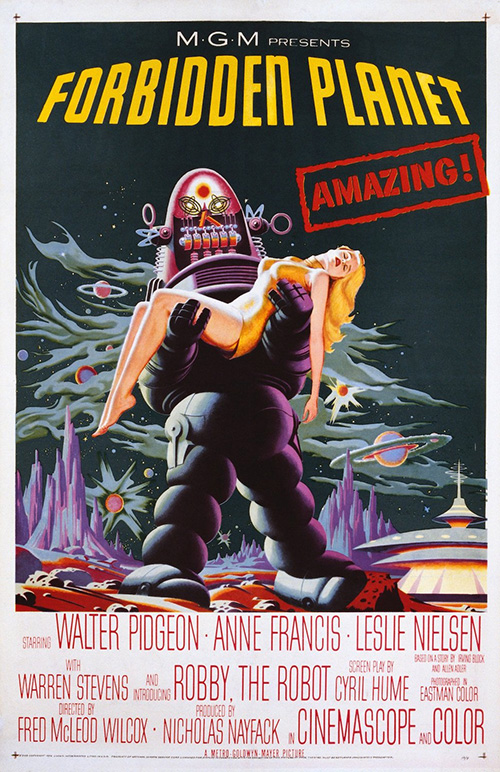
Forbidden Planet – September 25th, 2021

Forbidden Planet [1956]


Please join Cultivate Cinema Circle as we screen Fred M. Wilcox’s Oscar nominated (Best Effects, Special Effects) film Forbidden Planet [1956].


Event Sponsors:

Venue Information:

Downtown Central Library Auditorium
1 Lafayette Square, Buffalo, NY 14203
(Enter from Clinton Street between Oak and Washington Streets)
716-858-8900 • www.BuffaloLib.org
COVID protocol will be followed.


Synopsis
A rocket ship lands on a distant planet to investigate the disappearance of settlers, and the crew discovers a scientist, his daughter and a highly intelligent robot named Robby.

Tidbits:

  • Academy Awards – 1957 – Nominee for Best Effects, Special Effects
  • National Film Preservation Board – 2013 – National Film Registry

Director Bio

Courtesy of TCM:

Fred M Wilcox enjoyed success as a director over the course of his Hollywood career, owed mainly to a vast supply of imagination and a fierce attention to detail. In 1926, he was hired by MGM as a publicist. M Wilcox received his start directing films, including work on the drama “Lassie Come Home” (1943) with Roddy McDowall, the adventure “Courage of Lassie” (1946) with Elizabeth Taylor and the Edmund Gwenn drama “Hills of Home” (1948). Shortly thereafter, he received directorial credit for the Jeanette MacDonald musical comedy “Three Daring Daughters” (1948), the fantastical drama “The Secret Garden” (1949) with Margaret O’Brien and the drama “Shadow in the Sky” (1952) with Ralph Meeker. He also appeared in the drama “Tennessee Champ” (1954) with Shelley Winters. in the forties and the sixtiesLater in his career, M Wilcox directed “I Passed For White” (1960). M Wilcox passed away in September 1964 at the age of 57.

Filmography:

  • I Passed for White (1960)
  • Forbidden Planet (1956)
  • Tennessee Champ (1954)
  • Code Two (1953)
  • Shadow in the Sky (1952)
  • The Secret Garden (1949)
  • Hills of Home (1948)
  • Three Daring Daughters (1948)
  • Courage of Lassie (1946)
  • Lassie Come Home (1943)
  • Joaquin Murrieta (1938) – short film

Links

Here is a curated selection of links for additional insight/information:

  • Cultivate Cinema Circle info-sheet – link
  • “Fasten your seat belts, fellows. Get those space helmets clamped to your heads and hang on tight, because we’re taking off this morning on a wonderful trip to outer space. We are guiding you to “Forbidden Planet,” which is appropriately at the Globe. And we suggest you extend an invitation to Mom and Dad to go along.For this fanciful interstellar planet, which has been dreamed up at Metro-Goldwyn-Mayer and put on the screen in Eastman color and properly spacious CinemaScope, is the gaudiest layout of gadgets this side of a Florida hotel. It offers some of the most amusing creatures conceived since the Keystone cops.Best of the lot is Robby, a phenomenal mechanical man who can do more things in his small body than a roomful of business machines. He can make dresses, brew bourbon whisky, perform feats of Herculean strength and speak 187 languages, which emerged through a neon-lighted grille.” – Bosley Crowther, The New York Times (1956) – link
  • “An engaging 1956 science fiction gloss of Shakespeare’s Tempest, with a ship full of American astronauts landing on a mysterious planet where Walter Pidgeon and his miniskirted daughter, Anne Francis, guard the remains of a lost civilization. Even as the SF cliches fall fast and heavy, this is great to look at, thanks to the sumptuous MGM sets and the fine animation and matte work by Walt Disney Studios.” – Dave Kehr, Chicago Reader (2012) – link
  • “The film does show its age in its pervasive sexism. There are no women in the C-57D crew. Aware that his crew of “competitively selected super-perfect physical specimens” haven’t seen a woman for 378 days, Adams is concerned that they might behave improperly (for Motion Pictures Production Code versions of improperly). He has good reason to worry about his men, but not about Altaira, who is unimpressed with crewman Farman’s kissing prowess. [Farman and Altaira kiss] Altaira: Is that all there is to it? Farman: Well, you’ve sort of got to stick with it. Altaira: Just once more, do you mind? Farman: Not at all. [They kiss] Altaira: There must be something seriously the matter with me…because I haven’t noticed the least bit of stimulation. It’s probably a mercy that Farman is killed by the guardian soon after. Egregious 1950s sexism aside, Forbidden Planet works as pure entertainment. It’s a great whodunnit. It even hews to a classic mystery trope: the film drops clues here and there, clues that will lead to the reader (or viewer, in this case) saying at the end ‘well d’oh, I should have known.’ No surprise that the movie is widely held to be a SF film classic.” – James Davis Nicoll, Tor (2020) – link

A Coffee In Berlin – June 25th, 2016

A Coffee In Berlin [2012]


Please join us for a FREE one-day screening of Jan Ole Gerster’s A Coffee In Berlin [Oh Boy] [2012], the final film of our Public Espresso themed trilogy about coffee and Constructivism.

  • Screening Date: Saturday, June 25th, 2016 | 1:00pm
  • Venue: The Mason O. Damon Auditorium at Buffalo Central Library
  • Specifications: 2012 / 86 minutes / German with Subtitles / Black & White
  • Director(s): Jan Ole Gerster
  • Print: Supplied by Music Box Films
  • Tickets: Free and Open to the Public
  • Deal: Stop in early for a FREE Breadhive soft pretzel while supplies last!

Spring 2016 Season Sponsor:

Event Sponsors:

Venue Information:

1 Lafayette Square, Buffalo, NY 14203
(please use Clinton St entrance for Mason O. Damon Auditorium)


Synopsis

Courtesy of Music Box Films:

Jan Ole Gerster’s wry and vibrant feature debut A Coffee in Berlin, which swept the 2013 German Oscar Awards, paints a day in the life of Niko, a twenty-something college dropout going nowhere fast. Niko lives for the moment as he drifts through the streets of Berlin, curiously observing everyone around him and oblivious to his growing status as an outsider. Then on one fateful day, through a series of absurdly amusing encounters, everything changes: his girlfriend rebuffs him, his father cuts off his allowance, and a strange psychiatrist dubiously confirms his ’emotional imbalance’. Meanwhile, a former classmate insists she bears no hard feelings toward him for his grade-school taunts when she was “Roly Poly Julia,” but it becomes increasingly apparent that she has unfinished business with him. Unable to ignore the consequences of his passivity any longer, Niko finally concludes that he has to engage with life. Shot in timeless black and white and enriched with a snappy jazz soundtrack, this slacker dramedy is a love letter to Berlin and the Generation Y experience.

Tidbits:

  • AFI Fest – 2012
  • Berlin International Film Festival – 2013
  • German Film Awards – 2013 – Winner: Film Award in Gold – Outstanding Feature Film, Winner: Film Award in Gold – Best Performance by an Actor in a Leading Role, Winner: Film Award in Gold – Best Performance by an Actor in a Supporting Role, Winner: Film Award in Gold – Best Direction, Winner: Film Award in Gold – Best Screenplay, Winner: Film Award in Gold – Best Film Score, Nominee: Film Award in Gold – Best Performance by an Actress in a Supporting Role & Nominee: Film Award in Gold – Best Editing

Director Interview

Courtesy of press notes:

Before we talk about the movie that is, I want to ask about the movie that wasn’t, because this sprung from an abandoned project …

Well, there have been many ambitious scripts, and parts of the script I was working on are in the film. The original script made me feel like a fraud, so I stopped working on that and did nothing for a couple of years … I call this the research. And yeah, wrote this script in two weeks and for the first time it felt good to work on something like that! People gave me good feedback on it, and I got confident.

When people make debut features about aimless young people, it’s usually assumed that it’s in some way semi-autobiographical …

As I said I had to research it, it is a little bit autobiographical. It is personally, but not necessarily private. It’s inspired by a period I went through.

Were there any particular instances that were pulled from your life, or would you say it’s a kind of autobiographically inspired fiction?

That’s a nice way of putting it. No, for example, I was thinking about the conversations I had with my dad about future job situations and how a lot of young men—at one point in their life, when they’re stuck in the process—need to have this sort of conversation. A lot people identify with that scene more than I ever thought. This is definitely inspired by something personal.

Since you wrote it so quickly, did you do any other drafts?

Yes, I think there were two other drafts because the first draft was too long and my producer asked me to make it a bit shorter and I didn’t really know where to start … so I changed the size of the letters, which gave me 10 pages … then the producer figured it out, so I made a third draft, a real draft, and kicked out a few scenes.

Were there sequences of Niko meeting characters or encounters that ended up being dropped?

Yup, there were a couple of scenes. One scene I shot but had to lose during editing, and others I kicked out at an earlier point in the screenplay. Let me think, there was a scene where he meets a priest from Africa; they have a conversation about Bono from U2 and talk about music, and it was fun, but it just wasn’t leading anywhere.

Was that something you shot?

No, we shot a scene with a little boy after Niko walks through the forest. He comes to the lake and sees a little boy fishing, and they have a conversation about fishing and it was too much of a metaphor—these two boys, traveling back in time with this innocent kid, then the father joins them, and it was too much, so I had to cut it.

Seems like many of the people Niko encounters are doubles for him?

Yeah, I always saw him as this dark something that gets more and more visible by the encounters with other people that put a light on him. Every character makes something of his character understandable …

Did the character of Niko come first, or did the idea of the structure or the other characters?

Both came at the same time. I thought it was challenging and appealing to have this passive character and portray him through encounters with others. You can’t really tell what came first. I think these types of characters always fascinated me, so I always had him in mind and the idea of some sort of a road movie that never leaves Berlin, really. It’s a road movie of someone who has to walk because he lost his license. So yeah, this is how it started, with a vague idea of this passive young man that was inspired by many characters that I always loved in films and literature.

Could you give some examples of characters you love in film and literature?

Benjamin Braddock of The Graduate is someone I identified with as a teenager, and still do in a way. Not because I had an affair with a much older woman, but because of his relationship to the world he’s living in.

How long was your shoot?

21 days.

Why black and white?

It was black and white in my head from the first page. I think I needed some kind of abstraction from the neighborhood that I know very well from real life, especially because the film is about everyday life and normal conversations. I kind of felt like it needed this distance that at the same time expresses or describes the distance that the character feels from the world.

Lit specifically for black and white?

We did a lot of tests to figure out which colors turns out to be a shade of gray. That was actually my working title: 50 Shades of Gray! But you’re right, we tested the black and white, back and forth. I think we considered 60mm until the very end, and then when we knew what our budget would be like, because we were trying to get more money, we decided to shoot digital.

What is your method when it comes to working with and shooting actors?

Actually I shot a lot; I was a little bit embarrassed when I went to editing. But it was always the same situation. We had Tom on set, and everyday someone else came in. Because every scene was like a short movie, my feeling was always like, “we only have him for one day, so let’s try this with this shot.” I hope to shoot more economically in the future.

Would you shoot the characters in blocks or would you do a character a day?

Most of the actors agreed to perform in this film for free, and said they had this one day where they could shoot it and come to my set …

Did you rehearse with them beforehand?

We rehearsed a little bit. There were a few actors that were into rehearsing. Usually I don’t really make them rehearse, because sometimes my experience has been that it’s not a good idea to rehearse forever. I was very happy with my ensemble, with my cast. Almost everyone in the picture I wanted to have, and I was very confident I was going to get good performances. For example, the neighbor character is a friend of mine, and I had no doubt that he would deliver a great performance.

Was it always part of the design to have Niko going through a downward structure through the film?

I don’t know, I enjoyed writing these scenes, I enjoyed torturing this character, it was fun to write. I tried to make the movie darker and darker, I think also the tonality of the scenes, especially the one with the old man in the bar, is different from what the film is like in the beginning …

When you were writing the film, did you have specific places in mind? Or were they more general locations, then you found where you wanted to shoot?

Well I don’t go to golf courses, for example, so I had no golf course in mind. For me, they all look the same; some are more beautiful, some…I don’t know. But there were a few locations I had in mind: for example, that theater and the restaurant where they meet Julia for the first time. When we did location scouting with the cinematographer in Berlin, we tried to find places that we kind of like but are about to disappear because the city is constantly changing. It’s becoming cleaner and slicker every day …

Is his apartment over in East Berlin?

No, this apartment was not an easy location to find. Because we wanted it to be a place where obviously no one is living, you know he just moved in. But the worst thing about a black and white film is just clean white walls. We looked for that empty apartment forever. I thought that would be the easiest location to find …

Did you have a neighborhood in mind?

Okay, so the apartment is actually put together from three different locations. There’s the living room in one location, then the bathroom (when he’s in the shower) in a different location (the same location as his backyard where he sees the neighbor playing foosball against himself), and there’s his living room and the view out of his window—which is my place.

How did you keep it straight? Did you have to draw out a floor plan?

I was thinking about that. I think, yeah, we had some sort of floor plan, but we ignored it.

Was the role written with Tom Schilling in mind?

Tom is a very close old friend of mine. We share the same taste in music and films and talk a lot about our projects. At one point I gave him the screenplay of Oh Boy for his opinion, though I didn’t have him in mind when I was writing it because he looked very young and it was important that Niko was in his late twenties. But Tom gave it his best shot to age as fast as he could … drinking in the morning, smoking, became a father, didn’t sleep very much…something changed and he became more mature, and then he wrote me a handwritten five-page letter about how he understood the character, how he loved the screenplay. So he convinced me, and I’m happy for that every day.

Did you work on the film alone with Tom before working with other actors?

We talked a lot about the script, but we didn’t rehearse a lot. We did a few rehearsals, but not every scene with every actor. The psychological test, for example, we rehearsed. I rehearsed with the neighbor. I didn’t rehearse with the old man because he’s a very well known German actor. I’m a big fan, so I asked his agent to give him the script and his first response was, “he’s not shooting anymore student films, he had some terrible experiences and he’s through with student films.” But thank god the agent made him read it and give it a try.

Where did that scene with the old man in the bar come from?

It’s pretty close to something I experienced in a bar a few months after I moved to Berlin. There was a very drunk old man sitting next to me talking about the war. I didn’t have encounters like this where I came from, so for me it described the city very well—this ultramodern new Berlin where you can still experience the ghost of history everywhere. And the fact that some people really experienced what went on and are still around stuck with me. It was one of the first scenes that made it into the script.

You’re playing this history off of modern day life, which seems totally different. What does that interest stem from, wanting to counterpoise these two worlds?

Moving to Berlin made me think about the past and what it’s like being German. These days I don’t think about it too much anymore, but when I was in my early 20s I had some experience. I was traveling to foreign countries and had experiences that make me think about what it’s like being German, what it means. I had this awareness and interest in how Germans deal with it these days. So the scenes you see in the film aren’t necessarily about the past, but how the past is still part of the present and somehow still part of our everyday life. I’ve tried to find scenes that express that the past is still everywhere, in a way, and I thought the best way to show it was this Nazi film folklore. Somehow, the whole industry is obsessed with making films about that time, but for some reason I don’t like them or they aren’t good and I was wondering what the problem was making really truthful films like that, why they always turn out to be the same kind of film. I don’t know … I found it very appealing trying to express what I felt at that time by having that scene in the script.

Do you think this generation is spoiled?

I think not, I don’t like generalizations. I meet great young people; they have jobs, dreams, and they’re happy. But I meet a lot of people as well who are unhappy, spoiled, and kind of scared about the future.

They say this will be the first generation that will be poorer than their parents; do you think they have a good reason to be scared?

That’s what the experts say, yes. I know a lot of people who have this kind of financial backup in a way. I don’t know anyone who lies to their parents about that money. Having all the freedom and all the opportunities to find yourself, whatever that means, turn out to be a jail for a lot of people.

Do you think that encounter with the old man provides Niko with a kind of motivation? Is the implication that there’s a sense of purpose in his life after that moment?

Yeah, I’ve always seen the scene, besides the strong subject, as an encounter with someone like Niko who dies alone, having never really found a way to deal with his life. So I’ve always seen this scene as a wake-up call for him.

Do you think the film within a film is kind of a double for the movie?

I was seriously thinking about making that my next film. For lack of a better idea.

At what point did the decision to use jaunty jazzy music come in?

That’s a long story. I started the editing and I had singer-songwriter music in mind. I never thought about working with classical, traditional film composers. I always wanted to make a score with musicians. Maybe I liked the idea that the music could be a character of its own.

Were you going to have songs about the characters, like commentary?

Not really. You should have told me two years ago; that would have been the best idea! Unfortunately we don’t really have a German Paul Simon, so I never found a singer-songwriter I was happy with. The singer-songwriter music I worked with in editing made the film very heavy. Then I asked a friend of mine—Sheryl McNeal from South Africa, who lives in Berlin and has a band called The Reader—to give it a try, because she plays piano. At that point, I was already trying jazz but the temp tracks were all unaffordable, blue note jazz kind of stuff. So Sheryl played around on the piano, and at that point I was already in love with jazz as the right music for the film, because it has the irony I was looking for and the melancholy that is never too heavy in one direction or the other. Besides that, I liked that it gives the film some kind of a timeless feel. Sheryl wrote a few pieces that I liked a lot, but she felt very uncomfortable with the jazz moments. She was very good at scoring the solo piano sequences with Niko, the moments that describe his inner mood, feelings and character. Every time it was more about the city, the craziness of everyday life, the jazz parts, she was very unhappy and so was I—because she’s not a jazz musician.

So I tried to find jazz musicians, but in Berlin the techno scene is huge, not jazz. And I was a little concerned I wouldn’t find a band with old school groove to it, you know. We were in the process of mixing the film and the rough cut was already getting invited to festivals. We still had no score, but they were announcing our premiere. In desperation, I went to a bar in the middle of the night. You can solve many problems in your life by going to a bar in the middle of the night, that’s what I experienced at least. And there was a band playing, one guy on piano and the other on trumpet, and I don’t know if I was slightly drunk, but they sounded like Chet Baker. I was like, “Wow, these kids can groove” and gave them a DVD of my film. They invited me to their rehearsal room, where they jammed to the film and hit every cut. They had never done film music before, but they totally got the idea of editing and composing to cuts. I felt so relieved, you can’t imagine, it was a lucky break.


Director Bio

Courtesy of press notes:

Following his civil service, including training as a paramedic, Jan Ole Gerster completed an internship at X Filme Creative Pool GmbH, where he worked as Wolfgang Becker’s personal assistant and coordinator during the preparation, filming, editing and postproduction of Good Bye, Lenin! In 2003 Jan Ole Gerster began his studies in directing and screenwriting at the German Film and Television Academy in Berlin.

From 2003 to 2009, he completed several projects, including the documentary The Making of Good Bye, Lenin! and wrote the script for Sick House, part of the short film series GERMANY 09-13 SHORT FILMS ON THE STATE OF THE NATION (which also featured directors Tom Tykwer, Wolfgang Becker, Fatih Akin and Dani Levy, amongst others). A Coffee In Berlin (titled Oh Boy in Germany) is Gerster’s feature film debut.

Filmography:

  • Lara (2019)
  • A Coffee in Berlin (2012)
  • Der Schmerz geht, der Film bleibt (2004)

Links

Here is a curated selection of links shared on our Facebook page for additional insight/information:

  • 3/31/16 – “You know there’s a thing—since I was in high school, I read a book called The Art Spirit by Robert Henri, and in it he talks about this art spirit that transformed itself into the art life for me. Coffee is part of the art life. I don’t know quite how it works, but it makes you feel really good and it serves the creative process. It goes hand in hand with painting for sure.” David Lynch on coffee and creativity – link
  • 4/3/16 – What are your favorite scenes centered around coffee? – link
  • 6/4/16 – “The CCC turns one year old this month with a lineup highlighted by the great Werner Herzog. The Fitzcarraldo and Aguirre, the Wrath of God director is also a fascinating documentary filmmaker, and his latest looks to be no exception. Lo and Behold, Reveries of the Connected World by Werner Herzog, a study of our interconnecting online lives, has its Buffalo premiere at 7 p.m. on June 13 at the North Park Theatre (1428 Hertel Ave.). The month also includes Mark Cousins’ Atomic: Living in Dread and Promise – Free Film Screening, a documentary about the nuclear age, at 8 p.m. on June 8 at Burning Books (420 Connecticut St.). And Jan Ole Gerster’s charming narrative feature A Coffee In Berlin screens at 1 p.m. on June 25 at the Mason O. Damon Auditorium at the Buffalo & Erie Central Library (1 Lafayette Sq.).” Christopher Schobert, Buffalo Spree magazine – link
  • 6/16/16 – “With themes reminiscent of Frances Ha, down to its being filmed in black-and-white, A Coffee In Berlin presents a day or so in the life of Niko, as he careens from one absurd interaction to another, clearly floundering, but still not seeing that it is up to him to create the life he wants. Not tomorrow, but right now.” Sheila O’Malley, RogerEbert.com – link
  • 6/22/16 – “Imagine if, instead of Titanic taking the day, Good Will Hunting had swept the Oscars the year both films were nominated. That’s basically what happened in Germany when Jan-Ole Gerster’s low-budget Oh Boy beat Cloud Atlas at the Lolas last year. Here was a modest, black-and-white debut coming out of nowhere to win six of the country’s top film prizes, and to see the film is to understand why: Renamed A Coffee In Berlin for its long-overdue, Music Box-backed U.S. release, this day-in-the-life indie says something profound about an entire generation simply by watching a feckless young man try to figure it out.” Peter Debruge, Varietylink

Man with a Movie Camera – May 21st, 2016

Man with a Movie Camera [1929]


Please join us for a FREE one-day screening of Dziga Vertov’s Man with a Movie Camera [Chelovek s kino-apparatom] [1929], the second film of our Public Espresso themed trilogy about coffee and Constructivism.

  • Screening Date: Saturday, May 21st, 2016 | 1:00pm
  • Venue: The Mason O. Damon Auditorium at Buffalo Central Library
  • Specifications: 1929 / 68 minutes / Silent / Black & White
  • Director(s): Dziga Vertov
  • Print: Supplied by Kino Lorber
  • Tickets: Free and Open to the Public
  • Deal: Stop in early for a FREE Breadhive soft pretzel while supplies last!

Spring 2016 Season Sponsor:

Event Sponsors:

Venue Information:

1 Lafayette Square, Buffalo, NY 14203
(please use Clinton St entrance for Mason O. Damon Auditorium)


Synopsis

Courtesy of Kino Lorber:

Dziga Vertov’s Man With A Movie Camera is considered one of the most innovative and influential films of the silent era. Startlingly modern, this film utilizes a groundbreaking style of rapid editing and incorporates innumerable other cinematic effects to create a work of amazing power and energy.

After his work on The Commissar Vanishes, a multi-media art event of 1999, composer Michael Nyman (The Ogre, The Piano) continued researching the period of extraordinary creativity that followed the Russian Revolution. This artistic inquiry resulted in the celebrated score for Man With A Movie Camera, performed by the Michael Nyman Band on May 17, 2002 at London’s Royal Festival Hall.

This dawn-to-dusk view fo the Soviet Union offers a montage of urban Russian life, showing the people of the city at work and at play, and the machines that endlessly whirl to keep the metropolis alive. It was Vertov’s first full-length film, and it employs all the cinematic techniques at the director’s disposal — dissolves, split-screens, slow-motion, and freeze-frames — to produce a work that is exhilarating and intellectually brilliant.

Tidbits:

  • Locarno International Film Festival – 1967
  • Berlin International Film Festival – 1985
  • BFI London Film Festival – 2010

Director Bio

“I am eye. I am a mechanical eye. I, a machine, am showing you a world, the likes of which only I can see.”

Courtesy of Britannica.com:

Dziga Vertov, pseudonym of Denis Arkadyevich Kaufman (born Jan. 2, 1896 [Dec. 21, 1895, Old Style], Belostok, Russia—died Feb. 12, 1954, Moscow, Russia, U.S.S.R.), Soviet motion-picture director whose kino-glaz (“film-eye”) theory—that the camera is an instrument, much like the human eye, that is best used to explore the actual happenings of real life—had an international impact on the development of documentaries and cinema realism during the 1920s. He attempted to create a unique language of the cinema, free from theatrical influence and artificial studio staging.

As a newsreel cameraman during the Russian Civil War, Vertov filmed events that were the basis for such factual films as Godovshchina revolyutsii (1919; The Anniversary of the October Revolution) and Boi pod Tsaritsynom (1920; Battle of Tsaritsyn). At age 22 he was the director of a government cinema department. The following year he formed the Kinoki (the Film-Eye Group), which subsequently issued a series of manifestos against theatricalism in films and in support of Vertov’s film-eye theory. In 1922 the group, led by Vertov, initiated a weekly newsreel called Kino-pravda (“Film Truth”) that creatively integrated newly filmed factual material and older news footage.

The subject matter of Vertov’s later feature films is life itself; form and technique are preeminent. Vertov experimented with slow motion, camera angles, enlarged close-ups, and crosscutting for comparisons; he attached the camera to locomotives, motorcycles, and other moving objects; and he held shots on the screen for varying lengths of time, a technique that contributes to the rhythmic flow of his films. Outstanding among Vertov’s pictures are Shagay, Sovyet! (1925; Stride, Soviet!), Shestaya chast mira (1926; A Sixth of the World), Odinnadtsatyi (1928; The Eleventh), Chelovek s kinoapparatom (1928; The Man with a Movie Camera), Simfoniya Donbassa (1930; Symphony of the Donbass), and Tri pesni o Lenine (1934; Three Songs of Lenin). Vertov later became a director in the Soviet Union’s Central Documentary Film Studio. His work and his theories became basic to the rediscovery of cinéma vérité, or documentary realism, in the 1960s.

Filmography:

  • Novosti dnya (1954)
  • Klyatva molodykh (1944)
  • V gorakh Ala-Tau (1944)
  • Kazakhstan – frontu! (1942)
  • Blood for Blood, Death for Death (1941)
  • V rayone vysoty A (1941)
  • Tri geroini (1938)
  • Lullaby (1937)
  • Pamyati Sergo Ordzhonikidze (1937)
  • Three Songs About Lenin (1934)
  • Enthusiasm (1930)
  • Zvukovaya sbornaya programma No 2 (1930)
  • Man with a Movie Camera (1929)
  • The Eleventh Year (1928)
  • Forward, Soviet! (1926)
  • The Sixth Part of the World (1926)
  • Kino-Eye (1924)
  • Istoriya grazhdanskoy voyny (1922)
  • The Battle of Tsaritsyne (1920)
  • Godovchina revoljutsii (1919)
  • Kino-nedelya (1919)
  • Le Proces Mironov (1919)

Links

Here is a curated selection of links shared on our Facebook page for additional insight/information:

  • 4/8/16 – Thanks to Google Books, you can read Vlada Petrić’s Constructivism in Film for free – link
  • 5/2/16 – Man with a Movie Camera was voted #1 in Sight & Sound‘s recent poll of the Greatest Documentaries of All Time! – link
  • 5/9/16 – A thorough primer on the Soviet filmmaker behind the doc classic Man with a Movie Camera thanks to Senses of Cinemalink
  • 5/11/16 – “More than 85 years after its release in 1929, it is difficult to watch Dziga Vertov’s most famous film, Man with a Movie Camera, without being bowled over – by its energy, its dynamism, and its visually playful nature.” Ben Nicholson, BFI – link
  • 5/16/16 – “If you want to know exactly what cinema can do, catch this silent masterpiece recently voted the best doc of all time” Tom Huddleston, Time Out Londonlink
  • 5/17/17 – “Most movies strive for what John Ford called “invisible editing” — edits that are at the service of the storytelling, and do not call attention to themselves. Even with a shock cut in a horror film, we are focused on the subject of the shot, not the shot itself. Considered as a visual object, Man with a Movie Camera deconstructs this process. It assembles itself in plain view. It is about itself, and folds into and out of itself like origami.” Roger Ebert – link

A Film About Coffee – April 16th, 2016

A Film About Coffee [2014]


Please join us for a FREE one-day screening of Brandon Loper’s A Film About Coffee [2014], the first film of our Public Espresso themed trilogy about coffee and Constructivism.


Spring 2016 Season Sponsor:

Event Sponsors:

Venue Information:

1 Lafayette Square, Buffalo, NY 14203
(please use Clinton St entrance for Mason O. Damon Auditorium)


Synopsis

Courtesy of the film’s website:

A Film About Coffee is a love letter to, and meditation on, specialty coffee. It examines what it takes, and what it means, for coffee to be defined as “specialty.” The film whisks audiences on a trip around the world, from farms in Honduras and Rwanda to coffee shops in Tokyo, Portland, Seattle, San Francisco and New York. Through the eyes and experiences of farmers and baristas, the film offers a unique overview of all the elements—the processes, preferences and preparations; traditions old and new—that come together to create the best cups. This is a film that bridges gaps both intellectual and geographical, evoking flavor and pleasure, and providing both as well.

“No matter the quality of your cup, people who love coffee, love it. Coffee is about people, and people are what I’m interested in ultimately.”

Brandon Loper, Director

Director Interview

Conducted by Matt Viser of the Boston Globe:

Describe your coffee routine. Where do you frequent, what do you like?

I have a young child, so I get up early. The first thing I want, and my wife requests, is coffee. I’m the designated barista in the house. I have the Baratza Virtuoso grinder, which I love. I used the Hario hand grinder for two years, until I could justify spending several hundred dollars on a grinder. I love it. I use that grinder and I usually try to have very fresh coffee at home. I try to be strategic about when I try and make sure it’s within five days. This morning I had a coffee from Saint Frank.

I almost exclusively do V-60 with the white paper filter. I measure everything out. Usually I make two baby cups. My ratio is 24 grams to 380 grams of water for this coffee. We have little Heath Ceramics mugs.

That’s around 7.

Usually after I take my daughter to day care I’ll come back and make a full cup for myself. That’s cup two.

After lunchtime I’ll go somewhere. Usually Saint Frank or Four Barrel or Ritual.

What’s your order?

Usually a pour-over. I went through a phase of getting a cappuccino and a cookie. But I tried to cut back on the cookie. My favorite is a competition cappuccino, which is a single shot instead of two shots. So I’ll do a single shot cappuccino and the espresso on the side. The single shot cappuccino is so good.

When you’re buying, what time? And do the baristas know you?

I still go a lot in the morning. I’ll almost always do the cup at 7 at home. If I’m going into the office I’ll go by Saint Frank on the way to work. I know all the baristas. At Four Barrel they have a pour-over bar. I know the guy who runs that. They try to make me not pay but I always insist.

How do you take it (milk, sugar)?

Just black. And I let it cool down a bit.

Iced or hot?

Almost always hot. On a rare day I’ll go iced latte or iced café tonic situation.

Alone or with company?

Almost always with company. Whether it’s just a barista working there or I’m picking up to be with someone. I really value having coffee with someone. I appreciate that time. If I’m meeting a friend or coworker I try to make it revolve around coffee. I’m one of those people who likes that. I like sharing that with people.

Where do you drink it? Seated or on the go?

Usually the first two cups I’m in motion, whether getting my daughter ready for day care or getting ready myself. I’m taking a sip. The second cup is the same way. Usually it’s in my van heading to the office. But the afternoon cup usually I’m sitting down. I’m meeting a friend for coffee or settled in.

Any simultaneous noncaffeinated stimulation (newspaper, radio, cigarettes, etc.)?

I guess if I’m driving I’ll listen to NPR. So it’s the news and coffee. But at home its “Sesame Street” and a very nice single origin pour-over. In the afternoon it’s my computer or in a meeting.

What time will you drink your last cup?

I try to drink it by 3 or so. Sometimes it’s way sooner. But last night I had a cup at almost 6 o’clock because I knew I had a bunch of stuff to do. I had to stay open till midnight so I said I’ll let it slide this time. But usually I try to have it by 3, the latest 4.

What’s your stance on decaf?

You know, I maybe have one cup of decaf coffee a year. I rarely drink it. And that would be if I’m at dinner and it’s late, like 9 or 10, but I want coffee with dessert. But almost never.

When and why did you start drinking coffee?

I started drinking coffee in college. It probably wasn’t until my senior year of college. I was, I think, 21. I liked this girl who drank a ton of coffee but just regular Dunkin’ Donuts or Folgers and she doused it with hazelnut creamer. I started drinking because she did. I wanted to impress her. It was this sugar explosion. Then one of my friends, we were at a truck stop in Mississippi. He dared me to drink it black. So I drank it. And then from that day on I have always drank it black. It made me realize I could do it.

I wasn’t even thinking about taste. It was like drinking beer. You drink it for the effects. Now you can appreciate it.

Is your wife still drinking the sweet stuff, or did you bring her along?

She will drink the coffee I make in the mornings. But when we went home for the holidays, every day my wife would want a peppermint mocha [at Starbucks]. They do a blond roast pour-over, which is what I got. It’s not good but its not horrendous either.

Describe the most memorable cup of coffee you’ve ever had.

My most memorable, probably, was an Ethiopian natural coffee from a place called Misty Valley. It was roasted by Blue Bottle. I think it was in ’08. I was currently writing a coffee and wine blog that is so bad I won’t give you the Web address. It was a place to journal my thoughts. I started writing it, and then I was writing this is good, this is fun to drink. And then I had this coffee. It was like the blueberry explosion. I loved it. So I bought a bag. It took me several years to figure out what it was.


Links

Here is a curated selection of links shared on our Facebook page for additional insight/information:

  • 3/31/16 – “You know there’s a thing—since I was in high school, I read a book called The Art Spirit by Robert Henri, and in it he talks about this art spirit that transformed itself into the art life for me. Coffee is part of the art life. I don’t know quite how it works, but it makes you feel really good and it serves the creative process. It goes hand in hand with painting for sure.” David Lynch on coffee and creativity – link
  • 4/3/16 – What are your favorite scenes centered around coffee? – link

All That Heaven Allows / Far From Heaven – January 9th, 2016

Heaven Double Feature


Please join us for a FREE double feature screening event of Douglas Sirk’s All That Heaven Allows [1955] and Todd Haynes’ Far From Heaven [2002]. Stop by for one or both!

All That Heaven Allows


Far From Heaven

  • Screening Date: Saturday, January 9th, 2016 | 3:00pm
  • Venue: The Mason O. Damon Auditorium at Buffalo Central Library
  • Specifications: 2002 / 107 minutes / English / Color
  • Director(s): Todd Haynes
  • Print: Supplied by Focus Features c/o Movie Licensing USA
  • Tickets: Free and Open to the Public
  • Deal: Stop in early for a FREE Breadhive soft pretzel while supplies last!

Event Sponsors:

Venue Information:

1 Lafayette Square, Buffalo, NY 14203
(please use Clinton St entrance for Mason O. Damon Auditorium)


All That Heaven Allows


Courtesy of The Criterion Collection:

This heartbreakingly beautiful indictment of 1950s American mores by Douglas Sirk follows the blossoming love between a well-off widow (Jane Wyman) and her handsome and earthy younger gardener (Rock Hudson). When their romance prompts the scorn of her children and country club friends, she must decide whether to pursue her own happiness or carry on a lonely, hemmed-in existence for the sake of the approval of others. With the help of ace cinematographer Russell Metty, Sirk imbues nearly every shot with a vivid and distinct emotional tenor. A profoundly felt film about class and conformity in small-town America, All That Heaven Allows is a pinnacle of expressionistic Hollywood melodrama.

Tidbits:

  • National Film Preservation Board – 1995 – National Film Registry

Douglas Sirk

“If I can say one thing for my pictures, it is a certain craftsmanship. A thought which has gone into every angle. There is nothing there without an optical reason.”

Biography courtesy of Turner Classic Movies:

Best known for his Hollywood melodramas of the 1950s, Douglas Sirk first achieved success in post-WWI Germany, as a theater director. Under the name Claus Detlef Sierck, he directed for the stage from 1922 to 1937, emphasizing the work of such classic playwrights as Moliere, Ibsen, Shaw and Shakespeare. In 1934 he was hired by UFA, which released his first feature film, ‘T was een April/It Was in April, in 1935. Despite his great success, Sirk left Germany in 1937 because of his opposition to the policies of the Third Reich. After a brief stay in France and Holland, where he worked on several scripts and produced two films, Sirk was invited to America to remake Zu Neuen Ufern/To New Shores (1937), one of his most successful German films featuring the great star Zarah Leander.

In Hollywood, after several years of aborted projects, Sirk directed his first American feature, Hitler’s Madman (1943). His early work in Hollywood remains largely undistinguished, although Sirk devotees insist that, like his later, more important films, it contains ironic critiques of American culture. Lured (1947) and Sleep, My Love (1948) stand out in this period as atypical but competent thrillers.

Sirk’s great period was during his association with Universal-International studios, beginning in 1951 and continuing until his retirement from filmmaking in 1959, and particularly with producers Albert Zugsmith and Ross Hunter. The series of melodramas he made for Universal struck a responsive chord with audiences; among the best-remembered are Magnificent Obsession (1954), All That Heaven Allows (1956), Written on the Wind (1956), A Time to Love and a Time to Die (1958) and Imitation of Life (1959). During its release, Imitation of Life became Universal’s most commercially successful picture. Yet it also proved to be Sirk’s last film: either because of ill health, a distaste for American culture or both, Sirk retired from filmmaking and returned to Europe, living in Switzerland and Germany until his death.

Largely considered merely a director of competent melodramas by critics in North America, Sirk’s career was redefined by British criticism in the early 1970s. He became the subject of essays in theoretical film journals such as Screen and was given a retrospective at the 1972 Edinburgh Film Festival, along with an accompanying critical anthology. Such Sirk remarks as, “The angles are a director’s thoughts. The lighting is his philosophy” endeared him to a new generation of film critics viewing Sirk as a socially conscious artist who criticized Eisenhower America from within mainstream filmmaking.

Sirk’s style hinges on a highly developed sense of irony, employing subtle parody, cliche and stylization. At one time Sirk was seen as a filmmaker who simply employed conventional Hollywood rhetoric, but his style is now regarded as a form of Brechtian distancing that drew the viewer’s attention to the methods and purposes of Hollywood illusionism. The world of Sirk’s melodramas is extremely lavish and artificial, the colors of walls, cars, costumes and flowers harmonizing into a constructed aesthetic unity, providing a comment on the oppressive world of the American bourgeoisie. The false lake, a studio interior in “Written on the Wind”, for example, is presented as “obviously” false, an editorial comment on the self-deceptive, romanticized imagination that Marylee Hadley (Dorothy Malone) brings to the past. Sirk is renowned for his thematic use of mirrors, shadows and glass, as in the opening shot of Imitation of Life: behind the credits, chunks of glass, supposedly diamonds, slowly fill the frame from top to bottom, an ironic comment, like the film’s very title, about the nature of its own appeal. Later, more obviously political filmmakers like Rainer Werner Fassbinder have been influenced by Sirk’s American melodramas, which have been offered as models of ideological critique that may also pass as simple entertainment.

Filmography:

  • Imitation of Life (1959)
  • A Time to Love and a Time to Die (1958)
  • The Tarnished Angels (1958)
  • Written on the Wind (1957)
  • Battle Hymn (1957)
  • Interlude (1957)
  • All That Heaven Allows (1956)
  • There’s Always Tomorrow (1956)
  • Captain Lightfoot (1955)
  • Magnificent Obsession (1954)
  • Sign of the Pagan (1954)
  • Taza, Son of Cochise (1954)
  • Take Me to Town (1953)
  • All I Desire (1953)
  • No Room for the Groom (1952)
  • Meet Me at the Fair (1952)
  • Has Anybody Seen My Gal (1952)
  • Weekend with Father (1951)
  • Thunder on the Hill (1951)
  • The First Legion (1951)
  • The Lady Pays Off (1951)
  • Mystery Submarine (1950)
  • Slightly French (1949)
  • Shockproof (1949)
  • Sleep, My Love (1948)
  • Lured (1947)
  • A Scandal in Paris (1946)
  • Summer Storm (1944)
  • Hitler’s Madman (1943)
  • Boefje (1939)
  • Zu Neuen Ufern (1937)
  • La Habanera (1937)
  • La Chanson du Souvenir (1936)
  • Schlussakkord (1936)
  • Das Hofkonzert (1936)
  • ‘T was een April (1935)
  • Stutzen der Gesellschaft (1935)
  • April, April (1935)
  • Das Madchen vom Moorhof (1935)

Far From Heaven


Courtesy of Focus Features:

Far from Heaven marks the second teaming of leading lady Julianne Moore with writer/director Todd Haynes and producer Christine Vachon, following the trio’s collaboration on the acclaimed 1995 drama Safe. At the 2002 Venice International Film Festival, Far from Heaven was honored with the Coppa Volpi Award for Best Actress (Julianne Moore) and the Individual Contribution Award (given to cinematographer Edward Lachman).

Far from Heaven tells the story of a privileged housewife in 1950s America, and is inspired by the great Hollywood dramas of that era. Haynes lovingly depicts the gorgeous and placid surfaces of mid-century suburban family life, even as his story breaks them open to reveal a repressed world of limitless emotions and life-shattering desires that cross the boundaries of racial and sexual tolerance with tragic results.

It is the fall of 1957. The Whitakers, the very picture of a suburban family, make their home in Hartford, Connecticut. Their daily existences are characterized by carefully observed family etiquette, social events, and an overall desire to keep up with the Joneses. Cathy Whitaker (Julianne Moore) is the homemaker, wife and mother. Frank Whitaker (Dennis Quaid) is the breadwinner, husband and father. They have two pre-teen children, a boy and a girl. As the story unfolds before us, Cathy’s pristine world is transformed. Her interactions with her gardener, Raymond Deagan (Dennis Haysbert); her best friend, Eleanor Fine (Patricia Clarkson); and her maid, Sybil (Viola Davis), reflect the upheavals in her life. Cathy is faced with choices that spur gossip within the community and change several lives forever.

A Focus Features and Vulcan Productions presentation of a Killer Films/John Wells/Section Eight production. A Film by Todd Haynes. Julianne Moore, Dennis Quaid, Dennis Haysbert. Far from Heaven. Co-Starring Patricia Clarkson, Viola Davis. Casting by Laura Rosenthal. Music by Elmer Bernstein. Costume Designer, Sandy Powell. Edited by James Lyons. Production Designer, Mark Friedberg. Director of Photography, Edward Lachman, A.S.C. Co-Producers, Bradford Simpson, Declan Baldwin. Executive Producers, John Wells, Eric Robison, John Sloss. Executive Producers, Steven Soderbergh, George Clooney. Produced by Jody Patton. Produced by Christine Vachon. Written and Directed by Todd Haynes.

Tidbits:

  • Venice Film Festival – 2002 – Winner: Best Actress, Winner: Outstanding Individual Contribution, Honorable Mention: SIGNIS Award, Winner: Volpi Cup & Winner: Golden Osella
  • National Board of Review – 2002 – Winner: Best Actress, Winner: Top Ten Films
  • Academy Awards – 2003 – Nominee: Best Writing, Original Screenplay, Nominee: Best Actress in a Leading Role, Nominee: Best Cinematography & Nominee: Best Music, Original Score
  • Independent Spirit Awards – 2003 – Winner: Best Feature, Winner: Best Director, Winner: Best Supporting Male, Winner: Best Female Lead & Winner: Best Cinematography
  • Writers Guild of America – 2003 – Nominee: Best Original Screenplay
  • Screen Actors Guild Awards – 2003 – Nominee: Best Female Actor in a Leading Role & Nominee: Best Male Actor in a Supporting Role
  • Golden Globes (USA) – 2003 – Nominee: Best Performance by an Actress in a Motion Picture: Drama, Nominee: Best Performance by an Actor in a Supporting Role in a Motion Picture, Nominee: Best Screenplay: Motion Picture & Nominee: Best Original Score: Motion Picture

Todd Haynes

“I’ve always felt more politically comfortable making films that demonstrated problems and didn’t tell you how to solve them, but made you feel enough for the subjects who were hurt by these problems…”

Biography courtesy of Encyclopedia Britannica:

Born January 2, 1961, Los Angeles, California, U.S., Todd Haynes is an American screenwriter and director known for films that examine fame, sexuality, and the lives of people on the periphery of mainstream society.

Haynes graduated from Brown University in 1985 with a B.A. in art and semiotics. In 1987 he earned attention for Superstar: The Karen Carpenter Story, a short film he wrote and directed that focused on singer Karen Carpenter’s battle with, and subsequent death from, anorexia nervosa. The film was noted for its postmodern approach, mixing news footage and documentary-style interviews with reenactments of scenes from Carpenter’s life—staged with Barbie dolls playing the roles of Carpenter and her brother, Richard. It was pulled from distribution, however, when Richard Carpenter sued Haynes for illegal use of music by his and Karen’s band, the Carpenters.

For his first full-length film, Poison (1991), Haynes intertwined three narratives inspired by the writings of Jean Genet. The film proved controversial, not simply because it explored sexual themes, including a story line about a gay man in prison, but because it received National Endowment for the Arts (NEA) funding at a time when the agency was under attack from conservative groups for using public funds to support sexually explicit works. Haynes won further recognition for Safe (1995), a subtly unsettling depiction of a suburban woman (played by Julianne Moore) who believes she has become allergic to her environment. It was followed by Velvet Goldmine (1998), a multifaceted treatment of celebrity in the glam-rock era.

In Far from Heaven (2002), Haynes re-created the style of a Douglas Sirk melodrama to tell the tale of a seemingly perfect married couple in 1950s suburbia whose relationship is afflicted when the husband (Dennis Quaid) reveals to his wife (Moore) that he has been struggling with homosexuality. The film enjoyed substantial acclaim; Haynes was nominated for an Academy Award for best original screenplay, and he received best director awards from several critics’ groups. His next film was I’m Not There (2007), an unorthodox biography of American singer-songwriter Bob Dylan, in which various actors (including Christian Bale, Cate Blanchett, Richard Gere, and Heath Ledger) played characters representing Dylan at different stages of his life. Haynes later cowrote and directed the HBO miniseries Mildred Pierce (2011), based on James M. Cain’s novel of the same name and starring Kate Winslet as the beleaguered title character, a divorced mother in 1930s Los Angeles.

In 2015 Haynes released Carol, an adaptation of Patricia Highsmith’s novel The Price of Salt. The critically acclaimed drama is set in the 1950s, and it centres on the romantic relationship between a female store clerk (Rooney Mara) and an older married woman (Blanchett).

Filmography:

  • The Velvet Underground (2021)
  • Dark Waters (2019)
  • Wonderstruck (2017)
  • Carol (2015)
  • I’m Not There (2007)
  • Far from Heaven (2002)
  • Velvet Goldmine (1998)
  • Safe (1995)
  • Dottie Gets Spanked (1993)
  • Poison (1991)
  • Superstar: The Karen Carpenter Story (1987) (Short)

Links

Here is a curated selection of links shared on our Facebook page for additional insight/information:

  • 12/11/15 – All That Pastiche Allows:
  • 12/11/15 – “…the color comes into play before Ron is even a major part of her life, when Cary opts to wear a low-cut red dress for her “date” with Harvey, the pleasant old guy who either can’t acknowledge or can’t handle that her still-vibrant sexuality hasn’t died along with her late husband. Sirk isn’t afraid to embrace these visual symbols in full—Ron the gardener knows a hothouse flower when he sees one—and it’s striking, the degree to which color clarifies and intensifies the melodrama.” Scott Tobias on All That Heaven Allows, The Dissolvelink
  • 12/28/15 – “Far from Heaven doesn’t remake the Sirk movies in question so much as direct their mirrored surfaces at each other—transposing signs, exposing subtexts, renewing resonances. As in All That Heaven Allows, a middle-class heroine scandalizes her community by getting too friendly with her gardener. But Haynes’s ill-fated pair, Cathy (Safe (1995 film) star Julianne Moore) and Raymond (Dennis Haysbert), face a taboo more virulent than the age and class differences that keep the earlier film’s Jane Wyman and Rock Hudson apart: Cathy is white, Raymond black.” Dennis Lim, Village Voicelink
  • 12/31/15 – Need a primer on Douglas Sirk? Dig into this excellent retrospective feature and interview on and with the master of melodrama in Film Comment magazine from back in 1978. – link
  • 1/5/16 – “Sirk’s visual music eluded his critics even as it transcended Hollywood conventions, deepening the melodrama’s cultural and psychological dimensions by hyperbolizing its very mechanics. At their best, his films move beyond naturalism toward what Godard lovingly called ‘delirium’—where raw, even pathological emotions find their stylistic match. No longer at the “far side of paradise” where the late Andrew Sarris placed him in The American Cinema (1968), Sirk is unquestionably one of Hollywood’s greatest filmmakers.” Tony Pipolo in Artforum just two weeks ago! – link
  • 1/6/16 – “Wyman never telegraphs “repressed” with flutters and stammers, as so many do when playing uptight suburbanites. Any good actor knows a drunk scene is about showing the inebriated fighting their symptoms, and Wyman knows that Cary treats her emotions the same way. They’re giveaways, to be concealed as carefully as you’d try to avoid a stagger after one round too many.” – Farran Smith Nehme on All That Heaven Allowslink
  • 1/7/16 – “I feel that Far from Heaven may be one of the biggest, most experimental mainstream films of all time. Do you think it’s fair to call it experimental?” Anthony Kaufman interviewing Todd Haynes, indieWIRElink
  • 1/31/16 – Following up the Film Society of Lincoln Center’s season celebrating the work of Douglas Sirk, the expressive filmmaker behind CCC alum All That Heaven Allows, Film Comment magazine produced an hour long podcast discussing the master melodramatist’s work. – link
  • 10/30/16 – CCC alum All That Heaven Allows by Douglas Sirk gets a personal history via Noel Bjorndahl over at Film Alert 101link

The Lady from Shanghai / Touch of Evil – December 5th, 2015

Orson Welles Double Feature


Please join us for a FREE double feature screening event of Orson Welles’ The Lady from Shanghai [1948] and Touch of Evil [1958]. Stop by for one or both!

The Lady from Shanghai

  • Screening Date: Saturday, December 5th, 2015 | 1:00pm
  • Venue: The Mason O. Damon Auditorium at Buffalo Central Library
  • Specifications: 1948 / 87 minutes / English / Black & White
  • Director(s): Orson Welles
  • Print: Supplied by Columbia Pictures c/o Movie Licensing USA
  • Tickets: Free and Open to the Public
  • Deal: Stop in early for a FREE Breadhive soft pretzel while supplies last!

Touch of Evil

  • Screening Date: Saturday, December 5th, 2015 | 3:00pm
  • Venue: The Mason O. Damon Auditorium at Buffalo Central Library
  • Specifications: 1958 / 111 minutes (restored to Welles’ vision) / English / Black & White
  • Director(s): Orson Welles
  • Print: Supplied by Universal Pictures c/o Movie Licensing USA
  • Tickets: Free and Open to the Public
  • Deal: Stop in early for a FREE Breadhive soft pretzel while supplies last!

Event Sponsors:

Venue Information:

1 Lafayette Square, Buffalo, NY 14203
(please use Clinton St entrance for Mason O. Damon Auditorium)


The Lady From Shanghai


Courtesy of Sony Pictures Museum:

After being fired from RKO with his reputation tarnished by Hearst’s destructive campaign to bury Citizen Kane, Orson Welles was down for the count when Columbia Pictures studio chief Harry Cohn decided to take a chance on him by green-lighting what would become a film noir classic. Lady from Shanghai stars one of the biggest movie stars and a Columbia favorite, Rita Hayworth, who was easily sold on the project since Welles was her real life husband at the time. The film follows Hayworth as the femme fatale who baits an Irish seaman (Welles) into a dangerous, tangled web of lies, deceit and murder. The climactic “hall of mirrors” sequence is among the most spellbinding scenes in cinematic history. Although the film was subsequently misunderstood by audiences and critics of the time (Hayworth’s radically altered look – short platinum blonde hair – shocked movie-goers), it is now considered a masterpiece of the film noir genre.

Tidbits:

  • National Film Preservation Board – 2018 – National Film Registry

Touch of Evil


Courtesy of Barnes & Noble:

This baroque nightmare of a south-of-the-border mystery is considered to be one of the great movies of Orson Welles, who both directed and starred in it. On honeymoon with his new bride, Susan (Janet Leigh), Mexican-born policeman Mike Vargas (Charlton Heston) agrees to investigate a bomb explosion. In so doing, he incurs the wrath of local police chief Hank Quinlan (Welles), a corrupt, bullying behemoth with a perfect arrest record. Vargas suspects that Quinlan has planted evidence to win his past convictions, and he isn’t about to let the suspect in the current case be railroaded. Quinlan, whose obsession with his own brand of justice is motivated by the long-ago murder of his wife, is equally determined to get Vargas out of his hair, and he makes a deal with local crime boss Uncle Joe Grandi (Akim Tamiroff) to frame Susan on a drug rap, leading to one of the movie’s many truly harrowing sequences.

Touch of Evil dissects the nature of good and evil in a hallucinatory, nightmarish ambience, helped by the shadow-laden cinematography of Russell Metty and by the cast, which, along with Tamiroff and Welles includes Charlton Heston as a Mexican; Marlene Dietrich, in a brunette wig, as a brittle madam who delivers the movie’s unforgettable closing words; Mercedes McCambridge as a junkie; and Dennis Weaver as a tremulous motel clerk. Touch of Evil has been released with four different running times — 95 minutes for the 1958 original, which was taken away from Welles and brutally cut by the studio; 108 minutes and 114 minutes in later versions; and 111 minutes in the 1998 restoration. Based on a 58-page memo written by Welles after he was barred from the editing room during the film’s original post-production, this restoration, among numerous other changes, removed the opening titles and Henry Mancini’s music from the opening crane shot, which in either version ranks as one of the most remarkably extended long takes in movie history.

Tidbits:

  • National Film Preservation Board – 1993 – National Film Registry

Director Bio

“A film is never really good unless the camera is an eye in the head of a poet.”

Courtesy of Turner Classic Movies:

An undeniable pioneer in both radio and film, actor-director Orson Welles used his bona fide genius to change the face of both mediums with imagination, ambition and technically daring.

Having started off as a performer on stage, most notably with John Houseman, with whom he formed the famed Mercury Theatre, Welles used his distinctive baritone voice to create innovative radio dramas. He became famous – notorious, even – following his 1938 broadcast of H.G. Wells’ War of the Worlds, which he presented as a real time news event, sparking panic among listeners who thought Martians really were invading New Jersey.

The fame he achieved in the wake of the broadcast attracted RKO Pictures, where he made the most stunning directorial debut in the history of cinema with Citizen Kane (1941), long considered to be the greatest film ever made. Using innovative narrative and technological techniques, Welles singlehandedly changed the face of cinema, earning the nickname the Boy Wonder. He went on to direct The Magnificent Ambersons (1942), though both films were financial failures that prompted his exit from RKO.

After marrying Love Goddess Rita Hayworth and directing The Stranger (1946) and Macbeth (1948), Welles began a 10-year self-imposed Hollywood exile that saw him appear onscreen in movies like The Third Man (1949) while directing well-received films overseas like Othello (1952) and Mr. Arkadin (1955). He returned to Hollywood to helm Touch of Evil (1958), a classic film noir, while suffering a commercial drubbing with his adaptation of Franz Kafka’s The Trial (1962).

His take on Shakespeare’s famed character, Falstaff, in Chimes at Midnight (1966) again earned international acclaim despite being largely ignored in the United States. Though he fell on hard times in the 1970s, Welles nonetheless remained busy with numerous projects in various stages of completion while appearing onscreen in a number of performances and using his distinctive voice in a variety of narrator roles. When he died in 1985, Welles left behind a legacy as a consummate artist and true auteur whose influence was profoundly felt by several generations of filmmakers.

Filmography:

  • Hopper/Welles (2020)
  • The Other Side of the Wind (2018)
  • It’s All True (1993)
  • F for Fake (1973)
  • Don Quixote (1972)
  • The Deep (1970)
  • The Merchant of Venice (1969)
  • The Immortal Story (1968)
  • The Heroine (1967)
  • Chimes at Midnight (1965)
  • The Trial (1962)
  • No Exit (1962)
  • Orson Welles at Large: Portrait of Gina (1958)
  • The Fountain of Youth (1958)
  • Touch of Evil (1958)
  • Moby Dick Rehearsed (1955)
  • Confidential Report (1955)
  • Othello (1951)
  • Black Magic (1949)
  • Macbeth (1948)
  • The Lady from Shanghai (1947)
  • The Stranger (1946)
  • It’s All True (1943)
  • Journey Into Fear (1943)
  • The Magnificent Ambersons (1942)
  • Citizen Kane (1941)
  • Too Much Johnson (1938)

Links

Here is a curated selection of links shared on our Facebook page for additional insight/information:

  • 11/25/15 – “What exactly is Film noir? Is it a movement, a mode, a style, or a genre? These questions have preoccupied film scholars for decades. According to filmmaker Paul Schrader, noir began with The Maltese Falcon and ended with Orson Welles’ Touch of Evil.” Drew Morton, indieWIRElink
  • 12/02/15 – Orson Welles was notorious for being out of sync with the studios he worked with and went so far as to write a 58 page memo to the Vice President of Universal Studios at the time, Edward I. Muhl, on how Touch of Evil was being tampered with and the corrections that should be made to fix the film. You can read the full memo here.
  • 12/02/15 – “Restoring the Touch Of Genius to a Classic” by Walter Murch – link
  • 12/04/15 – “…It’s greater and stranger than most conventionally good movies because of this bizarre thematic Möbius strip: Welles tried to make a personal artistic statement out of a B-movie thriller, and the thriller became the exact nightmare he was trying to make a statement about. In a way, the art was more self-aware than he was; it refused to stop being life. He had built the hall of mirrors, then found that he’d wandered into it.” Brian Phillips on The Lady from Shanghai, Grantlandlink