Flux Gourmet – January 7th, 2023

Flux Gourmet


Please join Cultivate Cinema Circle as we screen four films written & directed by Peter Strickland. Next up is his horror/satire Flux Gourmet [2022].


Event Sponsors:

Venue Information:

Downtown Central Library Auditorium
1 Lafayette Square, Buffalo, NY 14203
(Enter from Clinton Street between Oak and Washington Streets)
716-858-8900 • www.BuffaloLib.org
COVID protocol will be followed.


Synopsis

A sonic collective who can’t decide on a name takes up a residency at an institute devoted to culinary and alimentary performance. The members Elle di Elle, Billy Rubin and Lamina Propria are caught up in their own power struggles, only their dysfunctional dynamic is furthermore exacerbated when they have to answer to the institute’s head, Jan Stevens. With the various rivalries unfolding, Stones, the Institute’s ‘dossierge’ has to privately endure increasingly fraught stomach problems whilst documenting the collective’s activities.

Upon hearing of Stones’s visits to the gastroenterologist, Dr Glock, Elle coerces him into her performances in a desperate bid for authenticity. The reluctant Stones puts up with the collective’s plans to use his condition for their art whilst Jan Stevens goes to war with Elle over creative differences.

Tidbits:

  • Berlin International Film Festival – 2022

Director’s Statement

‘Flux Gourmet’ originally started as a satire on artists and their complex relationship with the institutes that fund their work. I tried to remain neutral and look at both perspectives offering both sympathy and ridicule. Whilst exploring the month-long residency of an art collective that deal with food, I became interested in the idea of taboo and shock value in art, which in this context opened up the dark side of the stomach and the bowels. This eventually led to the story of a man in the institute suffering from very private and embarrassing stomach problems – the kind of problems many people suffer from, but are sometimes too embarrassed to mention even to a doctor.

I’ve often felt frustrated with cinema’s ignorance of allergies and intolerances, which are often portrayed as comedy, particularly when someone’s face swells up from anaphylactic shock. Though there are no allergies or anaphylactic shock in ‘Flux Gourmet’, I hope that the film treats stomach problems responsibly, whilst still pushing the boundaries of taste. I wanted to explore coeliac disease for ‘Flux Gourmet’ and treat all the symptoms methodically. At first, with all the mention of flatulence, the audience might think we are making a comedy, but we soon realise that this is serious and we never hear a single fart throughout the film. All the deeply embarrassing problems are never shown. We only hear the character mention them in solemn voice-over, yet there is humour elsewhere with the gender and creative conflicts between band members and the institute.

It’s clear by the end of the film that having coeliac disease is not the end of the world for the character and people can easily adapt to it, but I hope that audiences will understand the disease more instead of thinking it’s a ‘fad’ and thinking a coeliac sufferer won’t have any stomach problems if he or she eats gluten. Also, a lot of emphasis is on the fear prior to diagnosis.

The influences for ‘Flux Gourmet’ are Robert Bresson’s films with his solemn and almost religious voice-overs, Rob Reiner’s ‘Spinal Tap’ for the rock n’ roll clichés, the Viennese Aktionists for the corporeal shock value and Marcel Marceau for his mime work. The time and place are not specified in order to enhance the film’s dream-like nature. Ultimately, through the use of performance art and avant-garde music, I want to reveal a very human story about problems that people are often too embarrassed to talk about, but hopefully many of us can relate to regardless of how healthy or unhealthy our stomachs are. Within the seriousness, I also wanted to present a somewhat silly world exploring creative conflict, rejection, power and the dilemmas facing both artists and their patrons.


Director Bio

“I’m glad British film produces mainstream crowd-pleasers, but I don’t want to make one.”

Courtesy of Daniel Gasenzer.

Courtesy of Flux Gourmet press kit:

Peter Strickland (born in Great Britain’s Thames Valley in 1973) has made five feature films steeped in tragedy, sonic psychosis, bondage, retail nightmares and stomach problems.

Peter Strickland started making short films on Super 8 and 16mm in the early ’90s. After directing his adaptation of Kafka’s ‘Metamorphosis’ for Reading’s Progress Theatre in 1992 he went on to direct a short film in New York called ‘Bubblegum’, which played at festivals in 1996. After a long hiatus making culinary soundscapes with The Sonic Catering Band, he returned to film in the early part of this century. His first feature film, ‘Katalin Varga’ was funded from an inheritance and shot and edited on a budget of £25,000. The Carpathian tragedy led to funding from the British film industry and the Milano-Dorking sonic anguish of ‘Berberian Sound Studio’ followed in 2012 along with the bondage romance, ‘The Duke of Burgundy’ in 2015. Several radio plays along with a concert film for Björk co-directed with Nick Fenton were made in the last few years and his fourth feature, the Thames Valley retail nightmare, ‘In Fabric’ was released in 2019. His latest feature is the gastrointestinal drama ‘Flux Gourmet’.

Filmography:

  • Flux Gourmet (2022)
  • In Fabric (2019)
  • The Duke of Burgundy (2015)
  • Björk: Biophilia Live (2014)
  • Berberian Sound Studio (2012)
  • Katalin Varga (2009)

Links

Here is a curated selection of links for additional insight/information:

  • Cultivate Cinema Circle info-sheet – link
  • “Director Peter Strickland’s transportive, fully realized alternate worlds put to shame most of the ‘cinematic universes’ that dominate contemporary film conversation. In The Duke of BurgundyIn Fabric, and now Flux Gourmet, Strickland and his collaborators assemble fantasy social scenes that operate on their own internal, slightly askew logic, with the rules of real-life social norms heightened for parodic effect, featuring dry dark humor, kink, and readily apparent cinematic influences. The Duke of Burgundy, for instance, presented an all-female community of BDSM-loving lepidopterists, seemingly all residing in improbable stately manors. Flux Gourmet presents a similar hermetic sylvan setting, this time depicting enthusiasts of a robustly imagined music scene, satirizing both the art world and the entangled romantic and creative travails of collaboration…Strickland has made a career out of using familiar tropes from “Euro-sleaze,” giallo, and schlock horror to elevate comedies of manners into epic endeavors. He conjures those genres’ garish colors and aggressive sound work around relationship conflicts in The Duke of Burgundy, a meditation on retail culture of In Fabric, and a metatextual look at filmmaking in Berberian Sound Studio. Flux Gourmet in many ways feels like it’s remixing elements from each of those earlier works. It combines the setting and attention to interpersonal dynamics of Duke of Burgundy (and reuses its reference to a “human toilet”), the older woman/younger man romance of In Fabric (with Christie again playing the woman, to boot), and the meticulous attention to Foley work from Berberian Sound Studio. More than that, the film draws directly from Strickland’s time as a musician, as he’s spent decades with the Sonic Catering Band, which does indeed turn food noises into music. Many of the songs Elle’s collective performs in the film were originally performed by that band. To a more literal extent than many filmmakers already do, Strickland has fashioned a world in which his personal predilections become fixations for his characters. Here the name of his band identifies an entire respected field.” — Dan Schindel, Reverse Shot [2022] – link
  • “Tim Sidell’s cinematography, Saffron Cullane’s wonderfully outlandish costumes and the uncanny sound design all deserve mention for the rich aesthetic blanket draped across the film. But underneath that blanket Flux Gourmet is lacking something of the deep-seated viscera of Strickland’s other work. Flux Gourmet is superficially, affectedly weird in a way that misses the unsettling dreamlike wrongness that is so key to Berberian Sound Studio or In Fabric, while the psychology of its characters are often too rote to elicit the empathy and drama of The Duke of Burgundy or Katalin Varga. That’s not to say that Flux Gourmet is without delectable morsels. The aforementioned cinematography is rich with colour and contrast, bringing out the deep reds and inky blacks that dominate the frame. Elsewhere, the collective’s performances are a baffling delight to watch, as are the studied performances of the cast. Moreover, while the viscera of the film could be more pungent, its exploration of the ways that food, sex, performance and conflict intersect are at the very least intriguing. There is a great deal to enjoy here for devotees of Strickland’s work and the film feels destined to be described as his weirdest piece yet.” — Christopher Machell, Cinevue [2022] – link

In Fabric – December 3rd, 2022

In Fabric


Please join Cultivate Cinema Circle as we screen four films written & directed by Peter Strickland. Next up is his British Independent Film Awards-nominated In Fabric [2019].


Event Sponsors:

Venue Information:

Downtown Central Library Auditorium
1 Lafayette Square, Buffalo, NY 14203
(Enter from Clinton Street between Oak and Washington Streets)
716-858-8900 • www.BuffaloLib.org
COVID protocol will be followed.


Synopsis

A lonely woman (Marianne Jean-Baptiste), recently separated from her husband, visits a bewitching department store in search of a dress that will transform her life.

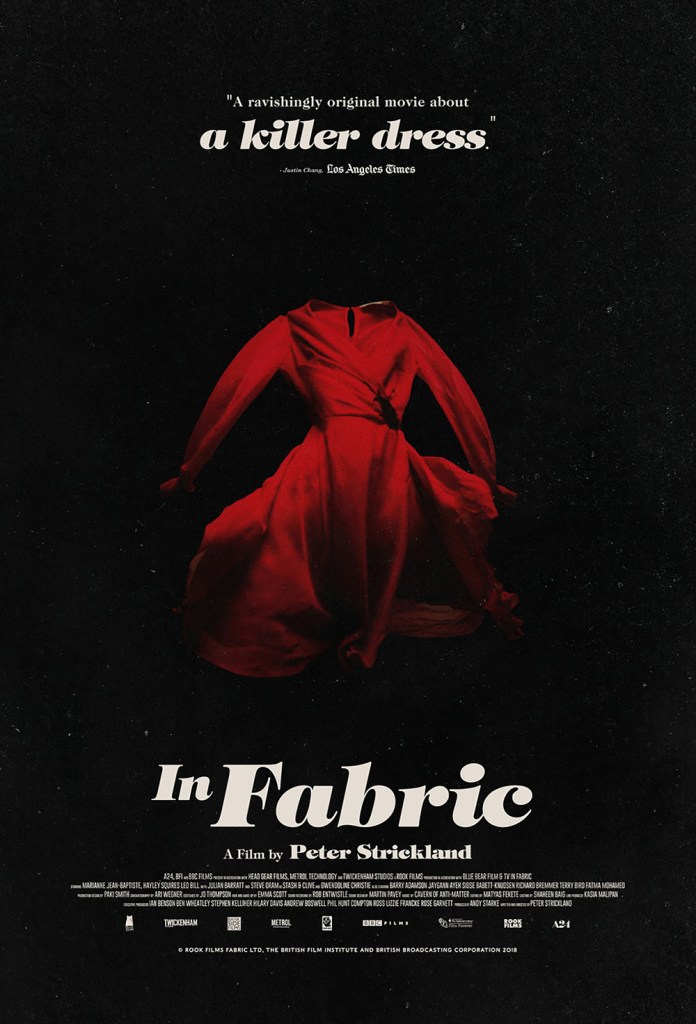
She’s fitted with a perfectly flattering, artery-red gown—which, in time, will come to unleash a malevolent curse and unstoppable evil, threatening everyone who comes into its path.

From acclaimed horror director Peter Strickland (the singular auteur behind the sumptuous sadomasochistic romance The Duke of Burgundy and auditory gaillo-homage Berberian Sound Studio) comes a truly nightmarish film, at turns frightening, seductive, and darkly humorous. Channeling voyeuristic fantasies of high fashion and bloodshed, In Fabric is Strickland’s most twisted and brilliantly original vision yet.

Tidbits:

  • Toronto International Film Festival – 2018
  • BFI London Film Festival – 2018
  • Tribeca Film Festival – 2019
  • AFI Fest – 2018
  • British Independent Film Awards – 2019 – Nominee: Best Production Design, Best Casting, Best Sound, Best Cinematography, Best Effects, Best Costume Design, Best Make-Up & Hair Design, Best Music & Best Screenplay

Director Bio

“I’m glad British film produces mainstream crowd-pleasers, but I don’t want to make one.”

Courtesy of Daniel Gasenzer.

Courtesy of Flux Gourmet press kit:

Peter Strickland (born in Great Britain’s Thames Valley in 1973) has made five feature films steeped in tragedy, sonic psychosis, bondage, retail nightmares and stomach problems.

Peter Strickland started making short films on Super 8 and 16mm in the early ’90s. After directing his adaptation of Kafka’s ‘Metamorphosis’ for Reading’s Progress Theatre in 1992 he went on to direct a short film in New York called ‘Bubblegum’, which played at festivals in 1996. After a long hiatus making culinary soundscapes with The Sonic Catering Band, he returned to film in the early part of this century. His first feature film, ‘Katalin Varga’ was funded from an inheritance and shot and edited on a budget of £25,000. The Carpathian tragedy led to funding from the British film industry and the Milano-Dorking sonic anguish of ‘Berberian Sound Studio’ followed in 2012 along with the bondage romance, ‘The Duke of Burgundy’ in 2015. Several radio plays along with a concert film for Björk co-directed with Nick Fenton were made in the last few years and his fourth feature, the Thames Valley retail nightmare, ‘In Fabric’ was released in 2019. His latest feature is the gastrointestinal drama ‘Flux Gourmet’.

Filmography:

  • Flux Gourmet (2022)
  • In Fabric (2019)
  • The Duke of Burgundy (2015)
  • Björk: Biophilia Live (2014)
  • Berberian Sound Studio (2012)
  • Katalin Varga (2009)

Links

Here is a curated selection of links for additional insight/information:

  • Cultivate Cinema Circle info-sheet – link
  • “Comics artist Howard Chaykin once (or twice) said that the role of advertising is to flatter you into thinking that you’re smarter than advertising. That concept is put to work in In Fabric, a slippery horror-comedy about the equally treacherous relationship between salespeople, consumers, and their possessions. Watching In Fabric, the latest giallo-inspired adult fairy tale by British writer/director Peter Strickland, is often disorienting given how blunt its anti-consumerist symbolism and queasy sense of humor can be. But if you respond to Strickland’s weird combination of psychedelic elusiveness and kitchen sink melodrama, In Fabric might stick in your mind. Strickland frequently tests viewers’ patience, but his off-putting sensibility is powerful enough to make In Fabric as mesmerizing as its subject matter: salesmanship as a sinister, inescapable form of hypnosis.” —Simon Abrams, RogerEbert.com [2019] – link
  • “Stylish in both subject and form, In Fabric is shot in retina-searing greens, oranges and, above all, reds (crimson-lacquered nails, oozing blood, the rippling chiffon of the dress), a lurid colour palette that heightens our senses, already sharpened by the film’s supernatural goings-on. The director Peter Strickland stitches strings of fetishistic images together to create an uneven, collage-like effect, a movie that rips through critiques of materialism and presentations of middle-aged solitude with a shuddering acuity. Through its exploration of commodification, the feature humorously satirises our obsession with endless acquisition, no matter what the cost. In Fabric is devilish and daring, a head-spinning journey into the paranormal. Passing from chest-beating alpha males to brides-to-be on its destructive path, the shape-shifting garment comes to mimic consumerist desire itself: an ambulant, morphing entity that, in the wrong hands, can prove cut-throat.” — Yasmin Omar, Harper’s Bazaar [2019] – link
  • “Strickland’s emphasis on sonic ‘texture’, and its ability to create mood and atmosphere evokes how a film’s surface holds an affective charge for spectators. As [Giuliana] Bruno puts it, ‘affect is actually ‘worn’ on the surface’ to become ‘an enveloping fabric…an extensive form of textural contact’ or, even more poetically, ‘our second skin, our sensory cloth’.10 In light of this, Fenton’s earlier criticism that she could not ‘wrap her head around’ the film seems beside the point. One might be able to read the film’s monstrous dress, insane department store, and tyrannical bankers as a critique of consumerism. Or, perhaps, view the film through a psychoanalytic lens to examine its use of the uncanny, the abject, or its Freudian motifs of motherhood, desire and death. But such approaches would – more than likely – prove ill-suited for the task. Indeed, it might very well be impossible to conclusively unravel In Fabric’s ‘meaning’. In Fabric asks us to not ‘read into’ and make sense of what might lie beneath its surface so much as sensually and emotionally feel our way through it. ‘Film itself can be said to be a form of tailoring,’ says Bruno, ‘stitched together in strands of celluloid, woven into patterns, designed and assembled…like a customized garment’. Just like its cursed red dress, In Fabric somehow seems to stick to the skin, lingers in the mind, and follows us long after we leave its strange world. Its textured imagery and wild soundtrack are woven into its own kind of “fabric” that gives an unrelenting affective caress. Like the hypnotic advertisements for Dentley & Soper that Sheila watches on the television, In Fabric lures spectators in and grabs hold. Being in In Fabric’s fabric returns us of our own materiality and, in doing so, also reminds us of our embodied capacity to feel, to be moved, and to imagine.” — David Evan Richard, Senses of Cinema [2019] – link

Berberian Sound Studio – November 5th, 2022

Berberian Sound Studio


Please join Cultivate Cinema Circle as we screen four films written & directed by Peter Strickland. First up is his British Independent Film Awards-winning Berberian Sound Studio [2012].


Event Sponsors:

Venue Information:

Downtown Central Library Auditorium
1 Lafayette Square, Buffalo, NY 14203
(Enter from Clinton Street between Oak and Washington Streets)
716-858-8900 • www.BuffaloLib.org
COVID protocol will be followed.


Synopsis

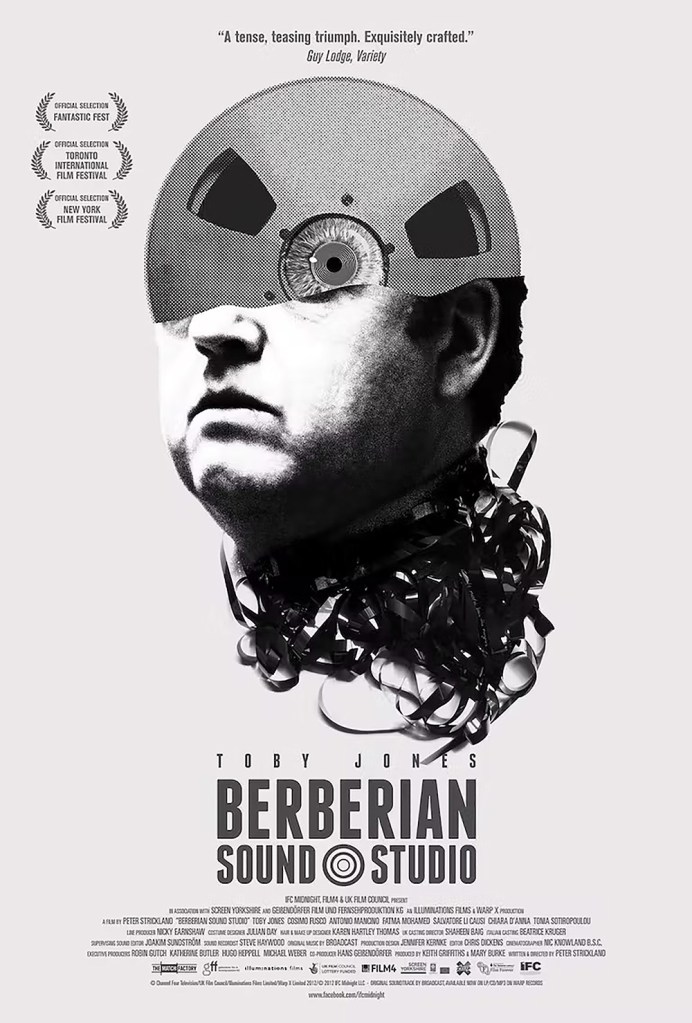
1976. A mild-mannered British sound engineer named Gilderoy (Toby Jones) arrives in Rome to work on the post-synchronized soundtrack to The Equestrian Vortex, a tale of witchcraft and murder set inside an all-girl riding academy. But as Gilderoy begins to work on this unexpectedly terrifying project, it’s his own mind that holds the real horrors. As the line between film and reality blurs, is Gilderoy working on a film – or in one?

Tidbits:

  • Locarno International Film Festival – 2012 – Special Mention: Junior Jury Award (International Competition)
  • Toronto International Film Festival – 2012
  • New York Film Festival – 2012
  • AFI Fest – 2012
  • International Film Festival Rotterdam – 2013
  • British Independent Film Awards – 2012 – Nominee: Best British Independent Film, Best Screenplay & Best Technical Achievement
  • British Independent Film Awards – 2012 – Winner: Best Technical Achievement, Best Director, Best Actor & Best Achievement in Production

Director Bio

“I’m glad British film produces mainstream crowd-pleasers, but I don’t want to make one.”

Courtesy of Daniel Gasenzer.

Courtesy of Flux Gourmet press kit:

Peter Strickland (born in Great Britain’s Thames Valley in 1973) has made five feature films steeped in tragedy, sonic psychosis, bondage, retail nightmares and stomach problems.

Peter Strickland started making short films on Super 8 and 16mm in the early ’90s. After directing his adaptation of Kafka’s ‘Metamorphosis’ for Reading’s Progress Theatre in 1992 he went on to direct a short film in New York called ‘Bubblegum’, which played at festivals in 1996. After a long hiatus making culinary soundscapes with The Sonic Catering Band, he returned to film in the early part of this century. His first feature film, ‘Katalin Varga’ was funded from an inheritance and shot and edited on a budget of £25,000. The Carpathian tragedy led to funding from the British film industry and the Milano-Dorking sonic anguish of ‘Berberian Sound Studio’ followed in 2012 along with the bondage romance, ‘The Duke of Burgundy’ in 2015. Several radio plays along with a concert film for Björk co-directed with Nick Fenton were made in the last few years and his fourth feature, the Thames Valley retail nightmare, ‘In Fabric’ was released in 2019. His latest feature is the gastrointestinal drama ‘Flux Gourmet’.

Filmography:

  • Flux Gourmet (2022)
  • In Fabric (2019)
  • The Duke of Burgundy (2015)
  • Björk: Biophilia Live (2014)
  • Berberian Sound Studio (2012)
  • Katalin Varga (2009)

Links

Here is a curated selection of links for additional insight/information:

  • Cultivate Cinema Circle info-sheet – link
  • “A cabbage, a kitchen knife and a microphone: what untold depths of horror can be delved into using just these items? In a parallel dimension it could be a task from Blue Peter. This second feature by Katalin Varga director Peter Strickland is a love letter to the weird territories of foley and film sound and also to giallo, the Grand Guignol horror genre carved into the flesh of Italian cinema by Argento, Fulci, Crispino, Avati et al in the 1970s. It follows Gilderoy (Toby Jones), a tweedy, buttoned-down sound engineer, as he leaves the cosy quiet of his home in 1970s Surrey for Italy, to work with Santini, fictionalised giallo producer and impresario. Like Dracula’s Harker, Gilderoy is an innocent abroad, a Home Counties product bewildered by Continental sophistication, an employee increasingly aware that there is something not very… nice about his new employers. The film opens with Gilderoy arriving at the reception of the Berberian Sound Studio to work on the post-production of Santini’s latest picture, and once there it never leaves. It’s an intensely inward-looking piece: in contrast to Katalin Varga (2009), a revenge narrative shot on location with natural lighting, Berberian Sound Studio is entirely enclosed, taking place within a claustrophobic handful of rooms and corridors under electric light. As a film about a film genre it hits all the notes of classic giallo: Santini’s project, The Equestrian Vortex, is an outrageously sexploitational potboiler, overflowing with blood, nubile young women, undead witches, horrific torture and an ‘aroused goblin’. Berberian Sound Studio is also fascinated by the mechanics of its own form. The camera roves over Gilderoy’s charts, his maps of how sounds and effects will overlay the visuals. It zooms in lovingly on the moment of projection itself: the glare of white light, the dust dancing, the click and whir of wheels, reels and spindles.” — Sam Davies, Sight & Sound [2012] – link
  • “The Human Scream is at the hub of our understanding of the 20th century. It resounds and echoes across the era, across the scope of historical and cultural experience – a universal response wholly apposite to the social, economic and political cruelties, architectures, changes and historical traumas of the era. In 20th century culture there is an abundance of screams and screamers. Consider, for instance, the paintings of the Irish artist Francis Bacon, whose images of boxed-in, silent screamers, resonate iconographically in English director and sound artist/designer Peter Strickland’s film Berberian Sound Studio in which again we are shown images of screaming bodies enclosed within the sound booths of the studio…Peter Strickland is a contemporary director and sound artist/designer whose work re-interrogates this 20th century cultural and cinematic phenomenon of the scream from a 21st century perspective. In Strickland’s films the scream is post-modern: reimagined, recast, deconstructed and re-mediated via a set of diegetic and non-diegetic devices, which forcefully separate the scream from the screamer, who is left as an inert, catatonic presence. This article seeks not only to discuss the role and presence of the scream in Strickland’s cinema but also to recognise the influence of the Irish dramatist and writer Samuel Beckett and the dissident surrealist and founder of the Theatre of Cruelty, Antonin Artaud within Strickland’s cinema. For both, the act and representation of screaming is bound up closely with cruelty (an ambiguous and multivalent term within their writing, drama and imagery), space, dis-embodiment, the search for and evanescence of personal subjectivity, and identity.” — Matthew Melia, Frames Cinema Journal [2017] – link
  • Berberian Sound Studio is Strickland’s second feature after his largely self-financed debut Katalin Varga, a surprise winner at Berlin in 2009. A former art student, versed in experimental film and music (he’s a member of a culinary-themed musique concrète outfit named the Sonic Catering Band), Strickland has declared that he owes his interest in giallo films to their soundtrack contributions by avant-garde musical luminaries such as Luigi Nono and Luciano Berio. And it’s the mixture of horror and experimental modes, as well as the formal panache with which they’re combined, that makes Berberian Sound Studio such an unusual British film, one that’s been warmly received by critics and won a number of prizes. But Berberian isn’t some worthy exercise in cultural contraband, smuggling in high culture under the guise of low. It’s funny, disturbing, and enjoyably puzzling, and its structure—a film (that we don’t see) within a film (in which we hear it)—allows Strickland to play an unsettling game with cinematic space.” —Chris Darke, Film Comment [2013] – link