Please join Cultivate Cinema Circle as we screen four films written & directed by Peter Strickland. Next up is his British Independent Film Awards-nominated In Fabric [2019].
Screening Date: Saturday, December 3rd, 2022 | 1:00pm
Downtown Central Library Auditorium 1 Lafayette Square, Buffalo, NY 14203 (Enter from Clinton Street between Oak and Washington Streets) 716-858-8900 • www.BuffaloLib.org COVID protocol will be followed.
Synopsis
A lonely woman (Marianne Jean-Baptiste), recently separated from her husband, visits a bewitching department store in search of a dress that will transform her life.
She’s fitted with a perfectly flattering, artery-red gown—which, in time, will come to unleash a malevolent curse and unstoppable evil, threatening everyone who comes into its path.
From acclaimed horror director Peter Strickland (the singular auteur behind the sumptuous sadomasochistic romance The Duke of Burgundy and auditory gaillo-homage Berberian Sound Studio) comes a truly nightmarish film, at turns frightening, seductive, and darkly humorous. Channeling voyeuristic fantasies of high fashion and bloodshed, In Fabric is Strickland’s most twisted and brilliantly original vision yet.
Tidbits:
Toronto International Film Festival – 2018
BFI London Film Festival – 2018
Tribeca Film Festival – 2019
AFI Fest – 2018
British Independent Film Awards – 2019 – Nominee: Best Production Design, Best Casting, Best Sound, Best Cinematography, Best Effects, Best Costume Design, Best Make-Up & Hair Design, Best Music & Best Screenplay
Director Bio
“I’m glad British film produces mainstream crowd-pleasers, but I don’t want to make one.”
Courtesy of Daniel Gasenzer.
Courtesy of Flux Gourmet press kit:
Peter Strickland (born in Great Britain’s Thames Valley in 1973) has made five feature films steeped in tragedy, sonic psychosis, bondage, retail nightmares and stomach problems.
Peter Strickland started making short films on Super 8 and 16mm in the early ’90s. After directing his adaptation of Kafka’s ‘Metamorphosis’ for Reading’s Progress Theatre in 1992 he went on to direct a short film in New York called ‘Bubblegum’, which played at festivals in 1996. After a long hiatus making culinary soundscapes with The Sonic Catering Band, he returned to film in the early part of this century. His first feature film, ‘Katalin Varga’ was funded from an inheritance and shot and edited on a budget of £25,000. The Carpathian tragedy led to funding from the British film industry and the Milano-Dorking sonic anguish of ‘Berberian Sound Studio’ followed in 2012 along with the bondage romance, ‘The Duke of Burgundy’ in 2015. Several radio plays along with a concert film for Björk co-directed with Nick Fenton were made in the last few years and his fourth feature, the Thames Valley retail nightmare, ‘In Fabric’ was released in 2019. His latest feature is the gastrointestinal drama ‘Flux Gourmet’.
Filmography:
Flux Gourmet (2022)
In Fabric (2019)
The Duke of Burgundy (2015)
Björk: Biophilia Live (2014)
Berberian Sound Studio (2012)
Katalin Varga (2009)
Links
Here is a curated selection of links for additional insight/information:
“Comics artist Howard Chaykin once (or twice) said that the role of advertising is to flatter you into thinking that you’re smarter than advertising. That concept is put to work in In Fabric, a slippery horror-comedy about the equally treacherous relationship between salespeople, consumers, and their possessions. Watching In Fabric, the latest giallo-inspired adult fairy tale by British writer/director Peter Strickland, is often disorienting given how blunt its anti-consumerist symbolism and queasy sense of humor can be. But if you respond to Strickland’s weird combination of psychedelic elusiveness and kitchen sink melodrama, In Fabric might stick in your mind. Strickland frequently tests viewers’ patience, but his off-putting sensibility is powerful enough to make In Fabric as mesmerizing as its subject matter: salesmanship as a sinister, inescapable form of hypnosis.” —Simon Abrams, RogerEbert.com [2019] – link
“Stylish in both subject and form, In Fabric is shot in retina-searing greens, oranges and, above all, reds (crimson-lacquered nails, oozing blood, the rippling chiffon of the dress), a lurid colour palette that heightens our senses, already sharpened by the film’s supernatural goings-on. The director Peter Strickland stitches strings of fetishistic images together to create an uneven, collage-like effect, a movie that rips through critiques of materialism and presentations of middle-aged solitude with a shuddering acuity. Through its exploration of commodification, the feature humorously satirises our obsession with endless acquisition, no matter what the cost. In Fabric is devilish and daring, a head-spinning journey into the paranormal. Passing from chest-beating alpha males to brides-to-be on its destructive path, the shape-shifting garment comes to mimic consumerist desire itself: an ambulant, morphing entity that, in the wrong hands, can prove cut-throat.” — Yasmin Omar, Harper’s Bazaar [2019] – link
“Strickland’s emphasis on sonic ‘texture’, and its ability to create mood and atmosphere evokes how a film’s surface holds an affective charge for spectators. As [Giuliana] Bruno puts it, ‘affect is actually ‘worn’ on the surface’ to become ‘an enveloping fabric…an extensive form of textural contact’ or, even more poetically, ‘our second skin, our sensory cloth’.10 In light of this, Fenton’s earlier criticism that she could not ‘wrap her head around’ the film seems beside the point. One might be able to read the film’s monstrous dress, insane department store, and tyrannical bankers as a critique of consumerism. Or, perhaps, view the film through a psychoanalytic lens to examine its use of the uncanny, the abject, or its Freudian motifs of motherhood, desire and death. But such approaches would – more than likely – prove ill-suited for the task. Indeed, it might very well be impossible to conclusively unravel In Fabric’s ‘meaning’. In Fabric asks us to not ‘read into’ and make sense of what might lie beneath its surface so much as sensually and emotionally feel our way through it. ‘Film itself can be said to be a form of tailoring,’ says Bruno, ‘stitched together in strands of celluloid, woven into patterns, designed and assembled…like a customized garment’. Just like its cursed red dress, In Fabric somehow seems to stick to the skin, lingers in the mind, and follows us long after we leave its strange world. Its textured imagery and wild soundtrack are woven into its own kind of “fabric” that gives an unrelenting affective caress. Like the hypnotic advertisements for Dentley & Soper that Sheila watches on the television, In Fabric lures spectators in and grabs hold. Being in In Fabric’s fabric returns us of our own materiality and, in doing so, also reminds us of our embodied capacity to feel, to be moved, and to imagine.” — David Evan Richard, Senses of Cinema [2019] – link
Please join Cultivate Cinema Circle as we screen four films written & directed by Peter Strickland. First up is his British Independent Film Awards-winning Berberian Sound Studio [2012].
Screening Date: Saturday, November 5th, 2022 | 1:00pm
Downtown Central Library Auditorium 1 Lafayette Square, Buffalo, NY 14203 (Enter from Clinton Street between Oak and Washington Streets) 716-858-8900 • www.BuffaloLib.org COVID protocol will be followed.
Synopsis
1976. A mild-mannered British sound engineer named Gilderoy (Toby Jones) arrives in Rome to work on the post-synchronized soundtrack to The Equestrian Vortex, a tale of witchcraft and murder set inside an all-girl riding academy. But as Gilderoy begins to work on this unexpectedly terrifying project, it’s his own mind that holds the real horrors. As the line between film and reality blurs, is Gilderoy working on a film – or in one?
Tidbits:
Locarno International Film Festival – 2012 – Special Mention: Junior Jury Award (International Competition)
Toronto International Film Festival – 2012
New York Film Festival – 2012
AFI Fest – 2012
International Film Festival Rotterdam – 2013
British Independent Film Awards – 2012 – Nominee: Best British Independent Film, Best Screenplay & Best Technical Achievement
British Independent Film Awards – 2012 – Winner: Best Technical Achievement, Best Director, Best Actor & Best Achievement in Production
Director Bio
“I’m glad British film produces mainstream crowd-pleasers, but I don’t want to make one.”
Courtesy of Daniel Gasenzer.
Courtesy of Flux Gourmet press kit:
Peter Strickland (born in Great Britain’s Thames Valley in 1973) has made five feature films steeped in tragedy, sonic psychosis, bondage, retail nightmares and stomach problems.
Peter Strickland started making short films on Super 8 and 16mm in the early ’90s. After directing his adaptation of Kafka’s ‘Metamorphosis’ for Reading’s Progress Theatre in 1992 he went on to direct a short film in New York called ‘Bubblegum’, which played at festivals in 1996. After a long hiatus making culinary soundscapes with The Sonic Catering Band, he returned to film in the early part of this century. His first feature film, ‘Katalin Varga’ was funded from an inheritance and shot and edited on a budget of £25,000. The Carpathian tragedy led to funding from the British film industry and the Milano-Dorking sonic anguish of ‘Berberian Sound Studio’ followed in 2012 along with the bondage romance, ‘The Duke of Burgundy’ in 2015. Several radio plays along with a concert film for Björk co-directed with Nick Fenton were made in the last few years and his fourth feature, the Thames Valley retail nightmare, ‘In Fabric’ was released in 2019. His latest feature is the gastrointestinal drama ‘Flux Gourmet’.
Filmography:
Flux Gourmet (2022)
In Fabric (2019)
The Duke of Burgundy (2015)
Björk: Biophilia Live (2014)
Berberian Sound Studio (2012)
Katalin Varga (2009)
Links
Here is a curated selection of links for additional insight/information:
“A cabbage, a kitchen knife and a microphone: what untold depths of horror can be delved into using just these items? In a parallel dimension it could be a task from Blue Peter. This second feature by Katalin Varga director Peter Strickland is a love letter to the weird territories of foley and film sound and also to giallo, the Grand Guignol horror genre carved into the flesh of Italian cinema by Argento, Fulci, Crispino, Avati et al in the 1970s. It follows Gilderoy (Toby Jones), a tweedy, buttoned-down sound engineer, as he leaves the cosy quiet of his home in 1970s Surrey for Italy, to work with Santini, fictionalised giallo producer and impresario. Like Dracula’s Harker, Gilderoy is an innocent abroad, a Home Counties product bewildered by Continental sophistication, an employee increasingly aware that there is something not very… nice about his new employers. The film opens with Gilderoy arriving at the reception of the Berberian Sound Studio to work on the post-production of Santini’s latest picture, and once there it never leaves. It’s an intensely inward-looking piece: in contrast to Katalin Varga (2009), a revenge narrative shot on location with natural lighting, Berberian Sound Studio is entirely enclosed, taking place within a claustrophobic handful of rooms and corridors under electric light. As a film about a film genre it hits all the notes of classic giallo: Santini’s project, The Equestrian Vortex, is an outrageously sexploitational potboiler, overflowing with blood, nubile young women, undead witches, horrific torture and an ‘aroused goblin’. Berberian Sound Studio is also fascinated by the mechanics of its own form. The camera roves over Gilderoy’s charts, his maps of how sounds and effects will overlay the visuals. It zooms in lovingly on the moment of projection itself: the glare of white light, the dust dancing, the click and whir of wheels, reels and spindles.” — Sam Davies, Sight & Sound [2012] – link
“The Human Scream is at the hub of our understanding of the 20th century. It resounds and echoes across the era, across the scope of historical and cultural experience – a universal response wholly apposite to the social, economic and political cruelties, architectures, changes and historical traumas of the era. In 20th century culture there is an abundance of screams and screamers. Consider, for instance, the paintings of the Irish artist Francis Bacon, whose images of boxed-in, silent screamers, resonate iconographically in English director and sound artist/designer Peter Strickland’s film Berberian Sound Studio in which again we are shown images of screaming bodies enclosed within the sound booths of the studio…Peter Strickland is a contemporary director and sound artist/designer whose work re-interrogates this 20th century cultural and cinematic phenomenon of the scream from a 21st century perspective. In Strickland’s films the scream is post-modern: reimagined, recast, deconstructed and re-mediated via a set of diegetic and non-diegetic devices, which forcefully separate the scream from the screamer, who is left as an inert, catatonic presence. This article seeks not only to discuss the role and presence of the scream in Strickland’s cinema but also to recognise the influence of the Irish dramatist and writer Samuel Beckett and the dissident surrealist and founder of the Theatre of Cruelty, Antonin Artaud within Strickland’s cinema. For both, the act and representation of screaming is bound up closely with cruelty (an ambiguous and multivalent term within their writing, drama and imagery), space, dis-embodiment, the search for and evanescence of personal subjectivity, and identity.” — Matthew Melia, Frames Cinema Journal [2017] – link
“Berberian Sound Studio is Strickland’s second feature after his largely self-financed debut Katalin Varga, a surprise winner at Berlin in 2009. A former art student, versed in experimental film and music (he’s a member of a culinary-themed musique concrète outfit named the Sonic Catering Band), Strickland has declared that he owes his interest in giallo films to their soundtrack contributions by avant-garde musical luminaries such as Luigi Nono and Luciano Berio. And it’s the mixture of horror and experimental modes, as well as the formal panache with which they’re combined, that makes Berberian Sound Studio such an unusual British film, one that’s been warmly received by critics and won a number of prizes. But Berberian isn’t some worthy exercise in cultural contraband, smuggling in high culture under the guise of low. It’s funny, disturbing, and enjoyably puzzling, and its structure—a film (that we don’t see) within a film (in which we hear it)—allows Strickland to play an unsettling game with cinematic space.” —Chris Darke, Film Comment [2013] – link
Please join Cultivate Cinema Circle as we screen six films in space. Next up is Todd Douglas Miller’s Emmy-winning (Outstanding Picture Editing for a Nonfiction Program, Outstanding Sound Editing for a Nonfiction or Reality Program & Outstanding Sound Mixing for a Nonfiction or Reality Program) film Apollo 11 [2019].
Screening Date: Saturday, September 10th, 2022 | 1:00pm
Downtown Central Library Auditorium 1 Lafayette Square, Buffalo, NY 14203 (Enter from Clinton Street between Oak and Washington Streets) 716-858-8900 • www.BuffaloLib.org COVID protocol will be followed.
Synopsis
From director Todd Douglas Miller (Dinosaur 13) comes a cinematic event fifty year s in the making. Crafted from a newly discovered trove of 65mm footage, and more than 11,000 hours of uncatalogued audio recordings, Apollo 11 takes us straight to the heart of NASA’s most celebrated mission—the one that first put men on the moon, and forever made Neil Armstrong and Buzz Aldrin into household names. Immersed in the perspectives of the astronauts, the team in Mission Control, and the millions of spectators on the ground, we vividly experience those momentous days and hours in 1969 when humankind took a giant leap into the future.
Miller and team were working closely with NASA and the National Archives (NARA ) to locate all existing Apollo 11 footage when NARA staff members made a startling discovery that changed the course of the project: an unprocessed collection of 65mm large format footage, never before seen by the public, containing stunning shots of the launch, the inside of Mission Control, and recovery and post-mission activities. The footage was so pristine and the find so significant that the project evolved beyond filmmaking into one of film curation and historic preservation.
The other unexpected find was a massive cache of audio recordings—more than 11,000 hours—made by two custom recorders which captured individual tracks from 60 key mission personnel throughout every moment of the mission. Apollo 11 film team members created code to restore the audio and make it searchable, then began the multi-year process of listening to and documenting the recordings, an effort that yielded remarkable new insights into key events of the mission as well as surprising moments of humor and camaraderie.
The digitization of the 65mm collection—as well as the re-scanning of 16mm and 35mm materials—was undertaken at Final Frame, a post-production house in New York City, which helped create a custom scanner, capable of high dynamic range scanning at resolutions up to 8K. The resulting transfer—from which the film was cut—is the highest resolution, highest quality digital collection of Apollo 11 footage in existence.
Constructed entirely from archival materials and eschewing talking heads, Apollo 11 captures the enormity of the event by giving audiences of all ages the direct experience of being there. When John F. Kennedy pledged in 1962 to put Americans on the moon by the end of the decade, he described it as a bold act of faith and vision. Apollo 11 bears witness to the culmination of that pledge, when America and the world came together in an extraordinary act of unity and resolve, to achieve one of the greatest and most complex feats in human history .
Tidbits:
SXSW Film Festival – 2019
Sundance Film Festival – 2019 – Winner: Special Jury Award for Editing (U.S. Documentary Competition)
Independent Spirit Awards – 2020 – Nominee: Best Documentary
National Board of Review – 2019
Director’s Statement
The mission of Apollo 11 is one of the greatest achievements in human history – hundreds of thousands of people spread across tens of thousands of companies all focused on putting the first humans on another world.
At times it felt like our film had just as many moving parts. What started out as a simple editing exercise—could we tell the entire story of the mission using only archival materials—turned into a cooperative effort by an international team of experts to create the definitive work on Apollo 11 for the screen. The remarkable discovery of a cache of untouched large format film and audio recordings added another dimension to the project: it was more than just a film now, it was an opportunity to curate and preserve this priceless historical material.
This film only exists because of the tremendous efforts and sacrifices of an extremely talented group of individuals. From the archivists and researchers, to the post production teams and production partners, everyone labored for years to ensure we got it right.
We are also indebted to the scores of writers, filmmakers, and researchers that have come before us to build on the canon of project Apollo. And to the astronauts, their families, NASA employees, contractors, and volunteers, many of whom we came to know in the course of making this film, we humbly say thank you. You remind us that great things can be accomplished when people unite for a common goal.
Please join Cultivate Cinema Circle as we screen six films in space. Next up is Theodore Melfi’s Oscar-nominated (Best Motion Picture of the Year, Best Performance by an Actress in a Supporting Role & Best Adapted Screenplay) film Hidden Figures [2016].
Screening Date: Saturday, July 30th, 2022 | 1:00pm
Downtown Central Library Auditorium 1 Lafayette Square, Buffalo, NY 14203 (Enter from Clinton Street between Oak and Washington Streets) 716-858-8900 • www.BuffaloLib.org COVID protocol will be followed.
Synopsis
Hidden Figures tells the incredible untold story of Katherine Jonson (Taraji P. Henson), Dorothy Vaughan (Octavia Spencer) and Mary Jackson (Janelle Monae) – brilliant African-American women working at NASA who served as the brains behind the launch into orbit of astronaut John Glenn, a stunning achievement that turned around the space race. The visionary trio crossed all gender and racial line and inspired generations.
Tidbits:
Academy Awards – 2017 – Nominee: Best Motion Picture of the Year, Best Performance by an Actress in a Supporting Role & Best Adapted Screenplay
National Board of Review – 2016 – Winner: Top Ten Films & Best Ensemble
Writers Guild of America – 2017 – Nominee: Adapted Screenplay
Screen Actors Guild Awards – 2017 – Winner: Outstanding Performance by a Cast in a Motion Picture
Screen Actors Guild Awards – 2017 – Nominee: Outstanding Performance by a Female Actor in a Supporting Role
Golden Globes (USA) – 2017 – Nominee: Best Original Score – Motion Picture & Best Performance by an Actress in a Supporting Role in a Motion Picture
Director Bio
“So $25 million is what Hidden Figures cost, but it looks a lot more than that; it’s just a testament to a hardworking crew and a hardworking cast that did it for the love of it, and I think that’s what movies should be done for, for the love of it, and if it’s a success, everyone will be rewarded.”
Writer, producer and filmmaker Ted Melfi began his career helming over 100 commercials before branching out into short films and full-length features, eventually making his mark in Hollywood as the director of the Bill Murray-starring comedy “St. Vincent” (2014). Born in Brooklyn, NY, Melfi’s early career was dominated by commercial work for the likes of FedEx, McDonalds and Slim Fast. But having directed his wife Kimberly Quinn in “Winding Roads” (1999), a low-budget indie drama released through his own production company, Goldenlight, Melfi’s focus began to shift towards the film industry.
After serving as producer on “Ronnie” (2002), a psychological thriller about a troubled young man who strikes up a relationship with a patient at a mental institution, “Joe Killionaire” (2004), a tongue-in-cheek satire of reality TV, and “Getno” (2005), a drama about a Hungarian family’s attempt to achieve the American Dream, Melfi wrote, produced and directed his first short, “The Story of Bob” (2005), a spoof documentary about a man’s obsession with IKEA. Following production work on trashy mutant TV movie “MorphMan” (Syfy, 2007) and children’s soccer drama “Game of Life” (2007), Melfi helmed a string of further shorts including mistaken identity tale “The Beneficiary” (2008), a mockumentary about a rock/paper/scissors tournament, “Roshambo” (2010) and the story of a search for the perfect nanny, “I Want Candy” (2010). After taking on a producer’s role on romantic comedy of errors “Bed & Breakfast: Love Is A Happy Accident” (2010), Melfi added screenwriter to his list of talents when he was hired to pen a remake of the crime comedy “Going In Style” (1979) and the New York Times best-selling memoir, The Tender Bar, and also set up his own content production company, Brother, with Rich Carter.
Having impressively managed to acquire the talents of Bill Murray, as well as Naomi Watts and Melissa McCarthy, for his first major full-length feature, Melfi made Hollywood sit up and take notice with “St. Vincent” (2014), the heart-warming story of a grouchy war veteran who forms an unlikely bond with his 12-year-old next-door neighbor. Melfi followed up the indie success with a commercial breakthrough, “Hidden Figures” (2016). Starring Octavia Spencer, Taraji P. Henson and Janelle Monáe as mathematicians employed by NASA in the early 1960s, the fact-based drama was a box office hit that was nominated for Best Picture; Melfi and co-writer Allison Schroeder also scored a Best Adapted Screenplay nod.
Filmography:
Hidden Figures (2016)
St. Vincent (2014)
Links
Here is a curated selection of links for additional insight/information:
“The top-earning Best Picture nominee of 2017 ($236 million), Hidden Figures presented three brilliant black women who just wanted to do their jobs. And they did: their expertise at a NASA field center helped send the first Americans into orbit, an extra-amazing feat since each was hobbled by segregation laws still in effect in the early ’60s. Mathematician Katherine Goble (Taraji P. Henson) had to trek a half-mile to use the bathroom at work; Dorothy Vaughan was reprimanded for conducting research in a library’s whites-only section; and Mary Jackson (Janelle Monáe) went to court seeking enrollment in an off-limits engineering program. Rated PG, the film aimed to be widely accessible, including a love story (between Henson and her previous Curious Case of Benjamin Button co-star Mahershala Ali), friendship excursions, historical context, and countdown drama. Budgeted at just $25 million, writer-director-producer Theodore Melfi delivered the first live-action, non-franchise film in six years that featured multiple female leads and registered successive victories at the weekend box office (its predecessor: The Help). The source material was Margot Lee Shetterly’s eponymous book, optioned before publication by 20th Century Fox. Beyond acknowledging the accomplishments of this trio and their peers, and the continued need for women in STEM jobs, Hidden Figures produced perhaps the most scholarly Barbie doll to ever sell out.” — Jenna Marotta, IndieWire [2018] – link
“Hidden Figures has a sexy title that the film downplays in favor of pure math and basic domesticity, so maybe it’s fitting to point out that the IBM 7090 was first turned on by a black woman. The progression from analog to digital provides an important subtext in Hidden Figures, also set in Virginia in the same time period as Loving. As Octavia Spencer’s Dorothy Vaughan teaches herself Fortran in the back of the bus, she also has to confront automation and figure out how to make it work for her and the other women on her staff of math geniuses, the ‘colored computers’ who do calculations for NASA as it gears up to put John Glenn into space. Theodore Melfi’s film takes the opposite tack from Nichols’s. This is an all-star feel-good movie about American ingenuity, in love with the future, stocked with hit music on the soundtrack and titles on-screen that tell us where we are. The film makes room for everyone in its cast. Taraji P. Henson, Mahershala Ali, Jim Parsons, Kirsten Dunst, and Janelle Monáe each get plenty to do, whether they are pure and good or shifty professionalized racists. Old-pro Kevin Costner chips in, desegregating the restrooms at NASA, a smaller triumph than John Glenn’s space flight but one that sped the US in the race to the moon. Hidden Figures lacks the self-seriousness and concern with special effects of recent space arias like Gravity and The Martian, proving that history and human society are more entertaining than the lives of lonely astronauts divorced from social context, who talk to themselves on another planet or float alone in space. The future in Hidden Figures is in our past, but it unrolls a blueprint to get back there.” — A. S. Hamrah, n+1 [2018] – link
Please join Cultivate Cinema Circle as we screen six films in space. Next up is James Gray’s Oscar-nominated (Best Achievement in Sound Mixing) film Ad Astra [2019].
Screening Date: Saturday, July 16th, 2022 | 1:00pm
Downtown Central Library Auditorium 1 Lafayette Square, Buffalo, NY 14203 (Enter from Clinton Street between Oak and Washington Streets) 716-858-8900 • www.BuffaloLib.org COVID protocol will be followed.
Synopsis
Brad Pitt gives a powerful performance in this, “absolutely enthralling” (Rolling Stone), sci-fi thriller set in space. When a mysterious life-threatening event strikes Earth, astronaut Roy McBride (Pitt) goes on a dangerous mission across an unforgiving solar system to uncover the truth about his missing father (Tommy Lee Jones) and his doomed expedition that now, 30 years later, threatens the universe.
Tidbits:
Venice Film Festival – 2019
Academy Awards – 2020 – Nominee: Best Sound Mixing
Director Bio
“What I’m after, making a film, is the most exact transcript of my most intimate impressions of behavior.”
Writer-director James Gray made his mark on the independent film world with a number of acclaimed dramas that explored his interest in human behavior; in particular, loyalty among families, tribes and lovers. Gray was nominated for an Independent Spirit Award for his first feature, “Little Odessa” (1994), and from that film’s gritty setting in Brooklyn’s Russian Mafia underworld, he went into the seedy New York club scene for “We Own The Night” (2007), starring Joaquin Phoenix and Mark Wahlberg. When Gray boldly moved away from crime dramas towards romance with “Two Lovers” (2009), more accolades were forthcoming, proving that the filmmaker was skilled enough to create absorbing, emotionally complex characters that were not necessarily packing heat.
Gray was born in New York City in 1969 and raised in the Flushing neighborhood of Queens. As a child, he dreamed of becoming a painter, but that all changed when he saw “Apocalypse Now” (1979) and “Raging Bull” (1980), and was inspired by how filmmaking could combine multiple forms of art into one work. He became a movie junkie, often skipping school to visit art houses in a quest to learn all he could about American and European film history. Despite his less-than-stellar attendance record, Gray maintained his academics enough to get accepted into the prestigious University of Southern California Film School, where he delved deeper into film theory. He graduated with a BFA in Film in 1991. That year, his short film, “Cowboys and Angels,” showcased a promising filmmaker and helped him secure an agent and his first bit of industry attention.
He made his feature film debut with the 1994 indie “Little Odessa,” about an icy hit man (Tim Roth) for the Russian Mafia who returns to his old neighborhood in Brooklyn for a quick kill and finds himself getting drawn back into family relationships, including with his ailing mother (Vanessa Redgrave), estranged father (Maximillian Schell), and the younger brother (Edward Furlong) who idolizes him. An impressive first film that achieved a solemn, thoughtful tone and offered excellent performances, “Little Odessa” won the Silver Lion Award at the Venice Film Festival, the Critics Award at the Deauville Film Festival, and Independent Spirit Award nominations for Best First Feature and Best First Screenplay.
In 1998, Gray began shooting his follow-up, “The Yards” (2000), based on a screenplay he wrote about the politics and corruption involved in the New York City transit system. When Gray was growing up, his father was an electronic parts manufacturer who was a supplier to the Metropolitan Transit Authority, and his stories of the shady deal-making and violence involved inspired Gray’s storyline. Set in a subway train yard in Queens, “The Yards” made its debut at Cannes in 2000 and starred Mark Wahlberg as an ex-con looking for honest work who joins his uncle (James Caan) in what turns out to be the dangerous and dishonest business. The film only received limited release, but it cemented Gray’s gelling reputation as a visual, detail-oriented director who elicited top-notch performances from his cast, which in this case included Joaquin Phoenix, Charlize Theron and Ellen Burstyn.
Seedy New York underworlds and the pitfalls of family businesses continued to provide inspiration for writer-director Gray, who next hit theaters in 2007 with “We Own The Night.” Gray paired two of his favorite actors, Wahlberg and Phoenix, to play brothers on opposite sides of the law who agree to join forces to avenge the death of their father (Robert Duvall). The crime drama was one of the most commercially popular films on Gray’s resume, but for his next project he made a decision to put aside the guns and murder that usually factored into his plots and make a film about love and desire. The creative leap re-invigorated his critical standing, and Gray earned an Independent Spirit Award nomination for Best Director for “Two Lovers” (2009), which starred Joaquin Phoenix as an unstable man drawn to two very different women – Gwyneth Paltrow as a lawyer who carries on an affair with her married boss, and Vinessa Shaw as a more stable option whose father will bring him into their family business if the pair marries.
Critics applauded “Two Lovers,” though unfortunately the film’s promotional efforts were overshadowed by bizarre appearances by Phoenix, including a severely bearded, bloated and dazed guest spot in David Letterman’s interview chair. While the appearance on “The Late Show with David Letterman” (CBS, 1993- ) was a hot YouTube selection, the odd antics failed to do justice to the film. When Phoenix went on to announce his retirement from acting to pursue a rap career, “Two Lovers” became his swan song, and an impressive achievement to go out on. Gray also made a marked change at the time, opting to finally leaving his Brooklyn-set stories behind in favor of South America. He scripted “The Lost City of Z” (2010), based on the actual story of an early 20th century explorer who was obsessed with finding unknown civilizations in the Amazon jungle before eventually going mad. Gray’s biggest budget outing to date partnered him with co-producer Brad Pitt, who also starred.
Filmography:
Ad Astra (2019)
The Lost City of Z (2016)
The Immigrant (2013)
Two Lovers (2008)
We Own the Night (2007)
The Yards (1999)
Little Odessa (1994)
Cowboys and Angels (1993)
Links
Here is a curated selection of links for additional insight/information:
“In Ad Astra, Gray travels far afield to reach far within himself; the movie is something like his own refraction of a Terrence Malick film, a conjuring of deep subjectivity in deep space. In some essential ways, Gray, escaping from the confines of familiar earthbound realism, goes aesthetically further than he has ever gone before. A basic problem for filmmakers to overcome in space movies is the demand of exposition. The required world-building of a movie about hypothetical lives in the imaginary future would seem to work at cross purposes to Gray’s usual method, which is to take the recognizable and infuse it, from the start, with a personal and distinctive tone. It turns out, though, that Ad Astra stands the world-building on its head, with ingenious touches that render the strange familiar and the implausible obvious—only to then fracture those instant new commonplaces with psychological turmoil. The canniness of Gray’s procedure is matched by the boldness, even the recklessness, of the extremes to which he pushes it—along with his characters, his story, his emotions, and his techniques. The result is to turn Ad Astra into an instant classic of intimate cinema—one that requires massive machinery and complex methods to create a cinematic simplicity that, for all the greatness of his earlier films, had eluded him until now.” – Richard Brody, The New Yorker [2019] – link
“As science fiction, Ad Astra is less Gravity, more gravitas, freighted down with furrowed-brow earnestness. The title comes from the Latin phrase ‘Per ardua ad astra’, ‘Through struggle to the stars’, and there’s no shortage of ardua here, for hero or viewer. This crazily ambitious film, sometimes successful but never less than mesmerically odd, seems an unlikely departure for the usually pragmatic, earthbound American director of The Yards, Two Lovers, and The Immigrant—although one might would have said the same for Gray’s daringly old-fashioned jungle exploration yarn The Lost City of Z…This is the ultimate drama of male angst, in the lineage of all those Hollywood movies, inescapable in the ’80s and ’90s, about boys growing up troubled because Dad missed their big ball game. As for Roy’s mother, we learn she fell ill because of her husband’s absence but we don’t even glimpse her or learn her name. And as the son repeats the flaws of the father, Roy’s wife Eve (Liv Tyler)—seen only as a phantasmal memory and as a face on a phone screen—reproaches him for his absence. Tyler’s occasional hazy floatings in and out of sight makes it clear how much Gray also owes to Solaris—not Tarkovsky’s, but the underrated Steven Soderbergh version.” – Jonathan Romney, Film Comment [2019] – link
“In some ways, Ad Astra does continue Gray’s upward trajectory. There’s the celestial grandeur of Max Richter’s irreplaceable score – music that somehow sounds like the motion of planets in orbit, or the singing of stars across the lens-flared light years of Hoyte van Hoytema’s majestic cinematography. There are single shots in which the sheer spectacle of sound and image is breathtaking, like an opening hatch reflected in two helmet visors that look like a pair of eyes in which the pupils are dilating in wonder. There is a consistent, voluptuous elegance to the filmmaking here that surpasses anything Gray, never an inelegant director, has achieved before. But if the expansion of the setting – the story, co-written by Gray and Ethan Gross, takes place on Earth, the moon, Mars, Neptune and in a series of spacecraft and stations in between – might have been hoped to prompt an expansion of his beautiful last film’s philosophies, there it stumbles. The gracefulness of the craft throws into relief the clumsiness of the dialogue, and the silkiness of the sensorial experience sits tonally at odds with the sometimes deranged side quests and adventures into which this otherwise very serious-minded film occasionally, alarmingly diverts.” – Jessica Kiang, Sight & Sound [2019] – link
Please join Cultivate Cinema Circle as we screen six films in space. First up is Damien Chazelle’s Oscar-winning (Best Achievement in Visual Effects) film First Man [2018].
Downtown Central Library Auditorium 1 Lafayette Square, Buffalo, NY 14203 (Enter from Clinton Street between Oak and Washington Streets) 716-858-8900 • www.BuffaloLib.org COVID protocol will be followed.
Synopsis
On the heels of their six-time Academy Award®-winning smash, La La Land, Oscar®-winning director Damien Chazelle and star Ryan Gosling reteam for Universal Pictures’ First Man, the riveting story behind the first manned mission to the moon, focusing on Neil Armstrong and the decade leading to the historic Apollo 11 flight. A visceral and intimate account told from Armstrong’s perspective, based on the book by James R. Hansen, the film explores the triumphs and the cost—on Armstrong, his family, his colleagues and the nation itself—of one of the most dangerous missions in history.
Written by Academy Award® winner Josh Singer (Spotlight, The Post), the epic drama of leading under the pressure of grace and tragedy is produced by Wyck Godfrey & Marty Bowen (The Twilight Saga, The Fault in Our Stars) through their Temple Hill Entertainment banner, alongside Isaac Klausner (Love, Simon) and Chazelle. Steven Spielberg, Adam Merims and Singer executive produce, while DreamWorks Pictures co-finances the film.
Tidbits:
Venice Film Festival – 2018
Telluride Film Festival – 2018
Toronto International Film Festival – 2018
Academy Awards – 2019 – Nominee: Best Production Design, Best Sound Editing, Best Sound Mixing
Academy Awards – 2019 – Winner: Best Visual Effects
Golden Globes (USA) – 2019 – Nominee: Best Performance by an Actress in a Supporting Role in any Motion Picture
Golden Globes (USA) – 2019 – Winner: Best Original Score
Director Bio
“There’s sometimes this fallacy in movies that you have to understand what people are doing. If people are at work, you have actually spell out to the audience what they’re doing. In [David Fincher]’s mind—and I agree with this—that actually doesn’t matter at all.”
An American film director, producer, and screenwriter known for his films Whiplash (2014), La La Land (2016), and First Man (2018). Chazelle’s breakout Whiplash began as a proof-of-concept short film, which debuted at the 2013 Sundance Film Festival and eventually attracted attention from financiers who helped to finance the full-length version. The film premiered at the 2014 Sundance Film Festival as the opening film where it won the U.S. Grand Jury Prize: Dramatic and Audience Award: U.S. Dramatic and went on to receive five Academy Award nominations, including Best Picture, winning three with Chazelle himself nominated for Best Adapted Screenplay.
Soon after, he was finally able to make his dream project, La La Land, which was nominated for fourteen Academy Awards, winning six including Best Director, making him the youngest person to win the award at age 32. His films have received critical and commercial success. Aside from filmmaking, Chazelle has ventured into television with “The Eddy”, an eight-episode Netflix miniseries set in Paris. Chazelle’s next film, Babylon, is set in 1920s Hollywood and will be given a limited release by Paramount Pictures on December 25, 2022, followed by a wide release on January 6, 2023.
Filmography:
Babylon (2022)
First Man (2018)
La La Land (2016)
Whiplash (2014)
Guy and Madeline on a Park Bench (2009)
Links
Here is a curated selection of links for additional insight/information:
“Chazelle does not simply relate Armstrong’s tale in terms of hero worship. In fact, quite the opposite: First Man could easily be called ‘Neil Before Armstrong.’ The film recontextualizes Armstrong (Ryan Gosling) and his expedition for what it was: a tool in a political struggle, and one that required long preparation and was subject to intense criticism. The material works well for Chazelle, who always makes movies about artistic searchers who subsume the people around them into their passions—protagonists who are not fully adapted to society and behave as outsiders and individualists. The idea of family is not a recipe for happiness for these characters, although there are some moments of carefree joy here with Armstrong, framed as ’60s-style home movies. The true heart of the film, then, is Armstrong’s wife Janet, played by The Crown’s Claire Foy, who serves as the perfect mediator between her own adolescent sons and the overgrown ‘lost boys’ playing in space. Armstrong’s trip becomes a means for emotional emancipation, a backdrop for an intimate, universal story about dealing with trauma.” – Diana Dabrowska, Cinema Scope [2018] – link
“I assume the title The Best Man wasn’t used because it was already taken. In their hagiographic portrayal of astronaut Neil Armstrong, director Damien Chazelle, screenwriter Josh Singer, and star Ryan Gosling depict him as the perfect—no, the only—choice to be the first man on the moon. He’s inherently modest and self-effacing; he’s all about putting the Gemini and Apollo programs first and letting actions speak for themselves. We’re made to understand that Armstrong’s emotional struggle with the cancer death of his and Janet’s two-year-old daughter Karen not only colored all his relationships but also drove him to achieve excellence when he joined NASA in 1962. It’s as if Orson Welles identified Rosebud as Kane’s sled from the beginning and tried to make us sob when it went up in flames at the end. Karen’s loss leads Armstrong to shed tears only in the privacy of his study, or, more cathartically, on the moon. Chazelle and Singer have created a grueling, prosaic, state-of-the-art docudrama (no imagination allowed) with the heart of a male weepie.” – Michael Sragow, Film Comment [2018] – link
“First Man’s script was adapted from Hansen’s biography by Josh Singer, who also had a hand in the screenplays of both Spotlight and The Post. Those talky, well-populated films felt embedded in their historical moment in a way the much more intimate and sparsely written First Man doesn’t. Though it takes place in between 1961 and 1969, the social upheaval of those years is almost invisible from the screen. Early on, we see a scrap of President John F. Kennedy’s televised speech promising a moon landing in the next decade. Much later, as the Apollo 11 mission is set to begin, there’s an awkwardly wedged-in montage—similar, in fact, to one in the middle of The Post—that juxtaposes Gil Scott-Heron’s proto-rap ‘Whitey on the Moon’ with clips of dissenters, including Kurt Vonnegut, objecting to the cost of the space program. What this brief glimpse of the outside world was meant to add to the film is unclear: Do Vonnegut and Scott-Heron have a point or not? What would Neil have to say about their arguments against space exploration? In a movie that’s usually so locked in to its hero’s point of view—never has a space epic featured this many tight close-ups—it feels strange for the camera to suddenly pull out to reveal a larger social landscape, then zoom back in again without our understanding why.” – Dana Stevens, Slate [2018] – link
Please join Cultivate Cinema Circle as we screen six films starring the late, great Sidney Poitier. Last up is Ralph Nelson’s Oscar-winning (Best Actor in a Leading Role) film Lilies of the Field [1963].
Screening Date: Saturday, June 18th, 2022 | 1:00pm
Downtown Central Library Auditorium 1 Lafayette Square, Buffalo, NY 14203 (Enter from Clinton Street between Oak and Washington Streets) 716-858-8900 • www.BuffaloLib.org COVID protocol will be followed.
Synopsis
An ex-GI builds a chapel for a desert convent, becoming the answer to the mother superior’s prayers while endearing himself to the local townspeople and avoiding an arrest for a previous crime.
Tidbits:
Berlin International Film Festival – 1963 – Winner: Best Actor (Silver Berlin Bear), Honorable Mention: Best Feature Film Suitable for Young People (Youth Film Award), Winner: Interfilm Award & Winner: OCIC Award
Academy Awards – 1964 – Nominee: Best Cinematography (Black-and-White), Best Picture, Best Actress in a Supporting Role & Best Writing (Screenplay Based on Material from Another Medium)
Academy Awards – 1964 – Winner: Best Actor in a Leading Role
National Board of Review – 1963 – Winner: Top Ten Films
BAFTA Awards – 1965 – Nominee: Best Foreign Actor & UN Award
Directors Guild of America – 1964 – Nominee: Outstanding Directorial Achievement in Motion Pictures
Writers Guild of America – 1964 – Winner: Best Written American Comedy (Screen)
Golden Globes (USA) – 1964 – Nominee: Best Motion Picture – Drama & Best Supporting Actress
Golden Globes (USA) – 1964 – Winner: Best Actor – Drama & Best Film Promoting International Understanding
Actor Bio
“I never had an occasion to question color, therefore, I only saw myself as what I was… a human being.”
“Guess Who’s Coming to Dinner?” returned Poitier to the familiar turf of “Negro problem” pictures, but with a contemporized twist: instead of battling the unabashed ignorance of racist America, he found himself opposite sophisticated Northerners played by Katherine Hepburn and Spencer Tracy (in his last film). The grand old screen duo played an ostensibly enlightened couple who find their liberal sensibilities strained when their daughter brings home her fiancé, an older, divorced doctor, who just happens to be Poitier. Again under Kramer’s direction, the picture parlayed the myriad pitfalls of the stark realities simple “love” still faced, given the country’s darkly drawn racial lines, especially at the zenith of the civil rights movement; the Supreme Court had just that summer struck down 14 Southern states’ standing laws against interracial marriages, and Martin Luther King, Jr., was assassinated while the film was still in theaters. The film’s heady discourse struck a chord, taking in a for-the-time whopping $56.7 million at the box office in North America.
But Poitier’s most dauntlessly cool performance came in “In the Heat of the Night,” a steamy neo-noir that set Poitier in the heart of the deep South – still so blatantly segregated that Poitier nixed location shooting in Mississippi, prompting the production to move to tiny Sparta, IL. Poitier played a Philadelphia homicide detective, Virgil Tibbs, initially accused of a murder in a hick Mississippi town, who then assists the local Sheriff Gillespie (Rod Steiger) solve the case. Under the deft direction of Norman Jewison, Poitier and Steiger played a dueling character study; a sophisticated black authority the likes of which the town has never seen versus an abrasive, outwardly racist yokel stereotype more enlightened and thoughtful than he lets on. The film also proved a hit, winning Oscars for Best Picture and Best Actor (Steiger).
Poitier’s three films in 1967 made him, by total box-office receipts, the No. 1 box-office draw in Hollywood. And yet, even in the thick of his success, Poitier’s singular identification as the spokesman for African-Americans came with proportionate scrutiny. While he had embraced the civil rights movement publicly – he keynoted the annual convention of Martin Luther King’s activist Southern Christian Leadership Conference in August 1967 – some in the African-American community (as well as some film critics) began vocalizing their displeasure with the never-ending string of saintly and sexless characters Poitier played. Black playwright and drama critic Clifford Mason became the sounding board for these sentiments in an analysis published on the front page of The New York Times’ drama section on Sept. 10, 1967. Mason referred to Poitier’s characters as “unreal” and essentially “the same role, the antiseptic, one-dimensional hero.”
Although devastated by the attacks, Poitier himself had begun to chafe against the cultural restrictions which cast him as the unimpeachable role model instead of a fully flawed and functioning human. Sidney Poitier attempted to take a greater hand in his work, penning a romantic comedy that he would star in called “For the Love of Ivy” (1968), and attempting a more visceral representation of the travails of inner city America in “The Lost Man” (1969), but neither met the success of his previous films or effectively muted his critics. The Times’ Vincent Canby called the latter, “Poitier’s attempt to recognize the existence and root causes of black militancy without making anyone – white or black – feel too guilty or hopeless.” He also founded a creator-controlled studio, First Artists Corp., with partners Paul Newman and Barbra Streisand. But his damaged image, amid an up-and-coming crop of black actors unencumbered by his “integrationist” stigma, enforced a sense of isolation about Poitier, likely amplified by a falling out with his longtime friend Belafonte and his estrangement from wife Juanita.
Some of that oddly went reflected in an unlikely, blaxploitation-infused sequel, “They Call Me MISTER Tibbs!” (1970), in which he reprised his classic character to ill-effect. By 1970, Poitier had struck up a passionate new romance with Canadian model Joanna Shimkus and exiled himself to a semi-permanent residence in The Bahamas. He would make one more forgettable Tibbs sequel, “The Organization” (1971), but he would return to Hollywood in a different capacity.
With Hollywood now recognizing the power of the black purse, even for cheaply produced “blaxploitation” pictures, Columbia saw the potential for “Buck and the Preacher” (1972), in which Harry Belafonte and Poitier would play mismatched Western adventurers who team up to save homesteading former slaves from cowboy predators. Belafonte co-produced and Poitier, after initial squabbles with the director, was given reign and Poitier, after initial squabbles with the director, was given reign by the studio to complete the film in the director’s chair.
He produced, directed and starred in his next outing, a tepid romance called “A Warm December” (1973), which tanked, but he found his stride soon after back among friends. He directed and starred with Belafonte, Bill Cosby and an up-and-coming Richard Pryor in their answer to the blaxploitation wave, “Uptown Saturday Night” (1974), an action/comedy romp about two regular guys (Cosby and Poitier) whose devil-may-care night out becomes an odyssey through the criminal underworld. “Uptown” proved such a winning combo that Poitier would make two more successful buddy pictures starring himself and Cosby: “Let’s Do it Again” (1975) and “A Piece of the Action” (1977).
Poitier also returned to Africa and an actor-only capacity for another anti-apartheid film, “The Wilby Conspiracy” (1975), co-starring Michael Caine. After marrying Shimkus in 1976, he returned to the States most notably to direct Pryor’s own buddy picture; the second comedy pairing Pryor with Gene Wilder, “Stir Crazy” (1980), a story about two errant New Yorkers framed for a crime in the west and imprisoned. With Poitier letting the two actors’ fish-out-of-water comic talents play off their austere environs, the film became one of highest-grossing comedies of all time. A later outing with Wilder, “Hanky Panky” (1982), and a last directorial turn with Cosby, the infamous flop “Ghost Dad” (1990), proved profoundly less successful.
After more than a decade absent from the screen, Poitier made a celebrated return as an actor in the 1988 action flick “Shoot to Kill” and the espionage thriller “Little Nikita” (1988), though both proved less than worthy of the milestone. He would take parts rarely after that; only those close to his heart in big-budget TV movie events: NAACP lawyer -later the U.S.’s first African-American Supreme Court justice – Thurgood Marshall in “Separate But Equal” (ABC, 1991), Nelson Mandela, the heroic South African dissident and later president, in “Nelson & De Klerk” (Showtime, 1997), and “To Sir, With Love II” (CBS, 1996). He also took some choice supporting roles in feature actioners “Sneakers” (1992) and “The Jackal” (1997).
In 1997, the Bahamas appointed Poitier its ambassador to Japan, and has also made him a representative to the United Nations Educational, Scientific and Cultural Organization. In 1999, the American Film Institute ranked Poitier No. 22 in the top 25 male screen legends, and in 2006, the AFI’s list of the “100 Most Inspiring Movies of All Time” tabulated more Poitier films than those of any other actor except Gary Cooper (both had five). In 2002, he was given an Honorary Oscar with the inscription, “To Sidney Poitier in recognition of his remarkable accomplishments as an artist and as a human being,” and in 2009, President Barack Obama awarded him the Presidential Medal of Freedom. trade, accepts one teaching marginal, troubled cockney students in London and reached them via honest empathy and by treating them as adults. Buoyed by the popular title song by Brit-pop star Lulu (who also played a student), the film became a sleeper hit.
Filmography:
Moms Mabley: I Got Somethin’ to Tell You (2013)
Sing Your Song (2011)
Tell Them Who You Are (2004)
The Last Brickmaker in America (2001)
The Simple Life of Noah Dearborn (1999)
Free of Eden (1999)
David and Lisa (1998)
Mandela and de Klerk (1997)
The Jackal (1997)
To Sir With Love II (1996)
Wild Bill: Hollywood Maverick (1995)
A Century Of Cinema (1994)
World Beat (1993)
Sneakers (1992)
Shoot To Kill (1988)
Little Nikita (1988)
The Spencer Tracy Legacy (1986)
A Piece Of The Action (1977)
The Wilby Conspiracy (1975)
Let’s Do It Again (1975)
Uptown Saturday Night (1974)
Buck and the Preacher (1972)
A Warm December (1972)
Brother John (1971)
The Organization (1971)
King: A Filmed Record … Montgomery to Memphis (1970)
Theater actor and director who began working in TV in the 1950s and made his feature debut with “Requiem for a Heavyweight” (1962), the film version of a Rod Serling teleplay he had previously directed. Divorced from actress Celeste Holm.
Filmography:
You Can’t Go Home Again (1979)
Christmas Lilies of the Field (1979)
Lady of the House (1978)
A Hero Ain’t Nothin’ But A Sandwich (1977)
Embryo (1976)
The Wilby Conspiracy (1975)
The Wrath of God (1972)
Flight of the Doves (1971)
Soldier Blue (1970)
…tick…tick…tick… (1970)
Counterpoint (1968)
Charly (1968)
Duel at Diablo (1966)
Once a Thief (1965)
Fate Is the Hunter (1964)
Father Goose (1964)
Soldier in the Rain (1963)
Lilies of the Field (1963)
Requiem for a Heavyweight (1962)
Links
Here is a curated selection of links for additional insight/information:
“It’s impossible now to assess the influence of positive discrimination in making Poitier the first black man to win the Oscar for Best Actor, but against competition from Albert Finney, Richard Harris and Paul Newman, his essentially lightweight performance as the handyman building a new chapel for a group of German nuns hardly seems, in hindsight, a front runner. Hard to begrudge him the plaudits, of course, but this gentle liberal offering from the Civil Rights era is too busy being audience friendly to count for much. Racial issues are the background, given the character’s rootless fortunes, and there’s a hint of tension with the construction company foreman (director Nelson, uncredited), but for the most part Poitier is all hard-working decency and will-to-succeed personified. Skala’s steely Mother Superior thankfully seasons the feelgoodery, but the other sisters contribute twee comedic misunderstandings and back-up chorus to Poitier’s thuddingly symbolic hot gospelling. It might be significant as an early independent movie made good, but Poitier got better when he got angrier for In the Heat of the Night four years later.” – Trevor Johnston, Time Out [2012] – link
“Lilies of the Field is a funny, sentimental, charming and uplifting film, in which intelligence, imagination and energy are proved again to be beyond the price of any super-budget. The United Artists release, produced and directed by Ralph Nelson, could be termed the sleeper of the year if it had not already grabbed a handful of prizes at the Berlin Film Festival. So it comes not unheralded. None the less, festival awards do not always indicate popular appeal. Lilies, it is safe to say, will be a great audience picture. It deserves all its popularity and whatever artistic success it is granted….Sidney Poitier plays the young Negro who wanders by chance into the small religious community somewhere in the desert Southwest. The nuns have inherited the arid property and are trying to make it a useful addition to the impoverished community, hopefully planning a church, a school, a hospital. It is apparent to the Mother Superior that Poitier is an instrument of the Lord in this plan. It is not so quickly apparent to Poitier…Although Poitier is a Negro, and plays a Negro, the role is not that of any Negro stereotype, however well intentioned. The character is a universal young man, today’s young man, hep, flip and yet with a longing to create, to build something of enduring value in a world where the bulldozer seems designed to level impartially hill and home. Poitier has had little opportunity to display his comic talents. He shows here his timing and technique are impeccable. His relationship with the five women is delicate — not because of difference in race but of sex — and plays beautifully.” – James Powers, The Hollywood Reporter [1963] – link
Please join Cultivate Cinema Circle as we screen six films starring the late, great Sidney Poitier. Fifth up is Daniel Petrie’s BAFTA-nominated (Best Foreign Actor & Best Foreign Actress) film A Raisin in the Sun [1961].
Downtown Central Library Auditorium 1 Lafayette Square, Buffalo, NY 14203 (Enter from Clinton Street between Oak and Washington Streets) 716-858-8900 • www.BuffaloLib.org COVID protocol will be followed.
Synopsis
A black family living in a cramped Chicago tenement in the 1940s have the opportunity to improve their social standing via an insurance-policy check, but are in disagreement about how best to spend the windfall. Lorraine Hansberry adapted the script from her hit Broadway play.
Tidbits:
Cannes Film Festival – 1961 – Winner: Gary Cooper Award
National Board of Review – 1961 – Winner: Best Supporting Actress
BAFTA Awards – 1962 – Nominee: Best Foreign Actor & Best Foreign Actress
Directors Guild of America – 1962 – Nominee: Outstanding Directorial Achievement in Motion Pictures
Writers Guild of America – 1962 – Nominee: Best Written American Drama (Screen)
Golden Globes (USA) – 1962 – Nominee: Best Actress – Drama & Best Actor – Drama
National Film Preservation Board – 2005 – National Film Registry
Actor Bio
“I never had an occasion to question color, therefore, I only saw myself as what I was… a human being.”
“Guess Who’s Coming to Dinner?” returned Poitier to the familiar turf of “Negro problem” pictures, but with a contemporized twist: instead of battling the unabashed ignorance of racist America, he found himself opposite sophisticated Northerners played by Katherine Hepburn and Spencer Tracy (in his last film). The grand old screen duo played an ostensibly enlightened couple who find their liberal sensibilities strained when their daughter brings home her fiancé, an older, divorced doctor, who just happens to be Poitier. Again under Kramer’s direction, the picture parlayed the myriad pitfalls of the stark realities simple “love” still faced, given the country’s darkly drawn racial lines, especially at the zenith of the civil rights movement; the Supreme Court had just that summer struck down 14 Southern states’ standing laws against interracial marriages, and Martin Luther King, Jr., was assassinated while the film was still in theaters. The film’s heady discourse struck a chord, taking in a for-the-time whopping $56.7 million at the box office in North America.
But Poitier’s most dauntlessly cool performance came in “In the Heat of the Night,” a steamy neo-noir that set Poitier in the heart of the deep South – still so blatantly segregated that Poitier nixed location shooting in Mississippi, prompting the production to move to tiny Sparta, IL. Poitier played a Philadelphia homicide detective, Virgil Tibbs, initially accused of a murder in a hick Mississippi town, who then assists the local Sheriff Gillespie (Rod Steiger) solve the case. Under the deft direction of Norman Jewison, Poitier and Steiger played a dueling character study; a sophisticated black authority the likes of which the town has never seen versus an abrasive, outwardly racist yokel stereotype more enlightened and thoughtful than he lets on. The film also proved a hit, winning Oscars for Best Picture and Best Actor (Steiger).
Poitier’s three films in 1967 made him, by total box-office receipts, the No. 1 box-office draw in Hollywood. And yet, even in the thick of his success, Poitier’s singular identification as the spokesman for African-Americans came with proportionate scrutiny. While he had embraced the civil rights movement publicly – he keynoted the annual convention of Martin Luther King’s activist Southern Christian Leadership Conference in August 1967 – some in the African-American community (as well as some film critics) began vocalizing their displeasure with the never-ending string of saintly and sexless characters Poitier played. Black playwright and drama critic Clifford Mason became the sounding board for these sentiments in an analysis published on the front page of The New York Times’ drama section on Sept. 10, 1967. Mason referred to Poitier’s characters as “unreal” and essentially “the same role, the antiseptic, one-dimensional hero.”
Although devastated by the attacks, Poitier himself had begun to chafe against the cultural restrictions which cast him as the unimpeachable role model instead of a fully flawed and functioning human. Sidney Poitier attempted to take a greater hand in his work, penning a romantic comedy that he would star in called “For the Love of Ivy” (1968), and attempting a more visceral representation of the travails of inner city America in “The Lost Man” (1969), but neither met the success of his previous films or effectively muted his critics. The Times’ Vincent Canby called the latter, “Poitier’s attempt to recognize the existence and root causes of black militancy without making anyone – white or black – feel too guilty or hopeless.” He also founded a creator-controlled studio, First Artists Corp., with partners Paul Newman and Barbra Streisand. But his damaged image, amid an up-and-coming crop of black actors unencumbered by his “integrationist” stigma, enforced a sense of isolation about Poitier, likely amplified by a falling out with his longtime friend Belafonte and his estrangement from wife Juanita.
Some of that oddly went reflected in an unlikely, blaxploitation-infused sequel, “They Call Me MISTER Tibbs!” (1970), in which he reprised his classic character to ill-effect. By 1970, Poitier had struck up a passionate new romance with Canadian model Joanna Shimkus and exiled himself to a semi-permanent residence in The Bahamas. He would make one more forgettable Tibbs sequel, “The Organization” (1971), but he would return to Hollywood in a different capacity.
With Hollywood now recognizing the power of the black purse, even for cheaply produced “blaxploitation” pictures, Columbia saw the potential for “Buck and the Preacher” (1972), in which Harry Belafonte and Poitier would play mismatched Western adventurers who team up to save homesteading former slaves from cowboy predators. Belafonte co-produced and Poitier, after initial squabbles with the director, was given reign and Poitier, after initial squabbles with the director, was given reign by the studio to complete the film in the director’s chair.
He produced, directed and starred in his next outing, a tepid romance called “A Warm December” (1973), which tanked, but he found his stride soon after back among friends. He directed and starred with Belafonte, Bill Cosby and an up-and-coming Richard Pryor in their answer to the blaxploitation wave, “Uptown Saturday Night” (1974), an action/comedy romp about two regular guys (Cosby and Poitier) whose devil-may-care night out becomes an odyssey through the criminal underworld. “Uptown” proved such a winning combo that Poitier would make two more successful buddy pictures starring himself and Cosby: “Let’s Do it Again” (1975) and “A Piece of the Action” (1977).
Poitier also returned to Africa and an actor-only capacity for another anti-apartheid film, “The Wilby Conspiracy” (1975), co-starring Michael Caine. After marrying Shimkus in 1976, he returned to the States most notably to direct Pryor’s own buddy picture; the second comedy pairing Pryor with Gene Wilder, “Stir Crazy” (1980), a story about two errant New Yorkers framed for a crime in the west and imprisoned. With Poitier letting the two actors’ fish-out-of-water comic talents play off their austere environs, the film became one of highest-grossing comedies of all time. A later outing with Wilder, “Hanky Panky” (1982), and a last directorial turn with Cosby, the infamous flop “Ghost Dad” (1990), proved profoundly less successful.
After more than a decade absent from the screen, Poitier made a celebrated return as an actor in the 1988 action flick “Shoot to Kill” and the espionage thriller “Little Nikita” (1988), though both proved less than worthy of the milestone. He would take parts rarely after that; only those close to his heart in big-budget TV movie events: NAACP lawyer -later the U.S.’s first African-American Supreme Court justice – Thurgood Marshall in “Separate But Equal” (ABC, 1991), Nelson Mandela, the heroic South African dissident and later president, in “Nelson & De Klerk” (Showtime, 1997), and “To Sir, With Love II” (CBS, 1996). He also took some choice supporting roles in feature actioners “Sneakers” (1992) and “The Jackal” (1997).
In 1997, the Bahamas appointed Poitier its ambassador to Japan, and has also made him a representative to the United Nations Educational, Scientific and Cultural Organization. In 1999, the American Film Institute ranked Poitier No. 22 in the top 25 male screen legends, and in 2006, the AFI’s list of the “100 Most Inspiring Movies of All Time” tabulated more Poitier films than those of any other actor except Gary Cooper (both had five). In 2002, he was given an Honorary Oscar with the inscription, “To Sidney Poitier in recognition of his remarkable accomplishments as an artist and as a human being,” and in 2009, President Barack Obama awarded him the Presidential Medal of Freedom. trade, accepts one teaching marginal, troubled cockney students in London and reached them via honest empathy and by treating them as adults. Buoyed by the popular title song by Brit-pop star Lulu (who also played a student), the film became a sleeper hit.
Filmography:
Moms Mabley: I Got Somethin’ to Tell You (2013)
Sing Your Song (2011)
Tell Them Who You Are (2004)
The Last Brickmaker in America (2001)
The Simple Life of Noah Dearborn (1999)
Free of Eden (1999)
David and Lisa (1998)
Mandela and de Klerk (1997)
The Jackal (1997)
To Sir With Love II (1996)
Wild Bill: Hollywood Maverick (1995)
A Century Of Cinema (1994)
World Beat (1993)
Sneakers (1992)
Shoot To Kill (1988)
Little Nikita (1988)
The Spencer Tracy Legacy (1986)
A Piece Of The Action (1977)
The Wilby Conspiracy (1975)
Let’s Do It Again (1975)
Uptown Saturday Night (1974)
Buck and the Preacher (1972)
A Warm December (1972)
Brother John (1971)
The Organization (1971)
King: A Filmed Record … Montgomery to Memphis (1970)
The prolific directorial career of Daniel Petrie does not end simply with his oeuvre but continues on with a new generation of actors, producers, directors, and writers in the form of his two sons, Daniel Jr. and Donald, and his twin daughters, Mary and June. Petrie began his career, like many up-and-coming directors of the 1950s, cutting his teeth on the corporate sponsor-produced dramas of early television: “The Motorola Television Hour,” “Goodyear Playhouse,” “Kraft Theatre,” and “The DuPont Show of the Month,” to name a few. He branched into features in a big way with the 1961 adaptation of Lorraine Hansberry’s “A Raisin in the Sun,” a film that not only solidified Sidney Poitier’s standing in Hollywood as a major star but also brought Petrie a Golden Palm nomination at the Cannes Film Festival. He would continue this practice–working extensively on episodic television while peppering his resume with the occasional feature film–until the 1970s, when he turned to made-for-TV films and big-screen productions for the remainder of his career. His most productive and artistically successful flourish came in the 1980s, beginning with the remarkable sleeper “Resurrection,” the heady crime drama “Fort Apache the Bronx,” the Jane Fonda TV vehicle “The Dollmaker,” and the movie with one of Burt Lancaster’s last starring roles, “Rocket Gibraltar,” in 1988. Petrie turned to TV movies exclusively in the 1990s and succumbed to cancer in 2004.
Filmography:
Walter and Henry (2001)
Wild Iris (2001)
Inherit the Wind (1999)
Monday After the Miracle (1998)
The Assistant (1997)
Calm at Sunset (1996)
Kissinger and Nixon (1995)
Lassie (1994)
A Town Torn Apart (1992)
My Name Is Bill W. (1989)
Cocoon: the Return (1988)
Rocket Gibraltar (1988)
Square Dance (1987)
The Dollmaker (1984)
The Bay Boy (1984)
The Execution of Raymond Graham (1984)
Six Pack (1982)
Fort Apache, The Bronx (1981)
Resurrection (1980)
The Betsy (1978)
The Quinns (1977)
Eleanor and Franklin: The White House Years (1977)
Lifeguard (1976)
Returning Home (1975)
Mousey (1974)
The Gun and the Pulpit (1974)
The Neptune Factor (1973)
Trouble Comes to Town (1973)
Buster and Billie (1973)
Moon Of The Wolf (1972)
Hec Ramsey (1972)
The City (1971)
A Howling in the Woods (1971)
The Spy With a Cold Nose (1966)
The Idol (1966)
The Main Attraction (1963)
Stolen Hours (1963)
A Raisin in the Sun (1961)
The Bramble Bush (1960)
Links
Here is a curated selection of links for additional insight/information:
“[Lorraine] Hansberry’s 1959 play A Raisin in the Sun and its 1961 film adaptation (for which she also wrote the screenplay) similarly highlight various strategies of African American resistance. Simultaneously fighting overlapping systemic oppressions, the members of the Younger family refuse to defer their dreams (to reference the same Langston Hughes poem from which the play and film take their title), instead affirming their belief in themselves and one another through moments of shared joy, connection, and nurturing. The film version was the second theatrical feature by director Daniel Petrie, a veteran of filmed television plays who treats the material with respectful restraint. Focusing on how the members of one black family living on the South Side of Chicago after World War II respond to receiving a ten-thousand-dollar life-insurance check after the death of their patriarch, A Raisin in the Sun engages with many issues that remain salient for African American people nearly two decades into the twenty-first century. Hansberry draws attention to gender, class, and generational tensions within black communities, relationships between African Americans and Africans in America, competing definitions of progress and success, and the ways in which structural racism affects the everyday lives of black people.” — Sarita Cannon, Current [2018] – link
“First things first, Sidney Poitier is one of the true artists of our time. Repeating the role he played on the stage in the film version of A Raisin in the Sun, Poitier gives a thrilling performance, expressing every emotion known to mankind, as the self-pitying, embittered Walter Lee Younger of Lorraine Hansberry’s story of a Negro family of the Chicago slums … A Raisin in the Sun, on Broadway for 15 months, won the Drama Critics’ award for the best play of 1959. The film version, virtually the play transferred to the screen with the same actors, is as emotionally stirring as the play. As for prizes this picture could receive, I cannot begin to predict how many it will rack up here and abroad.” — Wanda Hale, The New York Times [1961] – link
“I will always remember seeing Sidney in A Raisin in the Sun. It says a great deal about Sidney, and it also says, negatively, a great deal about the regime under which American artists work, that that play would almost certainly never have been done if Sidney had not agreed to appear in it. Sidney has a fantastic presence on the stage, a dangerous electricity that is rare indeed and lights up everything for miles around. It was a tremendous thing to watch and to be made a part of. And one of the things that made it so tremendous was the audience. Not since I was a kid in Harlem, in the days of the Lafayette Theatre, had I seen so many black people in the theater. And they were there because the life on that stage said something to them concerning their own lives. The communion between the actors and the audience was a real thing; they nourished and recreated each other. This hardly ever happens in the American theater. And this is a much more sinister fact than we would like to think. For one thing, the reaction of that audience to Sidney and to that play says a great deal about the continuing and accumulating despair of the black people in this country, who find nowhere any faint reflection of the lives they actually lead. And it is for this reason that every Negro celebrity is regarded with some distrust by black people, who have every reason in the world to feel themselves abandoned.” — James Baldwin, Look [1968] – link
Please join Cultivate Cinema Circle as we screen six films starring the late, great Sidney Poitier. Fourth up is Stanley Kramer’s Oscar-winning (Best Actress & Best Screenplay) film Guess Who’s Coming to Dinner [1967].
Downtown Central Library Auditorium 1 Lafayette Square, Buffalo, NY 14203 (Enter from Clinton Street between Oak and Washington Streets) 716-858-8900 • www.BuffaloLib.org COVID protocol will be followed.
Synopsis
In Spencer Tracy and Katharine Hepburn’s final screen pairing (their ninth), they play an affluent couple whose liberal views are put to the test when their daughter brings home her fiancé, and he turns out to be a black doctor.
Tidbits:
Academy Awards – 1968 – Nominee: Best Film Editing, Best Actor in a Leading Role, Best Music (Scoring of Music, Adaptation or Treatment), Best Actor in a Supporting Role, Best Actress in a Supporting Role, Best Director, Best Art Direction-Set Decoration & Best Picture
Academy Awards – 1968 – Winner: Best Actress in a Leading Role & Best Writing (Story and Screenplay – Written Directly for the Screen)
BAFTA Awards – 1969 – Winner: Best Actor, Best Actress & UN Award
Directors Guild of America – 1968 – Nominee: Outstanding Directorial Achievement in Motion Pictures
Writers Guild of America – 1968 – Nominee: Best Written American Drama (Screen) & Best Written American Original Screenplay (Screen)
Golden Globes (USA) – 1968 – Nominee: Best Actor – Drama, Best Supporting Actress, Most Promising Newcomer – Female, Best Motion Picture – Drama, Best Screenplay, Best Director & Best Actress – Drama
Actor Bio
“I never had an occasion to question color, therefore, I only saw myself as what I was… a human being.”
“Guess Who’s Coming to Dinner?” returned Poitier to the familiar turf of “Negro problem” pictures, but with a contemporized twist: instead of battling the unabashed ignorance of racist America, he found himself opposite sophisticated Northerners played by Katherine Hepburn and Spencer Tracy (in his last film). The grand old screen duo played an ostensibly enlightened couple who find their liberal sensibilities strained when their daughter brings home her fiancé, an older, divorced doctor, who just happens to be Poitier. Again under Kramer’s direction, the picture parlayed the myriad pitfalls of the stark realities simple “love” still faced, given the country’s darkly drawn racial lines, especially at the zenith of the civil rights movement; the Supreme Court had just that summer struck down 14 Southern states’ standing laws against interracial marriages, and Martin Luther King, Jr., was assassinated while the film was still in theaters. The film’s heady discourse struck a chord, taking in a for-the-time whopping $56.7 million at the box office in North America.
But Poitier’s most dauntlessly cool performance came in “In the Heat of the Night,” a steamy neo-noir that set Poitier in the heart of the deep South – still so blatantly segregated that Poitier nixed location shooting in Mississippi, prompting the production to move to tiny Sparta, IL. Poitier played a Philadelphia homicide detective, Virgil Tibbs, initially accused of a murder in a hick Mississippi town, who then assists the local Sheriff Gillespie (Rod Steiger) solve the case. Under the deft direction of Norman Jewison, Poitier and Steiger played a dueling character study; a sophisticated black authority the likes of which the town has never seen versus an abrasive, outwardly racist yokel stereotype more enlightened and thoughtful than he lets on. The film also proved a hit, winning Oscars for Best Picture and Best Actor (Steiger).
Poitier’s three films in 1967 made him, by total box-office receipts, the No. 1 box-office draw in Hollywood. And yet, even in the thick of his success, Poitier’s singular identification as the spokesman for African-Americans came with proportionate scrutiny. While he had embraced the civil rights movement publicly – he keynoted the annual convention of Martin Luther King’s activist Southern Christian Leadership Conference in August 1967 – some in the African-American community (as well as some film critics) began vocalizing their displeasure with the never-ending string of saintly and sexless characters Poitier played. Black playwright and drama critic Clifford Mason became the sounding board for these sentiments in an analysis published on the front page of The New York Times’ drama section on Sept. 10, 1967. Mason referred to Poitier’s characters as “unreal” and essentially “the same role, the antiseptic, one-dimensional hero.”
Although devastated by the attacks, Poitier himself had begun to chafe against the cultural restrictions which cast him as the unimpeachable role model instead of a fully flawed and functioning human. Sidney Poitier attempted to take a greater hand in his work, penning a romantic comedy that he would star in called “For the Love of Ivy” (1968), and attempting a more visceral representation of the travails of inner city America in “The Lost Man” (1969), but neither met the success of his previous films or effectively muted his critics. The Times’ Vincent Canby called the latter, “Poitier’s attempt to recognize the existence and root causes of black militancy without making anyone – white or black – feel too guilty or hopeless.” He also founded a creator-controlled studio, First Artists Corp., with partners Paul Newman and Barbra Streisand. But his damaged image, amid an up-and-coming crop of black actors unencumbered by his “integrationist” stigma, enforced a sense of isolation about Poitier, likely amplified by a falling out with his longtime friend Belafonte and his estrangement from wife Juanita.
Some of that oddly went reflected in an unlikely, blaxploitation-infused sequel, “They Call Me MISTER Tibbs!” (1970), in which he reprised his classic character to ill-effect. By 1970, Poitier had struck up a passionate new romance with Canadian model Joanna Shimkus and exiled himself to a semi-permanent residence in The Bahamas. He would make one more forgettable Tibbs sequel, “The Organization” (1971), but he would return to Hollywood in a different capacity.
With Hollywood now recognizing the power of the black purse, even for cheaply produced “blaxploitation” pictures, Columbia saw the potential for “Buck and the Preacher” (1972), in which Harry Belafonte and Poitier would play mismatched Western adventurers who team up to save homesteading former slaves from cowboy predators. Belafonte co-produced and Poitier, after initial squabbles with the director, was given reign and Poitier, after initial squabbles with the director, was given reign by the studio to complete the film in the director’s chair.
He produced, directed and starred in his next outing, a tepid romance called “A Warm December” (1973), which tanked, but he found his stride soon after back among friends. He directed and starred with Belafonte, Bill Cosby and an up-and-coming Richard Pryor in their answer to the blaxploitation wave, “Uptown Saturday Night” (1974), an action/comedy romp about two regular guys (Cosby and Poitier) whose devil-may-care night out becomes an odyssey through the criminal underworld. “Uptown” proved such a winning combo that Poitier would make two more successful buddy pictures starring himself and Cosby: “Let’s Do it Again” (1975) and “A Piece of the Action” (1977).
Poitier also returned to Africa and an actor-only capacity for another anti-apartheid film, “The Wilby Conspiracy” (1975), co-starring Michael Caine. After marrying Shimkus in 1976, he returned to the States most notably to direct Pryor’s own buddy picture; the second comedy pairing Pryor with Gene Wilder, “Stir Crazy” (1980), a story about two errant New Yorkers framed for a crime in the west and imprisoned. With Poitier letting the two actors’ fish-out-of-water comic talents play off their austere environs, the film became one of highest-grossing comedies of all time. A later outing with Wilder, “Hanky Panky” (1982), and a last directorial turn with Cosby, the infamous flop “Ghost Dad” (1990), proved profoundly less successful.
After more than a decade absent from the screen, Poitier made a celebrated return as an actor in the 1988 action flick “Shoot to Kill” and the espionage thriller “Little Nikita” (1988), though both proved less than worthy of the milestone. He would take parts rarely after that; only those close to his heart in big-budget TV movie events: NAACP lawyer -later the U.S.’s first African-American Supreme Court justice – Thurgood Marshall in “Separate But Equal” (ABC, 1991), Nelson Mandela, the heroic South African dissident and later president, in “Nelson & De Klerk” (Showtime, 1997), and “To Sir, With Love II” (CBS, 1996). He also took some choice supporting roles in feature actioners “Sneakers” (1992) and “The Jackal” (1997).
In 1997, the Bahamas appointed Poitier its ambassador to Japan, and has also made him a representative to the United Nations Educational, Scientific and Cultural Organization. In 1999, the American Film Institute ranked Poitier No. 22 in the top 25 male screen legends, and in 2006, the AFI’s list of the “100 Most Inspiring Movies of All Time” tabulated more Poitier films than those of any other actor except Gary Cooper (both had five). In 2002, he was given an Honorary Oscar with the inscription, “To Sidney Poitier in recognition of his remarkable accomplishments as an artist and as a human being,” and in 2009, President Barack Obama awarded him the Presidential Medal of Freedom. trade, accepts one teaching marginal, troubled cockney students in London and reached them via honest empathy and by treating them as adults. Buoyed by the popular title song by Brit-pop star Lulu (who also played a student), the film became a sleeper hit.
Filmography:
Moms Mabley: I Got Somethin’ to Tell You (2013)
Sing Your Song (2011)
Tell Them Who You Are (2004)
The Last Brickmaker in America (2001)
The Simple Life of Noah Dearborn (1999)
Free of Eden (1999)
David and Lisa (1998)
Mandela and de Klerk (1997)
The Jackal (1997)
To Sir With Love II (1996)
Wild Bill: Hollywood Maverick (1995)
A Century Of Cinema (1994)
World Beat (1993)
Sneakers (1992)
Shoot To Kill (1988)
Little Nikita (1988)
The Spencer Tracy Legacy (1986)
A Piece Of The Action (1977)
The Wilby Conspiracy (1975)
Let’s Do It Again (1975)
Uptown Saturday Night (1974)
Buck and the Preacher (1972)
A Warm December (1972)
Brother John (1971)
The Organization (1971)
King: A Filmed Record … Montgomery to Memphis (1970)
They Call Me MISTER Tibbs (1970)
The Lost Man (1969)
For Love of Ivy (1968)
To Sir, With Love (1967)
Guess Who’s Coming to Dinner (1967)
In the Heat of the Night (1967)
Duel at Diablo (1966)
A Patch of Blue (1965)
The Slender Thread (1965)
The Bedford Incident (1965)
The Greatest Story Ever Told (1965)
The Long Ships (1964)
Lilies of the Field (1963)
Pressure Point (1962)
A Raisin in the Sun (1961)
Paris Blues (1961)
All the Young Men (1960)
Virgin Island (1960)
Porgy and Bess (1959)
The Defiant Ones (1958)
The Mark of the Hawk (1958)
Edge of the City (1957)
Band of Angels (1957)
Something of Value (1957)
Good-Bye, My Lady (1956)
Blackboard Jungle (1955)
Go Man Go (1954)
Red Ball Express (1952)
Cry, the Beloved Country (1952)
No Way Out (1950)
Director Bio
“I’m always pursuing the next dream, hunting for the next truth.”
Stanley Kramer made his reputation during the 1950s and 60s as one of the few producers and directors willing to tackle issues most studios sought to avoid, such as racism, the Holocaust and nuclear annihilation. He came to Hollywood an aspiring writer and hooked on with MGM, working first as a scenery mover and carpenter and then in their research department before spending three years there as an editor. He wrote for radio as well as for Columbia and Republic Studios for awhile, but it was as a strong-willed independent producer that Kramer would finally make his mark. Though his first feature (“So This Is New York,” 1948) flopped, he hit his stride with his next one, the intense and exciting anti-boxing pic “Champion” (1949), which propelled Kirk Douglas to stardom and launched Mark Robson’s career as an important director.
The series of commercially successful economy productions that followed, by turns prestigious and socially responsible and all scripted by “Champion” screenwriter Carl Foreman, established Kramer as bankable in the industry’s eyes. Both Robson’s “Home of the Brave” (1949), which addressed the persecution of a black soldier by his white comrades, and Fred Zinnemann’s “The Men” (1950), a drama about paraplegic war veterans featuring Marlon Brando in his first screen role, were melodramas with provocatively modern and relevant situations and settings. Kramer then took a holiday from the contemporary tracts with “Cyrano de Bergerac” (1950), a film that earned a Best Actor Oscar for Jose Ferrer. By the time the last and best of these, the allegorical Western “High Noon” (1952), won an aging Gary Cooper a Best Actor Oscar (among the four it received), Kramer had already made his deal with the devil, having agreed to produce 30 films over a five year period for Columbia.
Money spoiled the look Kramer had managed to give his independent pictures. The films he oversaw for Columbia were glossier and closer in “production values” to other big-studio productions but lacked the do-it-yourself excitement of his earlier work, and all but the last one lost money. Edward Dmytryk’s hugely successful screen version of Herman Wouk’s “The Caine Mutiny” (1954) would cover the losses of the other nine, but Columbia had already seen enough and bought out his contract before the film’s release, opening the door for him to fulfill a long-standing ambition to direct as well as produce his films. Although his films for Columbia fell below the standards he had set on his own, most boasted fine acting and probably deserved better than they got, but adaptations of “Death of a Salesman” (1951) and “Member of the Wedding” (1952) proved too highbrow for the public while the remarkable cult children’s film “The Five Thousand Fingers of Dr T” (1953), a fantasy devised by Dr Seuss, was just a little too “out there” for the times.
“Not As a Stranger” (1955), a melodramatic hospital story which critics disparaged as well-acted fluff, started Kramer’s directing career off with a commercial bang, but his second film, “The Pride and the Passion” (1957), was the silliest project he ever undertook. “The Defiant Ones” (1958), regarded by many as his best directorial effort, returned to the race card and began his ten-year run as one of the most successful (and certainly the most earnest) directors in Hollywood. Kramer then tackled the problem of The Bomb itself with “On the Beach” (1959), arranging its simultaneous release in 18 cities, including Moscow, to help save the world, before helming two courtroom dramas based on real events, “Inherit the Wind” (1960), the gripping tale of the Scopes’ “monkey” trial, and “Judgment at Nuremberg” (1961), his indictment of Nazi war atrocities. Although the subject matter addressed was always important, Kramer’s excessive forthrightness stacked the deck to manipulate sentiment, causing many critics to resent his heavy-handedness, no one more than Pauline Kael who repeatedly assailed his “self-righteous, self-congratulatory” tone.
After picking up the 1961 Irving G Thalberg Award from the Academy of Motion Picture Arts and Sciences for his social responsibility, Kramer switched to comedy, giving slapstick a black eye with his overly ambitious “It’s a Mad Mad Mad Mad World” (1963), before returning to the more serious terrain of Katherine Anne Porter’s novel “Ship of Fools” (1995), which he dispatched in an absorbingly well-paced, tidily knit adaptation. Of course, the audience could not possibly miss the point that the world’s weakness permitted Hitler’s rise since there was an urbane and sardonic dwarf (Michael Dunn) to spell it out for them, yet despite the lack of subtlety exhibited during his heyday, Kramer consistently put great acting on display. His last big success, “Guess Who’s Coming to Dinner” (1967), was no exception, offering sterling performances by Sidney Poitier, Spencer Tracy and Katharine Hepburn that overcame a saccharine screenplay which nonetheless dealt with the then relatively taboo subject of interracial marriage. Could any eye stay dry at its end when he sustained that two shot of Tracy in profile on the left foreground of the screen and Hepburn, her eyes brimming with tears, in the right background looking at the love of her life knowing full well he is not long for the world?
Of Kramer’s remaining six films, “Oklahoma Crude” (1973), with its careful attention to period detail and fine performances by Faye Dunaway, George C Scott and Jack Palance, was probably the best, but after increasingly negative notices for “The Domino Principle” (1977) and the downright disastrous “The Runner Stumbles” (1979), there were no longer any studios willing to sponsor the man once regarded as the “conscience” of Hollywood. The hostility of the critical establishment towards Kramer is no doubt to some extent a reaction against the excessive praise which greeted his early work, but there can also be little doubt that he achieved his highest quality of artistic expression as an independent producer of the late 40s and early 50s, benefiting from fine scripts by Carl Foreman and the complementary vision of his men at the helm. Though flawed by their lack of even-handedness, his pictures as a producer-director were invariably intelligent, ambitious and well-intentioned efforts striking morally (and commercially) responsive chords for their times. In his later years, Kramer often turned up on TV interview documentaries about Hollywood’s past, proving himself a lively raconteur and unabashed fan of the many talented people with whom he had worked. In 1997, he published his memoirs, “It’s a Mad, Mad, Mad, Mad World: A Life in Hollywood.”
Filmography:
The Runner Stumbles (1979)
The Domino Principle (1977)
Oklahoma Crude (1973)
Bless the Beasts & Children (1971)
R. P. M. (1970)
The Secret of Santa Vittoria (1969)
Guess Who’s Coming to Dinner (1967)
Ship of Fools (1965)
It’s a Mad, Mad, Mad, Mad World (1963)
Judgment at Nuremberg (1961)
Inherit the Wind (1960)
On the Beach (1959)
The Defiant Ones (1958)
The Pride and the Passion (1957)
Not As a Stranger (1955)
Links
Here is a curated selection of links for additional insight/information:
“Problem: how to tell an interracial love story in a literate, non-sensational and balanced way. Solution: make it a drama with comedy. Guess Who’s Coming to Dinner is an outstanding Stanley Kramer production, superior in almost every imaginable way, which examines its subject matter with perception, depth, insight, humor and feeling. Spencer Tracy, Sidney Poitier and Katharine Hepburn head a perfect cast. A landmark in its tasteful introduction of sensitive material to the screen, the Columbia release can look to torrid b.o. response throughout a long-legged theatrical release…Apart from the pic itself, there are several plus angles. This is the ninth teaming of Tracy and Miss Hepburn, and the last, unfortunately; Tracy died shortly after principal photography was complete. Older audiences who remember their successful prior pix will be drawn to this one, while younger crowds will be attracted by the interracial romance.Also, for Poitier, film marked a major step forward, not just in his proven acting ability, but in the opening-up of his script character. In many earlier films, he seemed to come from nowhere; he was a symbol. But herein, he has a family, a professional background, likes, dislikes, humor, temper. In other words, he is a whole human being. This alone is a major achievement in screenwriting, and for Poitier himself, his already recognized abilities now have expanded casting horizons. To point out acting highlights would be to repeat the cast listing; suffice it to say that Kramer cast with care and directed in the same sure manner. Miss Houghton is an attractive, talented girl who is off to a running start. Miss Sanford, the maid, has not been in pix before, according to associate producer Glass; well, she’s off to a strong start, too.” — A.D. Murphy, Variety [1967] – link
“What it boils down to, then, is that the two fathers are overcome by implied attacks on their masculinity. The race question becomes secondary; what Tracy really had to decide is if he feels inadequate as a man. Kramer accomplishes this transition so subtly you hardly notice it. But it is the serious flaw in his plot, I think. Still, perhaps Kramer was being more clever than we imagine. He has pointed out in interviews that his film does accomplish its purpose, after all. And it does. Here is a film about interracial marriage that has the audience throwing rice. The women in the audience can usually be counted on to identify with the love story. I suppose. But what about those men? Will love conquer prejudice? I wonder if Kramer isn’t sneaking up on one of the underlying causes of racial prejudice when he implies that the fathers feel their masculinity threatened. All of these deep profundities aside, however, let me say that Guess Who’s Coming to Dinner is a magnificent piece of entertainment. It will make you laugh and may even make you cry. When old, gray-haired, weather-beaten Spencer Tracy turns to Katharine Hepburn and declares, by God, that he DOES remember what it is like to be in love, there is nothing to do but believe him.” — Roger Ebert, Chicago Sun-Times [1968] – link
“[Lyndon B.] Johnson’s evolving legacy was evoked in Norman Jewison’s Best Picture–winning In the Heat of the Night (1967), which allegorized his antisegragationist sentiments via Rod Steiger’s overtly racist yet ultimately justice-minded Mississippi police chief, who teams up with Sidney Poitier’s big-city Philadelphia cop to solve a murder. Poitier actually pulled double duty in 1967, emerging as the Summer of Love’s most significant sociological symbol. Besides sparring with Steiger, Poitier won over some not-so-liberal in-laws in Stanley Kramer’s Guess Who’s Coming to Dinner, a dated conversation piece of a movie updated and given a satirical flip on its 50th anniversary by Jordan Peele in Get Out. In the Heat of the Night and Guess Who’s Coming to Dinner toe the line between thoughtful, responsible social commentary and didactic messaging; their contents reflect a genuine national uncertainty in the wake of LBJ’s landmark bipartisan 1964 legislation formally outlawing discrimination on the basis of race. What undermines both films is the idea—particularly grating in Kramer’s film—that Poitier’s paragon-like nature (underlined by his status as the first black actor to win an Academy Award, as a saintly workman in Lilies of the Field) is what compels tolerance from his onscreen partners. Their shared implication is that to win even grudging respect from the older white cohort, an African American character has to embody a sort of baseline perfection. Both box office hits, neither In the Heat of the Night nor Guess Who’s Coming to Dinner was necessarily an explicit shot across Johnson’s bow: For that, you’d need to survey the margins of American moviemaking, where subversives were marshalling a belligerent resistance to LBJ’s efforts.” — Adam Nayman, The Ringer [2020] – link
Please join Cultivate Cinema Circle as we screen six films starring the late, great Sidney Poitier. Third up is Stanley Kramer’s Oscar-winning (Best Screenplay & Best Cinematography) film The Defiant Ones [1958].
Downtown Central Library Auditorium 1 Lafayette Square, Buffalo, NY 14203 (Enter from Clinton Street between Oak and Washington Streets) 716-858-8900 • www.BuffaloLib.org COVID protocol will be followed.
Synopsis
Two prisoners, one black and one white, must work together as they make a desperate bid for freedom while being manacled to each other after they escape from a chain gang in the Deep South. An Oscar winner for the screenplay, and stars Sidney Poitier and Tony Curtis were both nominated for Best Actor.
Tidbits:
Berlin International Film Festival – 1958 – Winner: Best Actor (Silver Berlin Bear)
Academy Awards – 1959 – Nominee: Best Actor in a Supporting Role, Best Actress in a Supporting Role, Best Director, Best Picture, Best Film Editing & Best Actor in a Leading Role (2)
Academy Awards – 1959 – Winner: Best Writing, Story and Screenplay – Written Directly for the Screen & Best Cinematography, Black-and-White
BAFTA Awards – 1959 – Winner: UN Award & Best Foreign Actor
Writers Guild of America – 1959 – Winner: Best Written American Drama (Screen)
Golden Globes (USA) – 1959 – Nominee: Best Actor – Drama (2), Best Supporting Actress, Best Director & Best Film Promoting International Understanding
Golden Globes (USA) – 1959 – Winner: Best Motion Picture – Drama
Actor Bio
“I never had an occasion to question color, therefore, I only saw myself as what I was… a human being.”
“Guess Who’s Coming to Dinner?” returned Poitier to the familiar turf of “Negro problem” pictures, but with a contemporized twist: instead of battling the unabashed ignorance of racist America, he found himself opposite sophisticated Northerners played by Katherine Hepburn and Spencer Tracy (in his last film). The grand old screen duo played an ostensibly enlightened couple who find their liberal sensibilities strained when their daughter brings home her fiancé, an older, divorced doctor, who just happens to be Poitier. Again under Kramer’s direction, the picture parlayed the myriad pitfalls of the stark realities simple “love” still faced, given the country’s darkly drawn racial lines, especially at the zenith of the civil rights movement; the Supreme Court had just that summer struck down 14 Southern states’ standing laws against interracial marriages, and Martin Luther King, Jr., was assassinated while the film was still in theaters. The film’s heady discourse struck a chord, taking in a for-the-time whopping $56.7 million at the box office in North America.
But Poitier’s most dauntlessly cool performance came in “In the Heat of the Night,” a steamy neo-noir that set Poitier in the heart of the deep South – still so blatantly segregated that Poitier nixed location shooting in Mississippi, prompting the production to move to tiny Sparta, IL. Poitier played a Philadelphia homicide detective, Virgil Tibbs, initially accused of a murder in a hick Mississippi town, who then assists the local Sheriff Gillespie (Rod Steiger) solve the case. Under the deft direction of Norman Jewison, Poitier and Steiger played a dueling character study; a sophisticated black authority the likes of which the town has never seen versus an abrasive, outwardly racist yokel stereotype more enlightened and thoughtful than he lets on. The film also proved a hit, winning Oscars for Best Picture and Best Actor (Steiger).
Poitier’s three films in 1967 made him, by total box-office receipts, the No. 1 box-office draw in Hollywood. And yet, even in the thick of his success, Poitier’s singular identification as the spokesman for African-Americans came with proportionate scrutiny. While he had embraced the civil rights movement publicly – he keynoted the annual convention of Martin Luther King’s activist Southern Christian Leadership Conference in August 1967 – some in the African-American community (as well as some film critics) began vocalizing their displeasure with the never-ending string of saintly and sexless characters Poitier played. Black playwright and drama critic Clifford Mason became the sounding board for these sentiments in an analysis published on the front page of The New York Times’ drama section on Sept. 10, 1967. Mason referred to Poitier’s characters as “unreal” and essentially “the same role, the antiseptic, one-dimensional hero.”
Although devastated by the attacks, Poitier himself had begun to chafe against the cultural restrictions which cast him as the unimpeachable role model instead of a fully flawed and functioning human. Sidney Poitier attempted to take a greater hand in his work, penning a romantic comedy that he would star in called “For the Love of Ivy” (1968), and attempting a more visceral representation of the travails of inner city America in “The Lost Man” (1969), but neither met the success of his previous films or effectively muted his critics. The Times’ Vincent Canby called the latter, “Poitier’s attempt to recognize the existence and root causes of black militancy without making anyone – white or black – feel too guilty or hopeless.” He also founded a creator-controlled studio, First Artists Corp., with partners Paul Newman and Barbra Streisand. But his damaged image, amid an up-and-coming crop of black actors unencumbered by his “integrationist” stigma, enforced a sense of isolation about Poitier, likely amplified by a falling out with his longtime friend Belafonte and his estrangement from wife Juanita.
Some of that oddly went reflected in an unlikely, blaxploitation-infused sequel, “They Call Me MISTER Tibbs!” (1970), in which he reprised his classic character to ill-effect. By 1970, Poitier had struck up a passionate new romance with Canadian model Joanna Shimkus and exiled himself to a semi-permanent residence in The Bahamas. He would make one more forgettable Tibbs sequel, “The Organization” (1971), but he would return to Hollywood in a different capacity.
With Hollywood now recognizing the power of the black purse, even for cheaply produced “blaxploitation” pictures, Columbia saw the potential for “Buck and the Preacher” (1972), in which Harry Belafonte and Poitier would play mismatched Western adventurers who team up to save homesteading former slaves from cowboy predators. Belafonte co-produced and Poitier, after initial squabbles with the director, was given reign and Poitier, after initial squabbles with the director, was given reign by the studio to complete the film in the director’s chair.
He produced, directed and starred in his next outing, a tepid romance called “A Warm December” (1973), which tanked, but he found his stride soon after back among friends. He directed and starred with Belafonte, Bill Cosby and an up-and-coming Richard Pryor in their answer to the blaxploitation wave, “Uptown Saturday Night” (1974), an action/comedy romp about two regular guys (Cosby and Poitier) whose devil-may-care night out becomes an odyssey through the criminal underworld. “Uptown” proved such a winning combo that Poitier would make two more successful buddy pictures starring himself and Cosby: “Let’s Do it Again” (1975) and “A Piece of the Action” (1977).
Poitier also returned to Africa and an actor-only capacity for another anti-apartheid film, “The Wilby Conspiracy” (1975), co-starring Michael Caine. After marrying Shimkus in 1976, he returned to the States most notably to direct Pryor’s own buddy picture; the second comedy pairing Pryor with Gene Wilder, “Stir Crazy” (1980), a story about two errant New Yorkers framed for a crime in the west and imprisoned. With Poitier letting the two actors’ fish-out-of-water comic talents play off their austere environs, the film became one of highest-grossing comedies of all time. A later outing with Wilder, “Hanky Panky” (1982), and a last directorial turn with Cosby, the infamous flop “Ghost Dad” (1990), proved profoundly less successful.
After more than a decade absent from the screen, Poitier made a celebrated return as an actor in the 1988 action flick “Shoot to Kill” and the espionage thriller “Little Nikita” (1988), though both proved less than worthy of the milestone. He would take parts rarely after that; only those close to his heart in big-budget TV movie events: NAACP lawyer -later the U.S.’s first African-American Supreme Court justice – Thurgood Marshall in “Separate But Equal” (ABC, 1991), Nelson Mandela, the heroic South African dissident and later president, in “Nelson & De Klerk” (Showtime, 1997), and “To Sir, With Love II” (CBS, 1996). He also took some choice supporting roles in feature actioners “Sneakers” (1992) and “The Jackal” (1997).
In 1997, the Bahamas appointed Poitier its ambassador to Japan, and has also made him a representative to the United Nations Educational, Scientific and Cultural Organization. In 1999, the American Film Institute ranked Poitier No. 22 in the top 25 male screen legends, and in 2006, the AFI’s list of the “100 Most Inspiring Movies of All Time” tabulated more Poitier films than those of any other actor except Gary Cooper (both had five). In 2002, he was given an Honorary Oscar with the inscription, “To Sidney Poitier in recognition of his remarkable accomplishments as an artist and as a human being,” and in 2009, President Barack Obama awarded him the Presidential Medal of Freedom. trade, accepts one teaching marginal, troubled cockney students in London and reached them via honest empathy and by treating them as adults. Buoyed by the popular title song by Brit-pop star Lulu (who also played a student), the film became a sleeper hit.
Filmography:
Moms Mabley: I Got Somethin’ to Tell You (2013)
Sing Your Song (2011)
Tell Them Who You Are (2004)
The Last Brickmaker in America (2001)
The Simple Life of Noah Dearborn (1999)
Free of Eden (1999)
David and Lisa (1998)
Mandela and de Klerk (1997)
The Jackal (1997)
To Sir With Love II (1996)
Wild Bill: Hollywood Maverick (1995)
A Century Of Cinema (1994)
World Beat (1993)
Sneakers (1992)
Shoot To Kill (1988)
Little Nikita (1988)
The Spencer Tracy Legacy (1986)
A Piece Of The Action (1977)
The Wilby Conspiracy (1975)
Let’s Do It Again (1975)
Uptown Saturday Night (1974)
Buck and the Preacher (1972)
A Warm December (1972)
Brother John (1971)
The Organization (1971)
King: A Filmed Record … Montgomery to Memphis (1970)
They Call Me MISTER Tibbs (1970)
The Lost Man (1969)
For Love of Ivy (1968)
To Sir, With Love (1967)
Guess Who’s Coming to Dinner (1967)
In the Heat of the Night (1967)
Duel at Diablo (1966)
A Patch of Blue (1965)
The Slender Thread (1965)
The Bedford Incident (1965)
The Greatest Story Ever Told (1965)
The Long Ships (1964)
Lilies of the Field (1963)
Pressure Point (1962)
A Raisin in the Sun (1961)
Paris Blues (1961)
All the Young Men (1960)
Virgin Island (1960)
Porgy and Bess (1959)
The Defiant Ones (1958)
The Mark of the Hawk (1958)
Edge of the City (1957)
Band of Angels (1957)
Something of Value (1957)
Good-Bye, My Lady (1956)
Blackboard Jungle (1955)
Go Man Go (1954)
Red Ball Express (1952)
Cry, the Beloved Country (1952)
No Way Out (1950)
Director Bio
“I’m always pursuing the next dream, hunting for the next truth.”
Stanley Kramer made his reputation during the 1950s and 60s as one of the few producers and directors willing to tackle issues most studios sought to avoid, such as racism, the Holocaust and nuclear annihilation. He came to Hollywood an aspiring writer and hooked on with MGM, working first as a scenery mover and carpenter and then in their research department before spending three years there as an editor. He wrote for radio as well as for Columbia and Republic Studios for awhile, but it was as a strong-willed independent producer that Kramer would finally make his mark. Though his first feature (“So This Is New York,” 1948) flopped, he hit his stride with his next one, the intense and exciting anti-boxing pic “Champion” (1949), which propelled Kirk Douglas to stardom and launched Mark Robson’s career as an important director.
The series of commercially successful economy productions that followed, by turns prestigious and socially responsible and all scripted by “Champion” screenwriter Carl Foreman, established Kramer as bankable in the industry’s eyes. Both Robson’s “Home of the Brave” (1949), which addressed the persecution of a black soldier by his white comrades, and Fred Zinnemann’s “The Men” (1950), a drama about paraplegic war veterans featuring Marlon Brando in his first screen role, were melodramas with provocatively modern and relevant situations and settings. Kramer then took a holiday from the contemporary tracts with “Cyrano de Bergerac” (1950), a film that earned a Best Actor Oscar for Jose Ferrer. By the time the last and best of these, the allegorical Western “High Noon” (1952), won an aging Gary Cooper a Best Actor Oscar (among the four it received), Kramer had already made his deal with the devil, having agreed to produce 30 films over a five year period for Columbia.
Money spoiled the look Kramer had managed to give his independent pictures. The films he oversaw for Columbia were glossier and closer in “production values” to other big-studio productions but lacked the do-it-yourself excitement of his earlier work, and all but the last one lost money. Edward Dmytryk’s hugely successful screen version of Herman Wouk’s “The Caine Mutiny” (1954) would cover the losses of the other nine, but Columbia had already seen enough and bought out his contract before the film’s release, opening the door for him to fulfill a long-standing ambition to direct as well as produce his films. Although his films for Columbia fell below the standards he had set on his own, most boasted fine acting and probably deserved better than they got, but adaptations of “Death of a Salesman” (1951) and “Member of the Wedding” (1952) proved too highbrow for the public while the remarkable cult children’s film “The Five Thousand Fingers of Dr T” (1953), a fantasy devised by Dr Seuss, was just a little too “out there” for the times.
“Not As a Stranger” (1955), a melodramatic hospital story which critics disparaged as well-acted fluff, started Kramer’s directing career off with a commercial bang, but his second film, “The Pride and the Passion” (1957), was the silliest project he ever undertook. “The Defiant Ones” (1958), regarded by many as his best directorial effort, returned to the race card and began his ten-year run as one of the most successful (and certainly the most earnest) directors in Hollywood. Kramer then tackled the problem of The Bomb itself with “On the Beach” (1959), arranging its simultaneous release in 18 cities, including Moscow, to help save the world, before helming two courtroom dramas based on real events, “Inherit the Wind” (1960), the gripping tale of the Scopes’ “monkey” trial, and “Judgment at Nuremberg” (1961), his indictment of Nazi war atrocities. Although the subject matter addressed was always important, Kramer’s excessive forthrightness stacked the deck to manipulate sentiment, causing many critics to resent his heavy-handedness, no one more than Pauline Kael who repeatedly assailed his “self-righteous, self-congratulatory” tone.
After picking up the 1961 Irving G Thalberg Award from the Academy of Motion Picture Arts and Sciences for his social responsibility, Kramer switched to comedy, giving slapstick a black eye with his overly ambitious “It’s a Mad Mad Mad Mad World” (1963), before returning to the more serious terrain of Katherine Anne Porter’s novel “Ship of Fools” (1995), which he dispatched in an absorbingly well-paced, tidily knit adaptation. Of course, the audience could not possibly miss the point that the world’s weakness permitted Hitler’s rise since there was an urbane and sardonic dwarf (Michael Dunn) to spell it out for them, yet despite the lack of subtlety exhibited during his heyday, Kramer consistently put great acting on display. His last big success, “Guess Who’s Coming to Dinner” (1967), was no exception, offering sterling performances by Sidney Poitier, Spencer Tracy and Katharine Hepburn that overcame a saccharine screenplay which nonetheless dealt with the then relatively taboo subject of interracial marriage. Could any eye stay dry at its end when he sustained that two shot of Tracy in profile on the left foreground of the screen and Hepburn, her eyes brimming with tears, in the right background looking at the love of her life knowing full well he is not long for the world?
Of Kramer’s remaining six films, “Oklahoma Crude” (1973), with its careful attention to period detail and fine performances by Faye Dunaway, George C Scott and Jack Palance, was probably the best, but after increasingly negative notices for “The Domino Principle” (1977) and the downright disastrous “The Runner Stumbles” (1979), there were no longer any studios willing to sponsor the man once regarded as the “conscience” of Hollywood. The hostility of the critical establishment towards Kramer is no doubt to some extent a reaction against the excessive praise which greeted his early work, but there can also be little doubt that he achieved his highest quality of artistic expression as an independent producer of the late 40s and early 50s, benefiting from fine scripts by Carl Foreman and the complementary vision of his men at the helm. Though flawed by their lack of even-handedness, his pictures as a producer-director were invariably intelligent, ambitious and well-intentioned efforts striking morally (and commercially) responsive chords for their times. In his later years, Kramer often turned up on TV interview documentaries about Hollywood’s past, proving himself a lively raconteur and unabashed fan of the many talented people with whom he had worked. In 1997, he published his memoirs, “It’s a Mad, Mad, Mad, Mad World: A Life in Hollywood.”
Filmography:
The Runner Stumbles (1979)
The Domino Principle (1977)
Oklahoma Crude (1973)
Bless the Beasts & Children (1971)
R. P. M. (1970)
The Secret of Santa Vittoria (1969)
Guess Who’s Coming to Dinner (1967)
Ship of Fools (1965)
It’s a Mad, Mad, Mad, Mad World (1963)
Judgment at Nuremberg (1961)
Inherit the Wind (1960)
On the Beach (1959)
The Defiant Ones (1958)
The Pride and the Passion (1957)
Not As a Stranger (1955)
Links
Here is a curated selection of links for additional insight/information:
“Viewed as a physical test of black and white, The Defiant Ones has a structure quite revolutionary for a Hollywood film…The artists involved in The Defiant Ones did not, however, dwell on the tensions in the film. The message, Poitier declared, was a gentle call for brotherhood: ‘It doesn’t pretend to give a cure-all for hate-thy-neighbor but it does say ‘I’m going through a hell of a lot with you, and still don’t dig everything about you, but in some ways you’re not so bad after all.” Americans in 1958 found both this message and the film ‘not so bad after all,’ and Defiant Ones [was nominated for] the Oscar for best picture of the year; Stanley Kramer [was nominated for] the Oscar as best director, and the script was declared best script. In a landmark move, however, something even more dramatic happened in the Academy: Sidney Poitier became the first black ever nominated for the best actor award. Though he didn’t win, The Defiant Ones brought him to the forefront of American actors.” – Lester J Keyser & Andre H. Ruszkowski, The Cinema of Sidney Poitier [1980] – link
“The theme of The Defiant Ones is that what keeps men apart is their lack of knowledge of one another. With that knowledge comes respect, and with respect comradeship and even love. This thesis is exercised in terms of a colored and a white man, both convicts chained together as they make their break for freedom from a Southern prison gang. The performances by Tony Curtis and Sidney Poitier are virtually flawless. Poitier captures all of the moody violence of the convict, serving time because he assaulted a white man who had insulted him. It is a cunning, totally intelligent portrayal that rings powerfully true. As ‘Jocker’ Jackson, the arrogant white man chained to a fellow convict whom he hates, Curtis delivers a true surprise performance. He starts off as a sneering, brutal character, willing to fight it out to-the-death with his equally stubborn companion. When, in the end, he sacrifices a dash for freedom to save Poitier, he has managed the transition with such skill that sympathy is completely with him. Picture has other surprises, not the least of which is Kramer’s sensitive and skilled direction, this being only his third try at calling the scenes. The scenes of Poitier and Curtis groping their way painfully out of a deep clay pit, their perilous journey down the river, as well as their clumsy attempt to break into a store and the subsequent near-lynch scene, become integral parts of the larger chase, for the posse is never far behind.” – Fred Hift, Variety [1957] – link
“The Defiant Ones, Stanley Kramer’s third directorial try proves, at least to me, that Kramer is an excellent producer but an uninspired director…Defiant Ones repeats all his previous directorial weaknesses. The plot is excellent, casting is excellent, production is excellent. In the hands of a Zinnemann or a Kazan, the film would have become a minor masterpiece. As it is, the picture goes through its prescribed motions, but remains shallow and on the surface. Kramer lacks the necessary creative sensibility; no inspiration visits him. One can see that he worked hard, as in all his previous films. He made careful drawings for every shot, he planned every image of his movie. However, as is the case with all Hollywood Eisensteins, instead of aiding the film, this meticulous pre-planning only helps to kill whatever inspiration, spontaneity, or improvisation remains.” — Jonas Mekas, Village Voice [1958] – link







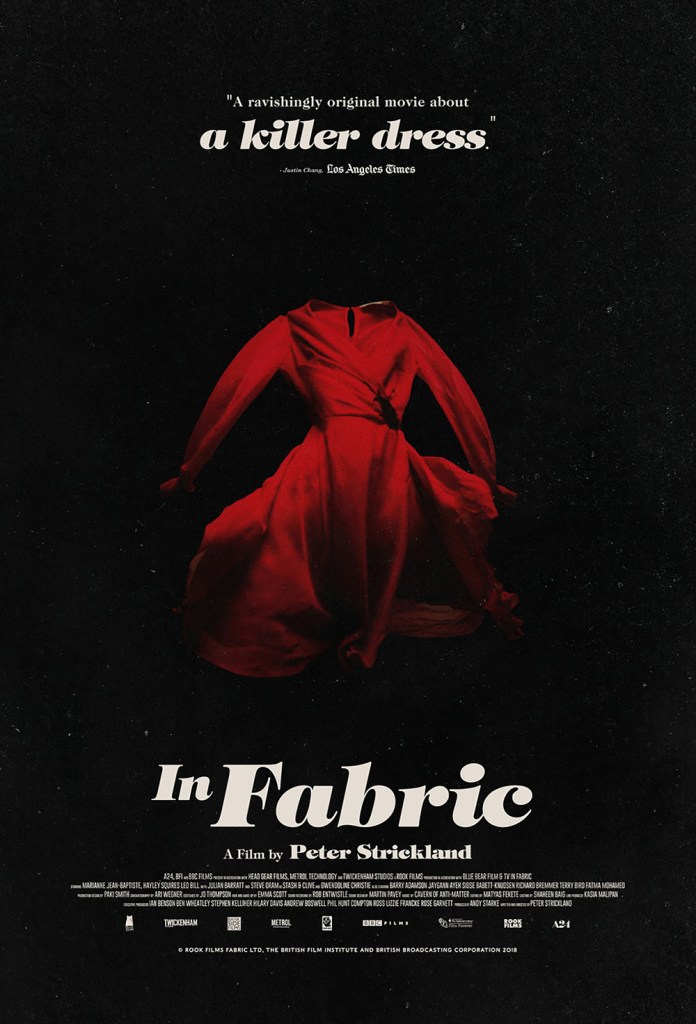


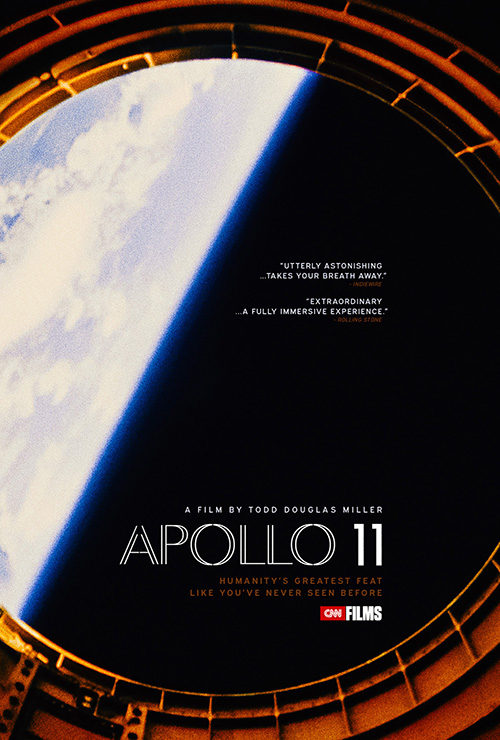






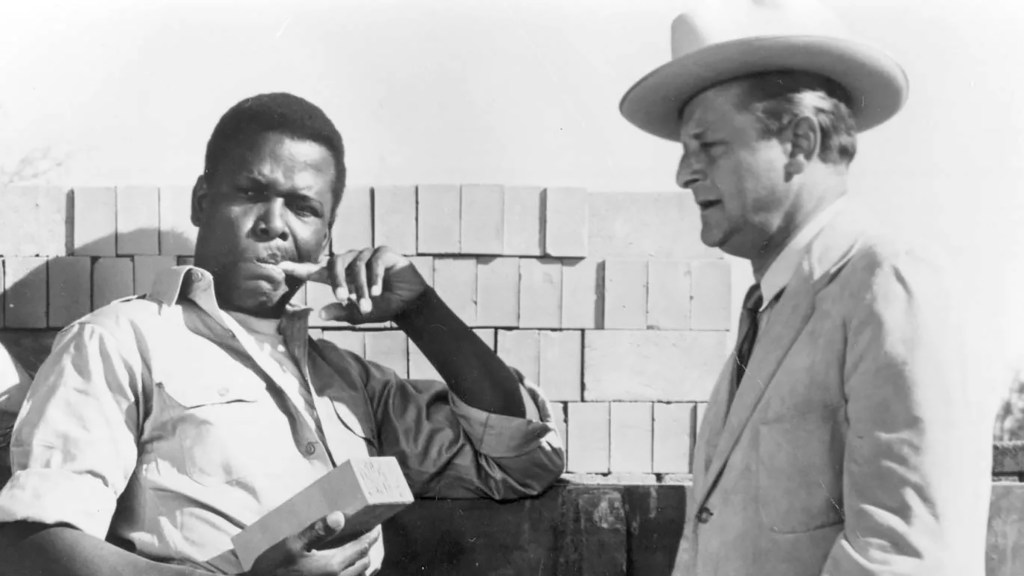

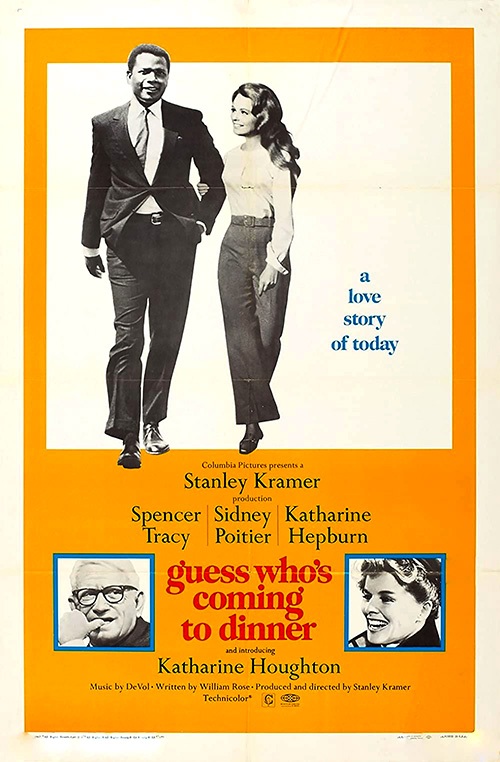

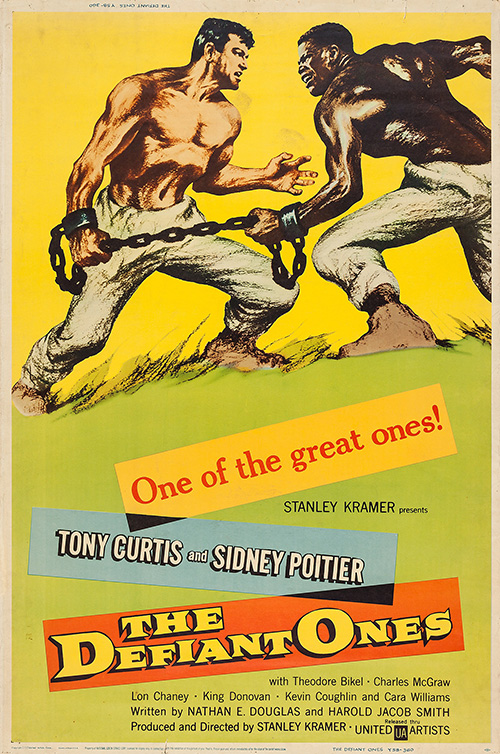
 Cultivate Cinema Circle